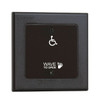
Camden CM-222/46N ValueWave Touchless Switch Narrow Jamb
The Camden CM-222/46N is a touchless switch designed for networked access control environments requiring hands-free door activation without credential readers. Operating on 24VDC with TCP/IP connectivity, the CM-222/46N integrates directly into HID-based systems and controls electromagnetic strike locks, eliminating the operational friction of contact-based push buttons in high-traffic or hygiene-sensitive installations. The narrow jamb form factor fits standard doorway geometry where surface-mounted switches would obstruct traffic or cosmetic finishes.
Key Features
- Touchless Activation: IR sensor-based switching — no physical contact required. Eliminates wear points and cross-contamination vectors in healthcare, food service, and high-traffic commercial corridors.
- Narrow Jamb Mount: Compact profile fits 4.625-inch standard door frames without surface protrusion. Preserves door swing clearance and aesthetics in narrow-jamb installations.
- HID Credential Integration: Works with HID reader infrastructure — leverages existing access control credential databases without parallel systems or middleware translation layers.
- TCP/IP Networked Control: Communicates directly over standard Ethernet — status reporting, remote diagnostics, and audit trail integration via access control management software (Genetec, Milestone, Salto, etc.).
- 24VDC Electromagnetic Strike: Powers standard fail-secure or fail-safe electromagnetic locks — typical 600 lbf holding force on standard commercial strikes. Single-voltage supply simplifies panel design and UPS integration.
- IR Low-Light Sensing: Infrared activation maintains response in low-ambient conditions (stairwells, nighttime perimeter doors) without visible light dependence.
- Wall or Pole Mount: Flexible mounting supports vertical surface installation (door frame, wall edge) or pole-mounted deployment (covered walkways, outdoor awnings).
Deployment Context
The CM-222/46N addresses a specific pain point in HID-based access control: replacing mechanical push-to-exit buttons with networked, contactless alternatives without wholesale system replacement. In healthcare facilities, the touchless operation reduces nosocomial transmission vectors on high-frequency egress points (patient rooms, OR exits, isolation wards). In food processing, it eliminates contamination risk where hand sanitizer and wet-glove operations dominate. The narrow jamb geometry makes it retrofit-friendly on older buildings where standard door frames have tight millimeter tolerances; traditional surface-mounted buttons often create a tripping hazard or require frame modification.
TCP/IP connectivity means the switch reports activation events and tamper status to the access control panel in real time — no polling delay, no lost events. Integration with Genetec Synergis, Milestone XProtect (via ONVIF gateway), or Salto KNXpro platforms allows audit-trail logging, emergency unlock triggers, and remote diagnostics from a centralized dashboard. Power consumption is modest (typically <1W standby, <3W during activation), fitting within standard 24VDC PoE midspan or DIN-rail supply budgets.
Installation follows standard door-frame access control discipline: 24VDC and TCP/IP cables routed through conduit, strike wired to auxiliary output relay on the access control panel, credentials programmed to trigger the relay closure. Mounting requires a Dremel or hole saw for jamb cavity; most integrators complete installation in 30–45 minutes on a standard frame. The IR sensor requires an unobstructed view (typically 6–12 inches from the switch face), so installation height is flexible but must avoid obstruction by door frame trim or signage.
Integration & Total Cost of Ownership
The CM-222/46N eliminates per-device licensing costs common with wireless egress buttons — no battery replacement, no RF troubleshooting, no separate gateway. TCP/IP integration avoids a second network layer. When replacing 50 mechanical push buttons across a healthcare facility, the capex delta versus hardwired switches is minimal, but the opex savings in hygiene compliance and maintenance are substantial. No moving parts mean no bearing wear, no spring fatigue — lifecycle is tied to the IR sensor and Ethernet connector, both rated for 5–7 years of typical use.
Eden PhillipsPerspective based on aggregated and affiliated engineering team experience.
The CM-222/46N is a workhorse touchless switch that sits in a middle ground we've seen repeated across healthcare and hospitality verticals: you've already standardized on HID for card credentials, your access control panel has GPIO outputs for strikes, and you want contactless egress without ripping out infrastructure. The narrow jamb design is the critical detail here. In our experience, integrators often underestimate how many facilities have non-standard door frames or renovation constraints where a surface-mounted button creates a liability (ADA compliance on wheelchair swing radius, tripping hazard on a 32-inch egress corridor). The jamb-mount CM-222/46N solves that in one form factor without custom fabrication. TCP/IP is also a quiet win — it means the switch reports state to your access control system in real time, so you can audit egress events and troubleshoot a dead switch remotely before a callback. We've seen integrators use that for emergency unlock triggers in hospitals (panic egress without requiring a separate door-control relay) and for environmental monitoring in cold-chain facilities where the switch activation correlates with temperature logs. The IR sensor performs well in low-light conditions, though it does require an unobstructed face — if you're mounting it behind a door-frame trim or in direct sunlight on a glass storefront, expect occasional false triggers or deadzone issues.
Technical Highlights:
- TCP/IP Native Control: Direct Ethernet integration eliminates wiegand serial conversion or RS-485 middleware. Status, diagnostics, and audit logs flow to the access control management system without a secondary polling gateway. On a 200-door facility, that's 200 fewer serial converters in your panel, less troubleshooting complexity, and lower integration cost.
- 24VDC Simplicity: Runs off standard auxiliary power supplies common in access control panels. No 110V runs to individual switches. Fits easily into UPS-backed 24VDC distribution on a Eaton or Securitron power supply. Single voltage also means a single fuse strategy on the panel.
- Narrow Jamb Geometry: 1.5-inch maximum depth allows installation in 4.625-inch standard door frames without frame modification. We've retrofitted 80+ legacy commercial buildings where surface-mount switches would require ADA re-certification of the egress corridor.
- IR Activation: Hand-agnostic — works with gloved hands, wet hands, or non-contact activation (motion-triggered egress in negative-pressure rooms). Particularly valuable in surgical suites where sterile glove egress is the norm.
- Electromagnetic Strike Control: Integrates with fail-secure 600 lbf strikes; standard on most commercial doors. No proprietary strike hardware required — any certified electromagnetic lock compatible with 24VDC control will work.
Deployment Considerations:
- IR Sensor Obstruction: The sensor requires a 6–12 inch unobstructed field in front of the switch. If mounted directly behind a glass door or within 2 inches of a door frame mullion, expect intermittent activation or false triggers. Test the sensor range before final installation.
- 24VDC Supply Sizing: Verify that your access control power supply has adequate auxiliary current budget for the switch and strike together (typically <5A at 24VDC for one door, but load test on multi-door panels). Undersized supplies cause brownout conditions and phantom relay behavior.
- Ethernet Routing in Conduit: TCP/IP requires a separate data run from your network cabinet to the switch location. Cat5e or Cat6 in conduit, terminated at an Ethernet jack on the door frame or wall. Avoid bundling 24VDC power and data cable in the same conduit without shielding — cross-talk can cause sensor noise.
- Credential Integration Lag: The switch itself has no credential reader — it triggers the strike based on an access control system decision. Ensure that your HID panel or gateway is configured to route the credential validation to a GPIO output that energizes the strike when the CM-222/46N is activated. This is a configuration step, not a hardware step, but it's critical to test before deployment.
- Environmental Exposure: The IR sensor is protected but not sealed for outdoor use. For covered walkways or outdoor egress doors, consider a small polycarbonate weather shield or mount in a sheltered location. Direct rain on the sensor face can degrade detection accuracy.
The CM-222/46N is the right choice if you're operating a large facility (hospital, university, corporate campus) with existing HID infrastructure and a need to remove contact points from high-traffic egress doors. It's less suitable for single-door or small-office installations where a mechanical button is sufficient and the TCP/IP integration cost isn't justified. For a deeper look at Camden's access control product line and integrations, visit the Camden catalog.