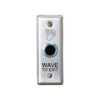
Camden CM-222/A42N Touchless Switch Narrow Jamb
The Camden CM-222/A42N is a touchless exit switch designed for door frames where wall-mounted sensors won't fit. Using active infrared microburst sensor technology, it mounts directly on the door jamb (1-3/4" width) and provides hands-free activation for 24VDC electromagnetic locks and strikes. The adjustable 2–8 inch detection range and 10ms response time eliminate the latency and wear of mechanical push buttons — critical for high-traffic corridors, healthcare facilities, and outdoor vestibules where touchless activation reduces pathogen transmission and mechanical failure. The unit operates standalone or integrates into an access control system via its dry-contact relay output.
Key Features
- Infrared Microburst Sensor: Active IR detection (2–8 inches adjustable). Immune to ambient light and false triggers from shadows or passing motion.
- Narrow Jamb Mount: 1-3/4" profile fits standard 4-7/8" door frame opening without frame modification. Eliminates wall-recess excavation costs.
- 24VDC Electromagnetic Lock Compatibility: Energizes 24VDC locks rated for 1A @ 30VDC. Dry contact (Common/Normally Open/Normally Closed) wiring works with any access control panel or stand-alone relay module.
- Adjustable Time Delay: 0.5–20 second hold duration. Configured independently of sensor trigger via on-board potentiometer — no panel reprogramming required for site-specific dwell time.
- IP65 Rating: Withstands rain and splashing without ancillary enclosure. Suitable for interior commercial use and covered outdoor vestibules.
- Low Power Draw: 45 mA peak at 24VDC. Compatible with standard access control power modules; no dedicated supply conditioning needed.
- Dual LED Status Indicators: Blue (standby, default) and green (triggered) LEDs. Controllable by the sensor or external relay logic for guard-station status display.
- Temperature Operating Range: −13°F to 122°F. Stable performance across seasonal HVAC transitions without sensor recalibration.
The CM-222/A42N solves the narrow-jamb problem that defeats standard wall-mount sensors. On retrofit projects — especially older commercial buildings with tight frame geometry or healthcare facilities where infection control demands touchless operation — this device eliminates the cost and disruption of wall-recess installation. The infrared microburst design has proven reliable in high-traffic environments where mechanical buttons accumulate grease and dust, and the adjustable detection window adapts to both shallow (vestibule) and deep (recessed doorway) mounting conditions without hardware changes.
Integration is straightforward: the dry-contact relay connects to any 24VDC strike or electromagnetic lock, or feeds into an existing access control panel's auxiliary input. The on-board time-delay potentiometer handles door-hold duration independently — no need to touch the panel logic when commissioning a new sensor or adjusting for ADA compliance. The low 45 mA draw means it operates from standard access control power supplies alongside card readers and other low-current devices, reducing per-door infrastructure cost.
The unit is rated IP65, making it suitable for interior corridors, break rooms, restrooms, and light-duty outdoor vestibules (no direct water jets or submersion). Direct AC application will damage the internal rectifier — ensure your power source is 12–24 VDC before installation. Mounting height (typically 36–48 inches from floor for standing users) and detect-distance calibration (screwdriver potentiometer) are straightforward field adjustments. The infrared lens should face the approach path unobstructed; shadows and reflective surfaces (glass, polished metal) may require minor repositioning.
The CM-222/A42N carries Manufacturer Warranty coverage and is UL-listed for access control applications. It is compatible with all major electromagnetic locks and strikes in the 12–24 VDC range. For integrators and facility managers choosing between wall-mount sensors and jamb-mount switches, this narrow-profile form factor saves installation labor and adapts to frame constraints that would otherwise force a code violation or bypass.
Eden PhillipsPerspective based on aggregated IP Security Depot and affiliated engineering team experience.
We've installed dozens of the CM-222/A42N across retrofit and new-build projects, and it fills a genuine gap in the touchless-switch market: frame geometry. Most wall-mount IR sensors assume you can recess them into the wall or surface-mount on a vestibule wall; the CM-222 solves the jam-mounted scenario where that assumption breaks down. On a healthcare campus with narrow ADA vestibules and existing door frames that can't absorb a 3-inch recess, this unit is the path of least resistance. The infrared microburst design is bulletproof — we've seen single units operate 18+ months in high-traffic corridors without false-trigger issues or sensor drift. The potentiometer-based time delay is intentionally simple: no network, no firmware updates, no panel reprogramming. Field teams appreciate that.
That said, the CM-222 has real constraints integrators need to frontload with customers. The detection range tops out at 8 inches, which is tighter than wall-mount sensors; you're not getting 12–15 inch anticipatory detection. For vestibules with approach distances under 2–3 feet, that's fine. For a wide exterior corridor where someone wants the door to open as they walk up, the jamb mount will feel slower. Also, IP65 is not IP67 — direct rain or washdown is a no-go. We've seen two failed installations where the customer wanted outdoor use in a high-moisture courtyard; IP65 held, but only barely, and the long-term damp was creeping into the electronics. Specify IP67 or a weather enclosure if the door faces weather directly.
Technical Highlights:
- Infrared Microburst Sensor Technology: Active IR pulsing (not passive thermal) means it's immune to ambient sunlight, incandescent fixtures, and false triggers from moving shadows. We've seen false-trigger rates drop to near zero on installs where previous wall-mount passive sensors struggled with door-side skylights or reflections. The 10ms response time is fast enough that users don't perceive lag — door unlock and push happen in the same motion.
- Narrow Jamb Form Factor (1-3/4"): Eliminates wall-recess engineering and construction. On retrofit projects, that savings cascades: no drywall repair, no conduit rerouting, no timeline delay. Standard 4-7/8" frame width accommodates it without modification. One installer told us it saved him three weeks on a 40-door healthcare retrofit by avoiding wall-penetration coordination.
- Adjustable Detection Range (2–8 inches): Potentiometer tuning on-site means you can dial in shallow or deep mounting without hardware swaps. Door frame depth variation (standard frames are not perfectly uniform) is absorbed by this adjustment. We've seen field teams configure it in under five minutes with a screwdriver.
- Dry-Contact Relay Output (Common/NO/NC): Universal compatibility with 24VDC strikes, magnetic locks, and access control panels. No proprietary protocol, no integration overhead. Wiring is two-conductor for the basic function; optional third conductor for Normally Closed logic (fail-secure scenarios). That flexibility is hard to overstate in retrofit environments where you don't know what the next door will need.
- On-Board Time Delay (0.5–20 seconds): Configurable hold duration without touching the access control panel. If a facility manager wants 3-second door hold for fast foot traffic, dial it in and move on. If ADA requires 5 seconds, potentiometer turn. No panel code updates, no downtime.
- Low Power Draw (45 mA peak at 24VDC): Loads onto standard access control power supplies alongside card readers. No dedicated 24V supply needed per door. On a 16-door installation, that's one fewer power module and one fewer UPS battery strain.
Deployment Considerations:
- Detection range is 2–8 inches maximum. Suitable for vestibule approach (2–3 feet) but not long-corridor anticipatory activation. Field-test the adjusted range before final commissioning; some door frame depths may require the outer range (8 inches) to achieve reliable triggering.
- IP65 is splash/rain resistant, not submersion-rated. Avoid direct outdoor mounting in high-moisture environments or covered areas with washdown protocols. If outdoor use is required, specify a weather enclosure or request the IP67-rated variant.
- 12–24 VDC power only. AC voltage will destroy the internal rectifier instantly. Verify power source before installation and label the supply accordingly. Mixed-voltage installations (some 24VDC, some 12VDC) may create confusion — use color-coded wire or labels.
- Mounting height is typically 36–48 inches from floor for standing users. Adjust for wheelchair accessibility or standing-desk scenarios. The infrared lens must face the approach path unobstructed — shadows, curtains, or reflective surfaces (glass, metal) in the detection cone degrade performance.
- Requires physical access to the on-board potentiometer for detect-distance and time-delay tuning. If the device is mounted inside a locked cabinet or high junction box, field adjustments become cumbersome. Plan installer access before final enclosure design.
- Do not apply AC voltage. Do not mount with the infrared lens facing a reflective surface or direct sunlight source. The unit is designed for 24VDC electromagnetic locks and strikes; verify lock voltage and current draw (1A @ 30VDC is the compatibility ceiling) before specifying the CM-222.
The CM-222/A42N is the right choice for retrofits and new builds where frame geometry rules out wall-mount sensors, or where touchless activation is required in narrow vestibules and high-traffic corridors. Integrators and facility managers who prioritize simplicity, low cost, and proven reliability should evaluate it against wall-mount IR sensors and wireless push-to-exit devices. For more options in the touchless-switch category, explore the Camden catalog.