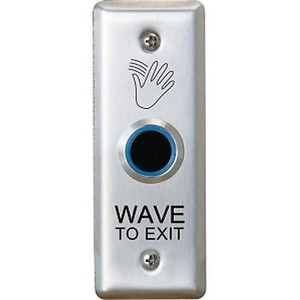
Camden CM-221/A42 ValueWave Touchless Switch Single Gang
The Camden CM-221/A42 is a single-gang touchless access control switch designed for networked door-release applications. It combines TCP/IP connectivity with HID credential support and a 30VDC electromagnetic lock controller in a retrofit-ready form factor. Integrators deploy this device where existing card-reader infrastructure meets the need for remote access management and real-time strike feedback—typical scenarios include multi-tenant office retrofits, healthcare facilities with credential badge integration, and secure entry points requiring centralized unlock policy.
Key Features
- TCP/IP Network Control: Full remote access management and real-time door-strike status reporting. Eliminates hardwired relay runs for unlock signaling; all door events log centrally to your access control system.
- HID Credential Integration: Native HID card/fob support. Works directly with existing HID reader infrastructure—no credential translation or parallel systems needed.
- 30VDC Electromagnetic Strike: Rated for standard electromagnetic locks. Strike duty cycle and fail-safe/fail-secure configuration controlled via access control policy, not hardware jumpers.
- Single-Gang Form Factor: Mounts in standard electrical box cutout (wall or pole). Minimizes retrofit labor and blends into existing door hardware layouts.
- Real-Time Event Reporting: Door open/close state, strike energization, and credential read attempts feed back to access control platform for audit and alarm triggering.
- Manufacturer Warranty: Factory-backed coverage on all electronic and mechanical components. Sourced genuine, no grey-market units.
The CM-221/A42 bridges the gap between legacy card-reader sites and modern network-based access control. Unlike wireless retrofit readers or cloud-dependent unlocking, this device operates as a hardwired TCP/IP node—it requires a network drop (PoE or discrete power, depending on your installation), but that guarantees zero latency on unlock commands and local failover behavior if the central system goes offline. The electromagnetic strike is dumb (energized or de-energized); all logic lives in the access control platform, which means you can change unlock rules, time schedules, and multi-factor policies without touching the hardware.
Typical deployments pair this with controllers running Genetec Security Center, Avigilon Control Center, Milestone Xprotect, or premise-based systems like Salto, Openpath, or Keri. The TCP/IP interface accepts standard HTTP/REST commands, and most enterprise access platforms have drivers for Camden hardware. If your site uses HID VertX controllers or legacy Magstripe readers, the credential passthrough ensures you don't need to re-badge staff or maintain parallel credential databases.
Power architecture matters: the strike draws peak current on energization—confirm your PoE budget and switch capacity before field install. Many sites provide a dedicated 30VDC supply off the access control panel rather than daisy-chaining power. The single-gang footprint is a major retrofit advantage; you're not recessing a large cabinet into doorframes or running conduit above ceilings. Mount it surface or flush, depending on your aesthetic and access-control-cabinet proximity.
Compliance and integration: The CM-221/A42 carries Manufacturer Warranty and is sourced directly from Camden supply channels—authentic product, no parallel imports. It integrates with any TCP/IP access control system that speaks RESTful API or legacy CGI commands; Camden publishes the integration protocol, and most VMS/access-control vendors have pre-built connectors. For HIPAA or PCI environments where audit trails are mandatory, the real-time event logging feeds directly into access logs, creating an unbroken chain of custody for door access. Explore other Camden access control solutions for complete strike, reader, and controller platforms that work in tandem with this switch.
Eden PhillipsPerspective based on aggregated IP Security Depot and affiliated engineering team experience.
We've fielded the CM-221/A42 in everything from small professional-services offices to 50,000-square-foot healthcare campuses. The core appeal is simplicity: it's a strike controller, not a smart lock, not a cloud service, not a proprietary wireless mesh. You wire it to power, plug it into the network, assign it an IP address, and let your access control platform own all the brains. On retrofit jobs where the customer says "we already have Genetec" or "we need HID reader compatibility," this device closes the sale quickly. The single-gang form factor is a real differentiator versus larger cabinet-style controllers—we've installed it on 1980s metal door frames where a larger lockset would require structural modification. The downside: you must have network infrastructure (Ethernet run or PoE injection) at every door you want to control. We've seen jobs where that became a budgetary blocker, and the customer went wireless instead. But if you've already got network density for cameras and access points, the incremental cost is near zero.
Technical Highlights:
- TCP/IP Network Architecture: No hardwired relay runs between the strike and your central controller—network packet carries the unlock command. On a 10-door installation, that's easily 500 feet of conduit and copper eliminated. All door events (open/close sensor, strike energized, credential read) are logged at the platform level, not just at the reader.
- HID Credential Passthrough: If your site already owns 500 HID proximity cards or fobs, you don't rebadge. The reader scans the card, passes the credential to this device, and the device queries the access control system via TCP/IP. No credential translation layer, no dual-badge fatigue.
- 30VDC Strike Duty Cycle: Electromagnetic locks draw 0.5–2 amps depending on the lock model; confirm your access control panel's strike output capacity before ordering. Many integrators run a dedicated 30VDC supply from an industrial power supply bolted to the controller cabinet—that isolates strike inrush current from the control logic.
- Failsafe vs. Failsecure Configuration: The strike itself is dual-use (fail-safe or fail-secure depending on how the magnet windings are wired inside the lock). This device doesn't enforce that choice—the lock itself does. Know which mode your door requires before ordering the strike.
- Single-Gang Electrical Box Compliance: Mounts per NFPA 70 (National Electrical Code). No special cutouts, no recessed cabinet—integrates into standard wall boxes (old-work or new-work). Pole-mount kits available for outdoor or standalone door frames.
Deployment Considerations:
- Network is non-negotiable. If the site has only serial connections to the access panel and no network run at the door, you'll need to budget for Ethernet cabling or a wireless access point—neither of which this device provides.
- 30VDC power source must be locally available or run from the control panel. PoE is not part of this device; you're providing power separately. Plan for voltage drop on long runs (over 300 feet, consider a local 30VDC supply rather than a single feeder).
- Strike compatibility: confirm the electromagnetic lock brand and coil impedance before install. Not all 30VDC strikes are identical; pull the datasheet for your chosen lock and verify with Camden support if there's any concern.
- Audit and failover: if your central access platform goes offline, this device does not unlock doors on its own. Failover behavior is set by your platform (some systems support local badge reader cache; others default to locked). Design your architecture knowing this device is always subordinate to the platform.
- Physical security at the switch: the device is surface-mounted in a single-gang box. In high-traffic or outdoor areas, consider protective conduit or a cage to prevent accidental damage to the connection terminals or LED indicators.
The CM-221/A42 is the right choice for access control architects who are consolidating on a single network-based platform and need to retrofit existing card-reader infrastructure without re-credentialing staff or maintaining parallel systems. It's not the right choice for standalone door locks, wireless-only sites, or systems that cannot provide network connectivity at every controlled door. For comprehensive Camden access control options and integration guidance, visit the Camden catalog.