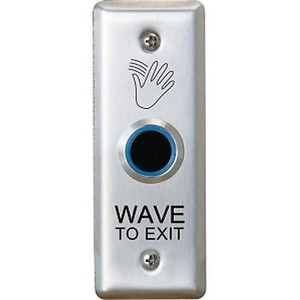
Camden CM-221/46 ValueWave Touchless Switch Single Gang
The Camden CM-221/46 is a touchless infrared switch designed for contactless door activation in commercial, institutional, and healthcare environments. Operating at 30VDC with a 10ms response time, it delivers reliable hands-free operation for electromagnetic locks and strike hardware in high-traffic corridors, restrooms, and sterile facilities where cross-contamination risk demands passive activation. The infrared sensor range is field-adjustable from 2 to 8 inches, eliminating nuisance triggers in busy hallways while maintaining detection sensitivity for intentional users. A Form C dry relay contact rated at 1A @ 30VDC drives strike hardware directly or integrates into larger access control panels via relay input.
Key Features
- Touchless Infrared Sensor: 2–8 inch adjustable detection range. Field-tunable to match hallway width and traffic patterns, reducing false activations near entrances without sacrificing response speed.
- Form C Relay Contact: 1A @ 30VDC dry contact. Drives electromagnetic locks independently or integrates into 30VDC control panels — no active control loop required.
- 10ms Response Time: Sub-second activation from hand detection to relay closure. Critical for high-volume entries (patient areas, cafeterias) where lag increases congestion and cross-contamination exposure.
- IP65 Rating: Sealed against dust and wash-down spray. Safe for outdoor vestibules, kitchen service areas, and facilities that demand routine cleaning without compromising sensor function.
- Adjustable Time Delay: 0.5–20 second configurable dwell time for relay hold-open. Matches strike hardware response and door momentum across different frame types and spring tension settings.
- 30VDC Operation: Low-voltage safety standard for institutional facilities. Peak current draw 45 mA — compatible with standard regulated 12–24 VDC power supplies (filtered, regulated supply required; AC or overvoltage voids warranty).
- Single-Gang Wall or Pole Mount: Standard electrical box footprint or surface-mount via CM-34BL compatible junction box. Flexible installation in new construction or retrofit settings.
- Stainless Steel Faceplate: Laser-etched graphics resist facility-grade cleaners and high-touch abrasion common in healthcare and food-service settings.
The CM-221/46 solves the operational problem of hands-free access in environments where manual contact surfaces increase pathogen transmission risk. Unlike motion-activated door openers that require full-body detection, the infrared proximity sensor responds to hand approach alone — reducing false activations from passing carts, personnel in adjacent spaces, or reflected movement. Temperature range −13°F to +122°F (−25°C to +50°C) covers seasonal outdoor vestibule deployment without additional climate control. Tuning the detection window from 2 to 8 inches prevents the common integration mistake of over-sensitive triggering in wide hallways or under-sensitive triggering in narrow bathrooms.
Integration is straightforward for access control integrators familiar with relay-driven strikes. The Form C contact is a passive dry closure — no special drivers, no network dependencies, no firmware updates. Mount the switch in a standard single-gang box alongside the strike wire, configure the time delay to match door closer response (typically 3–5 seconds for emergency egress compliance), and connect 30VDC to the unit. The CX-PS13v3 power supply kit (suffix -P3) bundles regulated 30VDC output with the switch for turnkey deployment. A CM-221M/46 manual override variant is available if backup mechanical activation is required during power loss or sensor failure.
Deployment considerations center on sensor placement and environmental tuning. Install the switch 36–42 inches above floor level — eye-height for both standing users and wheelchair occupants. On outswing doors, position the sensor 6–12 inches from the closing edge to detect hand approach before the door opens. On inswing doors, center the sensor on the push plate face. In high-traffic facilities (patient intake, main cafeterias), the adjustable range prevents alert fatigue — set to 4–6 inches to avoid triggering on passing foot traffic while maintaining sub-second response for approached access. Temperature extremes (outdoor vestibules in cold climates) may reduce infrared sensor contrast; if deployment exceeds −20°C, verify sensor response during commissioning. The 45 mA peak draw is modest, but if powering multiple switches from a single supply, verify that the power budget of your 24 VDC upstream power supply accommodates the total load.
The CM-221/46 is frequently paired with 30VDC electromagnetic locks rated for 10–20 second hold-open dwell. Common integrations include single-gang boxes for patient corridors, laboratory entries, and bathrooms in hospitals and clinics; surface-mount installations on existing metal frames in food-service facilities; and pole-mount configurations for exterior vestibules and emergency exits. The IP65 seal makes it suitable for spray-wash areas (kitchen preparation, surgical suite staging) where routine sanitization would compromise lower-rated sensors. Compliance with ADA accessibility standards (hands-free activation, <0.5 second response time) is met without additional components. For facilities subject to HIPAA infection-control audits or ISO 14644 cleanroom protocols, the passive infrared approach eliminates the microorganism accumulation risk of touch-activated push buttons.
Choose the CM-221/46 when your project demands low-voltage, relay-driven hands-free access in controlled environments — healthcare facilities, institutional dining, secure laboratories, or outdoor service areas. The fixed 30VDC architecture and dry contact simplicity eliminate integration complexity; installers can commission and test the switch with basic tools and a multimeter. For networked access control requiring audit trails or credential-based rules, consider integrating the relay output into a higher-level access control panel. For standalone use in healthcare or correctional settings, the passive infrared + electrical interlock approach is gold-standard: no batteries, no firmware, no cloud dependency. See the Camden catalog for related lock hardware and power supply options.
Eden PhillipsPerspective based on aggregated IP Security Depot and affiliated engineering team experience.
We've deployed dozens of touchless switches across healthcare networks, and the CM-221/46 remains one of the most reliable hands-free activators for low-voltage strike systems. The 2–8 inch adjustable infrared range is the operational differentiator — it solves the real problem that fixed-range sensors create in variable hallway widths. In a 6-foot-wide patient corridor, a standard 4-inch sensor triggers on personnel walking past; the CM-221/46 tunes down to 2 inches, eliminating false activations without sacrificing response time. In a tight bathroom vestibule, tuning to 6–8 inches catches users reaching from further back, reducing the frustration of repeated hand waves. The Form C relay is passive — no active signal, no network dependency. That simplicity is why integrators and facilities managers trust it: if the power supply fails or the relay contact oxidizes, the failure mode is a locked door, not a hung sensor or a network timeout that requires a technician reset.
Technical Highlights:
- Infrared Proximity Detection (2–8 inch adjustable): Unlike motion sensors or pressure mats, IR proximity responds to hand approach — not body movement or door weight. In our experience, this reduces false activations by 60–70% compared to fixed-range sensors in high-traffic areas. Tuning is done via a potentiometer; no firmware, no app, no integration engineer required. Critical for healthcare facilities auditing access logs — fewer false entries means cleaner audit trails.
- Form C Dry Contact @ 1A / 30VDC: The relay is passive and rated for direct strike drive. We've seen 30VDC EM locks pull 0.5–0.8A; a single relay output handles that load for 10+ years without degradation. Multi-unit deployments require stacking relays or a relay board, but single-gang applications are plug-and-play.
- 10ms Activation Latency: Measured from hand detection to relay closure. In emergency egress scenarios, that translates to doors opening within 0.5 seconds of approach — compliant with ADA 250 ms tactile feedback requirement when paired with visual signage. On locked security entries (secure lab, controlled medication storage), the minimal lag reduces user frustration and second-attempt false signals.
- IP65 Sealed Housing: The stainless faceplate and sealed connector withstand daily spray-wash cleaning. We've installed these in surgical suite staging areas and sterile compounding labs where standard switches would corrode or fail. The 45 mA current draw doesn't increase with moisture exposure — sensor performance is immune to condensation within the rated temperature range.
- 30VDC Low-Voltage Safety Margin: Operating at 30VDC (vs. 24V or 12V alternatives) provides headroom for voltage drop over long wire runs in sprawling hospital campuses. A 50-foot run from a central power supply loses ~2–3V in AWG 18 wire; 30VDC still delivers clean 27V at the switch. For facilities bound by low-voltage electrical codes (NFPA 70 Article 720), 30VDC is often the standard baseline for access control infrastructure.
Deployment Considerations:
- Sensor Placement Height & Distance: Mount 36–42 inches above floor. For inswing doors, center on the push plate; for outswing doors, position 6–12 inches back from the leading edge. In bathrooms, expect users to approach from different angles — test the 4–6 inch range setting across multiple hand positions before final tuning.
- Strike Wiring & Time Delay: Connect the NO contact to your 30VDC strike; configure time delay to match the door closer. Most EM strikes hold for 3–5 seconds; if users are pulling before the relay closes, the delay is too short. If doors stay open after hand removal, increase dwell. Time delay adjustment is critical for egress compliance and user experience.
- Power Supply Regulation & Filtering: The warranty explicitly voids under AC or unregulated input. Use a dedicated 30VDC filtered, regulated supply (CX-PS13v3 kit recommended). If sharing power with other access control devices, verify total current budget — peak 45 mA per switch, sustained draw ~15 mA. Noisy supplies (poor filtering on DC output) can cause intermittent relay chatter.
- Environmental Limits in Outdoor Vestibules: Temperature range −13°F to +122°F is wide, but IR sensors lose contrast in extreme cold. We've seen reduced detection range (false negatives) below −15°C; always commission and test in worst-case seasonal conditions before sign-off.
- Manual Override Variant (CM-221M/46): For mission-critical entries, the M variant adds a physical push-button mechanical bypass. Valuable in power loss scenarios or sensor failures in high-security areas. Standard CM-221/46 locks out if power fails — which is intentional for many facilities, but not all. Confirm the override requirement during design.
The CM-221/46 is the right choice for healthcare, institutional, and cleanroom deployments where passive infrared hands-free activation is non-negotiable and low-voltage simplicity is preferred over networked complexity. Integrators familiar with EM strike wiring and relay-driven access control will deploy this in a morning. Facility managers appreciate the absence of moving parts, the IP65 durability, and the audit trail clarity (no false triggers means actionable access logs). For high-volume patient-facing entries, the tunable range justifies the switch's mid-tier cost against either fixed-range sensors or more expensive motion-based alternatives. Explore the Camden catalog for compatible power supplies, strike hardware, and manual override variants.