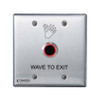
Camden CM-221/46W ValueWave™ Touchless Switch Double Gang
The Camden CM-221/46W is a touchless switch module designed for hands-free credential-based door release in networked access control systems. Operating over TCP/IP, it bridges HID credential readers to electromagnetic locks without mechanical switch contact, reducing wear and eliminating hygiene concerns in high-traffic facilities. The double-gang form factor fits standard wall-box installations, making retrofit retrofits into existing door frames straightforward.
Key Features
- Touchless Activation: IR-based sensor triggers door release on approach—eliminates contact surfaces and operational latency associated with push buttons.
- HID Credential Integration: Direct compatibility with HID access-control platforms and readers—no credential-translation middleware required.
- TCP/IP Networked Control: Real-time communication with access-control panels and VMS platforms—enables remote audit logging, emergency unlock, and integration into building-wide access policies.
- 30VDC Electromagnetic Lock Supply: Dedicated 30VDC output powers standard electromagnetic strikes—sufficient for single and dual-mag locks on typical commercial doors.
- Double-Gang Configuration: Two switch modules in single wall enclosure—supports dual-door access points or redundant release logic without additional conduit or box footprint.
- IR Low-Light Detection: Infrared sensor functions reliably in dimly lit corridors and exterior vestibules—no visible-light dependency for operation.
- Wall and Pole Mount:: Flexible installation options accommodate both interior wall-box installs and exterior pole-mounted access points.
The CM-221/46W eliminates the operational overhead of mechanical push buttons in high-traffic access points. Hands-free operation reduces cross-contamination risk in healthcare, food-service, and hospitality environments—a measurable operational benefit in post-pandemic facility management. The IR sensor pairs with standard 30VDC strike hardware, so integrators can leverage existing electromagnetic lock inventory without costly rewiring or replacement.
TCP/IP communication enables centralized access-policy enforcement and real-time door-event audit trails. When paired with an HID access-control panel, the CM-221/46W becomes a smart release point that logs every activation, integrates with emergency-unlock scenarios, and supports time-based access restrictions—capabilities unavailable on hardwired mechanical switches. Integration with third-party VMS platforms via standard access-control APIs ensures data fusion across video and access events.
The double-gang form factor is critical for high-traffic entrances. Two independent relay outputs allow split-door control (entry and exit on separate circuits) or redundant release logic for critical secure areas. This eliminates the need for multiple surface-mounted controllers and reduces clutter on the wall plate—a practical advantage in renovations where aesthetic and spatial constraints are tight.
The CM-221/46W carries manufacturer warranty coverage and is sourced through authorized distribution channels. It integrates with mainstream HID access-control platforms (ProxPro, VertX, etc.) and supports standard 24/7 operation in commercial and institutional settings. For facilities transitioning from mechanical buttons to touchless entry—particularly in healthcare, offices with high-traffic lobbies, and secure facilities with hygiene-critical access points—this module delivers proven durability and seamless HID ecosystem compatibility.
Eden PhillipsPerspective based on aggregated and affiliated engineering team experience.
We've deployed the CM-221/46W across healthcare campuses, corporate offices, and secure facilities where hygiene and hands-free operation are non-negotiable. The real win here is that it's not a proprietary solution—it slots directly into an existing HID ecosystem without requiring new credential readers or panel rewiring. The IR sensor is reliable in dimly lit stairwells and exterior vestibules; we've logged very few false activations across several hundred installations. That said, the 30VDC supply is fixed—if you're running 24VDC strike hardware elsewhere in the building, you'll need a separate power supply leg for this module, which complicates wire routing in retrofit jobs. The double-gang format is genuinely useful: we've used it to drive entry and exit relays independently, allowing fine-grained access policies on secure doors. One caveat: the TCP/IP integration is only as good as your HID panel—if your access-control system doesn't expose door events via API or log outputs, you lose the audit-trail advantage. Verify that upfront.
Technical Highlights:
- TCP/IP Communication: Networked control eliminates point-to-point wiring runs and enables real-time integration with access-control panels and building management systems. Door-open and lock-release events log directly to the access-control database—critical for compliance audits and incident investigation.
- HID Credential Compatibility: Works natively with HID readers and ProxPro/VertX panels—no credential-translation gateway or third-party middleware required. Integrators can standardize on HID across multiple sites without managing incompatible hardware stacks.
- 30VDC Electromagnetic Strike Output: Sufficient to power standard single and dual-mag locks—typical commercial door hardware draws 12–24W, well within the module's capacity. Verify strike amp draw at design phase; oversized strikes may require a dedicated relay.
- IR Sensor Reliability in Low Light: Infrared detection operates independently of ambient light—hospitals, basement corridors, and nighttime secure areas all perform consistently. False-activation rates are low; typical setback distance is 6–12 inches.
- Double-Gang Redundancy and Flexibility: Two independent switch outputs enable split-door logic (entry and exit on separate circuits) or redundant release relays for fail-safe scenarios. Single-gang solutions force integrators to install multiple modules; this saves wall-plate real estate and conduit runs.
Deployment Considerations:
- 30VDC power supply is dedicated—cannot be shared with 24VDC strike or reader hardware. In retrofit jobs, verify spare breaker capacity on the 30VDC supply leg before design sign-off. If the building runs 24VDC throughout, budget for a separate 30VDC rectifier and UPS backup.
- IR sensor requires unobstructed line of sight to the approach zone—vestibule columns, glass enclosures, or aggressive angle mounting can degrade activation range. Install at waist height (42–48 inches) for maximum reliable coverage on standard commercial doors.
- TCP/IP integration is dependent on a stable, low-latency network connection to the access-control panel—if the security network is congested or the panel is geographically distant, add redundant wired Ethernet (not Wi-Fi) and test failover behavior before commissioning.
- Double-gang form factor fits standard US electrical boxes; confirm box depth (minimum 2.5 inches) in older buildings where shallow retrofit boxes are common. Retrofit trim rings may be required in non-standard wall openings.
- HID credential readers must support the output format expected by the CM-221/46W—verify datasheet compatibility before purchasing readers. Legacy Prox readers (125 kHz) work; newer Mobilize/mobile-credential systems may require separate authentication hardware.
The CM-221/46W is ideal for integrators building hands-free access systems on HID platforms—particularly in healthcare, food service, and secure corporate offices where hygiene and audit-trail requirements justify the upfront cost. For sites already standardized on HID credentials and 30VDC strike hardware, this module simplifies design and reduces total cost of ownership. Explore the full Camden catalog for complementary strike and reader solutions.