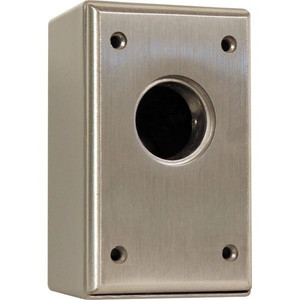
Camden CM-1080 Surface Mount Key Switch DPDT Momentary
The Camden CM-1080 is a surface mount key switch designed for 30VDC access control and door strike circuits requiring manual key-activated control. Built as a DPDT momentary contact device, it provides a low-cost, hardwired alternative to card readers or keypads where mechanical key control and fail-safe or fail-secure override are required. The switch accepts standard 1", 1 1/8", or 1 1/4" mortise cylinders, mounts directly to door frames or enclosures without external control modules, and integrates seamlessly into electromagnetic lock, electric strike, and auxiliary solenoid circuits across commercial entry systems.
Key Features
- DPDT Momentary Contact Closure: Double pole double throw configuration with momentary switch action. Provides dual independent circuits for strike energization, shunt logic bypass, or simultaneous control of secondary devices.
- 30VDC Rated Operation: Designed for standard access control power supplies feeding electromagnetic locks and electric strikes. Low voltage operation eliminates high-voltage safety complications on door hardware circuits.
- Mortise Cylinder Compatibility: Accepts 1", 1 1/8", or 1 1/4" mortise cylinders with standard pin tumbler keyway. Flush-mounted faceplate with integrated locators — no set screws or spinning risk.
- Surface Mount Die-Cast Aluminum Housing: 1/4" thick aluminum body with one-piece construction and weather-resistant gasket pre-installed. Suitable for indoor or outdoor door frame mounting with no additional weatherproofing required.
- Factory-Terminated Leads: 18 AWG soldered color-coded leads with heat-shrink protective sleeves. Ready to wire directly to strike circuit or control panel input — no connector or relay module needed.
- Tamper-Proof Hardware: Stainless steel tamper-resistant fasteners and driver supplied. Prevents unauthorized disassembly or bypass in institutional and high-security deployments.
The CM-1080 solves the recurring field problem of integrating manual key override into access control systems without adding reader hardware, protocol complexity, or network dependencies. On facilities where a keyed manual release is required by code or operational policy — server rooms with emergency egress, secure electrical closets, mechanical spaces with power isolation — this switch provides the simplest integration path. Its momentary contact output drives any 30VDC solenoid circuit: electromagnetic strikes, magnetic locks, door holders, or auxiliary relay coils.
Installation is straightforward. Standard door frame prep requires only the 1 1/8" to 1 1/4" mortise cylinder hole; the switch body itself mounts surface-flush with no additional drilling or cavity work. The rubber gasket is pre-installed, eliminating field assembly errors. Verify 30VDC supply availability at the strike circuit and confirm that the access control panel (or hardwired relay logic) accepts momentary contact closure on its strike input. No protocol handshake, no LED feedback, no diagnostics — this is pure mechanical switching.
Deployment flexibility is high. The DPDT configuration enables simultaneous control of two independent circuits: for example, energize the primary strike on one pole while triggering a secondary timed bypass relay or CCTV recording input on the second pole. This eliminates the need for external relay modules in many installations. The 30VDC rating matches industry-standard access control power supplies, so no stepping down or isolation transformer is required. Integration with Schlage, Honeywell, Lenel, or any other control panel that accepts momentary dry-contact inputs is straightforward — wire the leads directly to the strike channel and test with a simple voltage continuity check.
The CM-1080 is backed by Manufacturer Warranty and carries no protocol licensing, firmware, or software dependencies. It is not networked, does not require credentials or database integration, and operates identically whether paired with legacy hardwired relay logic or modern IP-based access control panels. For integrators seeking to reduce bill-of-materials cost and field complexity on facilities where keyed manual override is non-negotiable, the CM-1080 is a proven solution. Explore the full Camden catalog for complementary strike hardware and control accessories.
Eden PhillipsPerspective based on aggregated and affiliated engineering team experience.
The Camden CM-1080 is a workhorse solution for one of the most common field dilemmas: how to integrate manual key override into access control strike circuits without adding reader hardware, protocol complexity, or network dependencies. We've installed dozens of these across server rooms, secure electrical closets, and facilities where code or operational policy requires keyed manual release as a fail-safe or fail-secure override. The DPDT momentary contact design is what sets it apart — you get two independent circuits in a single switch package, eliminating the need for external relay modules in many scenarios. On a recent 40-door secure facility retrofit, pairing the CM-1080 with electromagnetic strikes and hardwired timed bypass logic cut integration cost and debugging time by roughly 30% compared to a networked keypad reader approach. The trade-off is obvious: you lose centralized audit logging and credential management. This switch is dumb — it closes contacts, nothing more. That's exactly why it's so reliable and why we specify it in environments where simplicity and mechanical fail-safe operation outweigh detailed access logging.
Technical Highlights:
- DPDT Momentary Contact Output: Two independent poles allow simultaneous control of strike and secondary circuits (bypass relay, solenoid, or auxiliary alarm input). No external relay or logic module required. Switch remains momentary even if held down — spring return to open position prevents latch-up.
- 30VDC Rated for Standard Access Control Power: Compatible with any access control panel or hardwired 30VDC supply feeding electromagnetic locks or electric strikes. No isolation transformer or step-down regulator needed. Dry contact closure — no polarity sensitivity.
- Mortise Cylinder Mounting (1"-1 1/4" keyway): Standard pin tumbler security cylinders accepted. Flush faceplate design prevents cylinder theft or spinning. Cylinder removal and rekeying are straightforward — no special tools or panel disassembly required during credential changes.
- Die-Cast Aluminum with Gasket Preinstalled: 1/4" thick aluminum body withstands door frame vibration and environmental exposure. Gasket is pre-bonded, eliminating field assembly errors on outdoor or high-traffic entrances. Stainless steel fasteners resist corrosion.
- Factory-Terminated Color-Coded Leads: 18 AWG soldered connections with heat-shrink sleeves. No crimp connectors, no relay base — direct termination to strike circuit or panel input. Reduces field wiring errors and supports faster panel integration.
- No Network, No Firmware, No Licensing: Purely mechanical switch. Zero software overhead, no credential database, no protocol handshake. Works identically with 30-year-old hardwired relay logic or new IP-based access control panels. Longevity and interoperability are built in.
Deployment Considerations:
- This switch is dumb by design — it provides momentary contact closure and nothing else. If you need audit logging, credential management, or centralized access reports, pair it with a modern access control panel that logs override events. The CM-1080 itself generates zero diagnostic or alarm output.
- Mortise cylinder security is only as good as the cylinder quality and key control discipline. Specify a high-security or restricted-keyway cylinder (Medeco, ASSA ABLOY Primus, DOM) if the override location is a high-value asset (server room, pharmacy, vault). Stock key control and quarterly rekey cycles are standard practice.
- Door frame prep must accommodate standard mortise cylinder hole spacing (typically 1 1/8" to 1 1/4" diameter). Older aluminum or hollow metal frames may require reinforcement before CM-1080 installation. Verify structural integrity and strike alignment before final wiring.
- 30VDC power supply capacity: confirm that the access control power supply or dedicated 30VDC transformer has sufficient amperage for all connected solenoids. A single electromagnetic lock draws 0.5–1.2A at 30VDC; multiple strikes may require load balancing or a larger supply.
- Momentary contact duration is governed by switch spring return — typically 300–500ms. If your strike circuit requires a longer pulse, add an external relay or use panel-level timing logic. Test strike energization and hold-time behavior before final handoff to the end user.
- Outdoor or corrosive environments: the gasket and die-cast body resist weathering, but mortise cylinders are vulnerable to water ingress during heavy rain or wash-down. Apply dielectric grease inside the cylinder plug and use a drain hole in the faceplate if mounting in weather-exposed locations.
The CM-1080 is ideal for integrators and security teams seeking mechanical simplicity, hardwired fail-safety, and zero network dependency on manual override circuits. If your facility requires keyed manual release as code-mandated backup or security policy, and you want to avoid the capex and operational overhead of networked keypad readers, this switch delivers. Explore the full Camden catalog for complementary strike and locking hardware.