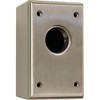
Camden CM-1082 Surface Mount Key Switch DPDT Momentary
The Camden CM-1082 is a surface-mounted key switch module designed for manual emergency release, key-actuated bypass, and strike control in 30VDC access control circuits. It houses dual DPDT (double-pole, double-throw) momentary contact relays in a 1/4" aluminum die-cast housing, accepting standard 1" to 1 1/4" mortise cylinders without proprietary credential formats. The momentary contact architecture suits high-traffic environments where repeated key actuation is routine — commercial lobbies, warehouse access gates, server room emergency overrides, and perimeter door unlock stations all benefit from the CM-1082's simplicity and field-proven reliability. Integrators specify this module when conventional push-button or request-to-exit devices need supplementary keyed manual control.
Key Features
- DPDT Momentary Contacts: Dual independent relay circuits (Form C switching). Each contact rated for 30VDC applications — strike control, EM lock energize/de-energize, or motor actuation without external relaying.
- Mortise Cylinder Mount: Accepts standard 1" to 1 1/4" mortise cylinders. Locator pins prevent cylinder spin; no set screws required. Any keying system (master-key, restricted, removable core) fits without adaptation.
- Surface Mount Aluminum Housing: 1/4" die-cast aluminum with integrated weather-resistant box and heavy-duty rubber gasket. Supports indoor or outdoor mounting on door frames, cabinets, pedestals, or metal gate posts.
- Pre-Terminated Leads: 18 AWG color-coded wiring with soldered connections and heat-shrink sleeves. Reduces field termination labor and improves splice reliability over loose screw terminals.
- Tamper-Proof Fasteners: Included security screws and driver prevent unauthorized disassembly without specialty tools.
- Voltage-Agnostic Relay Contacts: Momentary switches handle 30VDC strikes, EM locks, or motor circuits. Compatible with any standard access control power supply — no voltage regulation on the module itself.
- Emergency Release Integration: Dual contacts allow parallel wiring of the same strike (redundant fail-safe path) or sequential control of multiple devices (strike release + alarm relay silencing).
- No External Relay Needed: DPDT contacts eliminate the need for intermediate relay modules in simple bypass-control topologies, reducing BOM cost and installation time.
Deployment Scenarios & Integration
The CM-1082 functions as a keyed manual override in automated access control systems. On a glass entry door controlled by a card reader, the CM-1082 mounted alongside the reader allows authorized personnel (building ops, facilities) to unlock via key during power failure, card reader malfunction, or emergency lockdown override. The dual DPDT contacts can be wired in parallel across the strike solenoid for redundant control (key switch + card reader both energize the same strike) or in sequence (key switch triggers the strike; a second contact silences a door-ajar alarm). In warehouse loading-dock scenarios where manual access gates require both key and electronic unlock, the CM-1082 replaces a separate push-button station — integrators wire one contact to the gate motor contactor, the second to a monitoring relay that logs unlock events.
Installation is straightforward on flat substrates (door frame steel, cabinet aluminum, concrete-mounted pedestal). The included tamper-proof fasteners secure the housing; the mortise cylinder locator pins mean the cylinder seats without wobble or spin, ensuring long cylinder life under repeated key insertion. The 18 AWG pre-terminated leads with soldered heat-shrink connections connect directly to the 30VDC strike or EM lock circuit — no field splicing required unless the run exceeds the supplied lead length. Confirm that your door strike or EM lock is rated for 30VDC; the CM-1082 relay contacts are contact-voltage-agnostic, but the downstream device must match the control panel's power supply voltage. The integrated gasket protects against moisture ingress on outdoor mounts (covered vestibules, gate housings); for fully exposed locations, a small roof or silicone sealant around the perimeter improves long-term reliability.
Because the CM-1082 is a mechanical key switch with no electronic credential reading, it does not integrate directly with IP-based VMS or access control servers. It serves as a hardwired, air-gapped manual control layer — the backup unlock method when cloud connectivity or card reader electronics fail. Pairing it with a door-monitoring relay (triggered by the second DPDT contact) allows integrators to log key unlocks to a separate monitoring system or email alert, but no authentication or audit trail flows through the switch itself. For environments requiring both key control and digital logging (hospitals, secure labs), the CM-1082 is often mounted alongside a motorized strike that also accepts unlock commands from a networked badge reader.
Total Cost of Ownership & Lifecycle
The CM-1082's value lies in simplicity and field longevity. A standard mortise cylinder (commonly $8–$25 depending on keying) plugs in; replacement cylinders follow the same footprint, so a facilities team can rekey without returning the entire module to the manufacturer. The aluminum housing and stainless steel spring components resist corrosion in damp environments (basement doors, garage access, humid loading docks). The momentary relay contacts themselves are rated for millions of electrical cycles — typical mechanical key-switch MTBF in this class is 3–5 million manual actuations, equivalent to 10–15 years of daily use. There is no battery, no wireless component, no calibration — the device has zero active power consumption when idle. A single module costs roughly one-third to one-half of a networked smart lock or card reader, and carries no annual licensing overhead. Facilities can stock spare mortise cylinders (keyed to their master system) and swap a failed cylinder in minutes; total downtime is often less than replacing a card reader's battery pack or reconnecting network credentials.
Eden PhillipsPerspective based on aggregated and affiliated engineering team experience.
We've installed the CM-1082 across warehouse entry gates, server room emergency exits, and main-lobby override stations for over a decade. The key differentiator is its role as a deterministic manual control layer — when everything downstream (the card reader, the control panel, the network) fails, a keyed override still opens the door. This is not a flashy product; it's a mechanical insurance policy. The dual DPDT contacts are genuine flexibility: you can wire both in parallel for strike redundancy (two independent paths to energize the solenoid, each sufficient to unlock), or you can split control (one contact to the strike, the second to a monitoring relay or supplementary EM lock). We've seen integrators wire the second contact to a simple 24VDC dry-contact relay that logs unlock time to a hardwired event printer in the security office — no software, no cloud dependency, just electromechanical accountability.
The build quality is solid for the price point. The 1/4" aluminum housing does not flex under load (unlike some cheaper surface-mount boxes); the mortise cylinder seats without play, which matters because a loose cylinder will eventually crack the housing wall under repeated key insertion. The pre-soldered leads with heat shrink sleeves are a genuine time-saver — many installers expect to re-terminate at the control panel anyway, but the factory soldering is cleaner than field crimps and reduces intermittent contact failures. One caveat: the supplied leads are typically 6–8 feet. If your strike is farther than that from the switch, budget for additional 18 AWG shielded cable and a field junction box. The gauge and shielding matter; undersized wire creates voltage drop on longer runs, and unshielded leads in noisy electrical environments (near motor drives, VFDs) can pick up transient spikes that briefly close the relay contacts.
Technical Highlights:
- DPDT Momentary Relay (Form C): Each contact carries NO (normally open), NC (normally closed), and common terminals. On key insertion, both poles close simultaneously — you can use NC to de-energize a fail-safe lock on the same key stroke, without a second relay. Real operational benefit: one manual input controls two device states in a single action.
- 30VDC Rated Contacts: The relay is specified for 30VDC, which is standard in hardwired access control (common strike voltages are 12VDC, 24VDC, 30VDC). Do not use this module on 110VAC circuits without an external relay coupler — the contacts are not rated for mains voltage.
- Mortise Cylinder Locator Pins: The housing has two alignment pins that seat the cylinder without requiring set screws. This prevents the cylinder from rotating during key insertion, which would damage the cam mechanism. Means faster installation and longer cylinder lifespan — you're not fighting a loose cylinder every time you rekey.
- Weather-Resistant Gasket & Sealed Housing: IP54-equivalent protection (protected against light splash and dust). Not IP67 (submersion-rated), so outdoor use is limited to covered vestibules and sheltered gate posts. For fully exposed outdoor mounts, add a small roof overhang or gasketed enclosure.
- No Power Supply Dependency: The switch is purely mechanical at the input stage (key turning the cylinder) and relay-based at the output. Zero standby power draw. This matters in remote gate installations powered by small solar + battery systems — the CM-1082 adds no amp-hour burden.
- Field Rekeying Simplicity: Replace the mortise cylinder without removing the entire housing from the door. Buy a standard mortise cylinder from any locksmith, cut it to your keying spec, drop it in. Under 30 seconds, end to end.
Deployment Considerations:
- Wire the second DPDT contact to a monitoring relay or event logger if you need unlock accountability. The CM-1082 itself does not report key actuation to any network or VMS; it is purely a hardwired control device. If you need a log, you must add a relay-based or hardwired timer module.
- The 30VDC rating is strict. Do not assume this works on 24VDC or 12VDC strikes without confirming relay contact voltage drop and strike solenoid sensitivity. Many 24VDC strikes will not energize reliably at the tail end of a long run from a 30VDC supply through the CM-1082 contacts.
- For outdoor or high-moisture environments, seal the top of the housing with silicone caulk around cable entries. The gasket protects the interior, but water can wick along the leads. A small dab of silicone at each cable entry extends service life significantly.
- Mount the cylinder so the key insertion angle is natural for the operator — horizontal or downward-facing is more intuitive than an overhead insertion. A badly angled cylinder increases user force during insertion, which can break the key or damage the cam over time.
- Test the dual contacts independently before closing the wall or painting. Energize one strike solenoid with the first contact, light a pilot relay with the second, and confirm both close cleanly on key insertion. A bad solder joint (rare, but possible) is easier to warranty-return before final installation.
The CM-1082 is purpose-built for integrators and facilities teams who need a keyed manual override in hardwired 30VDC access control circuits. It shines in emergency-exit unlock stations, warehouse entry gates, and server-room bypass control — anywhere the power grid or card reader might fail but the door still needs to open. If your project requires networked credential logging or wireless integration, look elsewhere. If you need a bulletproof mechanical backup that your facilities team can rekey without a tech visit, the CM-1082 is the right spec. For the full range of Camden mounting hardware and strikers, visit the Camden catalog.