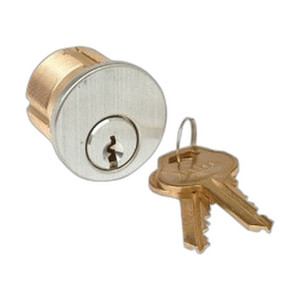
Camden CM-2290 Key Switch DPDT Maintained
The Camden CM-2290 is a DPDT maintained key switch designed for manual control of 30VDC-rated access devices, electromagnetic strikes, and door locks in commercial and industrial access control installations. Unlike momentary pushbutton or card readers, the maintained contact configuration holds its switched position until the key is physically rotated back — eliminating the need for a sustained electrical signal and providing positive feedback that the control action has been executed and locked in place.
Key Features
- DPDT Contact Configuration: Double Pole Double Throw allows simultaneous control of two independent 30VDC circuits. Enables interlocked relay logic or parallel strike activation on the same key rotation.
- 30VDC Rated: Designed for standard access control voltage rails. Compatible with any 30VDC DC solenoid strike, electromagnetic lock, or relay coil circuit.
- Maintained Contact Logic: Switch stays in the actuated position until manually reset. No spring return or electrical pulse needed — critical for fail-safe strike circuits or sustained lock release scenarios.
- Mortise Cylinder Profile: Accepts standard 1" to 1 1/4" bore mortise cylinders. Keying and cylinder sourcing managed independently through your locksmith or access control vendor.
- High-Cycle Rated: Engineered for frequent daily use in high-traffic entrance control applications. Durable switch mechanism rated for thousands of key rotations.
- Standard Electrical Box Mount: Fits into standard 2×4 or surface enclosures. Wiring terminals accept 14 to 18 AWG conductors for integration into access control panel circuits.
- Manufacturer Warranty: Factory warranty covers defects in materials and workmanship. Service and replacement available through authorized access control channels.
The DPDT maintained switch is fundamentally different from momentary control devices. Once the key is turned, both poles lock into their new state and remain there until the key is manually rotated back. This behavior is essential in applications where you need the access panel to confirm and hold a command without relying on a timed relay pulse or continuous electrical signal. A security guard using a key switch to unlock an emergency exit, or a manager controlling a server room door strike from a reception desk, both benefit from the tactile certainty and electrical simplicity of maintained contacts.
Integration begins with wiring the CM-2290 terminals into your 30VDC control loop — typically the strike or lock circuit on a standard access control panel. DPDT configuration means you have separate switched contacts for Pole 1 and Pole 2; each pole independently switches between its Normally Open and Normally Closed terminal pairs when the key turns. This dual-pole design is particularly useful for interlocked access scenarios (e.g., one pole controls the main strike, the other energizes a visual or audible alert, or both poles feed separate solenoid circuits in sequence). Consult your panel documentation for terminal voltage confirmation and conductor gauge requirements before final installation.
The CM-2290 is commonly used in building entry points where key-based manual override or controlled access is a regulatory or operational requirement. Hospital emergency exits, data center server rooms, secure storage areas, and executive office suites often deploy key switches as a secondary access method independent of card readers or biometric systems. Because the switch is passive (no electronics, no communication protocol), it operates reliably without network dependency — a key factor in critical-access facilities where uptime is non-negotiable. Total cost of ownership remains low: the device itself has no firmware, no connectivity costs, and minimal maintenance beyond periodic cylinder and keying updates through your locksmith.
The CM-2290 integrates with any access control panel or relay logic that accepts hardwired 30VDC switched inputs. It is not an IP-networked device and does not require ONVIF, TCP/IP, or API connectivity. Instead, it operates as a simple electrical switch in the control circuit — offering maximum compatibility across legacy and modern panel ecosystems. Facility managers appreciate the mechanical feedback (the key turn itself is the confirmation), and integrators value the elimination of wireless or network dependencies for a mission-critical access point.
Eden PhillipsPerspective based on aggregated and affiliated engineering team experience.
We've installed the Camden CM-2290 in dozens of deployments where key-based manual access control is mandated by building code, security policy, or operational necessity. The maintained contact behavior is the key differentiator here — once the key turns, the strike or lock stays energized (or de-energized, depending on your circuit topology) until someone physically rotates the key back. This eliminates the complexity and cost of timed relays, momentary pushbuttons with electrical feedback loops, or network-dependent smart locks. On a hospital emergency exit, a server room, or a secure supply closet, that simplicity translates directly to reliability. We've also found that the DPDT configuration solves a lot of two-circuit problems elegantly: energize a strike on Pole 1 and a visual alert on Pole 2 with a single key turn — no additional relay logic needed.
Technical Highlights:
- DPDT Contact Arrangement: Each pole independently switches between NO (Normally Open) and NC (Normally Closed) terminals. On a single key turn, you get synchronized switching of both poles — critical for interlocked access logic or dual-solenoid control without relay overhead.
- 30VDC Rated Contacts: Designed for the standard access control voltage rail. Strike and lock coils operate at 30VDC; the switch contacts are rated to handle the full inductive load without arc suppression circuitry. Confirm your panel supplies true 30VDC (not 24VDC) before installation.
- Maintained (Held) Position: Unlike momentary switches, the CM-2290 does not spring back. The key stays in the turned position, holding the electrical circuit, until you manually turn it back. This is operationally critical in fail-safe scenarios where you need to confirm the access decision has been locked in.
- Mortise Cylinder Receptive: Standard 1" to 1 1/4" mortise bore. The cylinder itself (and all keying) is sourced separately — we recommend coordinating with your locksmith or the access control vendor to ensure keying scheme alignment with your master key system.
- High-Cycle Mechanical Switch: No solenoid, no moving parts beyond the key mechanism. Rated for thousands of rotations. On a high-traffic exit or a frequently accessed secure room, this means minimal maintenance and long service life.
- No Network or Power Draw (Beyond Circuit Load): The switch itself draws zero standby power. It is purely passive — the 30VDC strike or lock consumes power when energized, but the switch introduces no additional load or connectivity overhead.
Deployment Considerations:
- Confirm your access control panel supplies 30VDC, not 24VDC. Many legacy panels and some modern controllers default to 24VDC for door strikes. A 24VDC switch will not operate correctly at 30VDC, and vice versa. Check the panel datasheet and use a multimeter to verify the circuit voltage before wiring.
- Plan your mortise cylinder and keying scheme separately. The CM-2290 accepts the cylinder, but the cylinder itself, all master keys, and key distribution are your responsibility or your locksmith's. Ensure keying aligns with your facility's master key hierarchy.
- DPDT contact switching is simultaneous and synchronized. If you are using both poles, verify that the loads on Pole 1 and Pole 2 are electrically compatible (e.g., both inductive strike loads, or one strike and one relay coil). Avoid connecting mismatched loads (high inductive current on one pole, low-current signal on another) without consulting the panel vendor on arc suppression or transient protection.
- Wiring into an access control panel requires careful terminal mapping. The panel documentation must specify which terminals correspond to the strike circuit and which are available for auxiliary switched outputs. Double-check terminal assignments before energizing — reversed polarity or incorrect terminal selection can disable the strike or lock.
- Mount the switch in an accessible but secure location — typically a wall-mounted electrical box or enclosure near the controlled door. Ensure the key cylinder protrudes at a comfortable height (typically 48–54 inches above finished floor) and the enclosure is tamper-resistant if it controls critical access.
The CM-2290 is the right choice for security managers and integrators who need reliable, code-compliant manual access control without network dependencies, firmware updates, or connectivity overhead. It fits well into hybrid access ecosystems where key switches serve as secondary or emergency override points. For facilities that must comply with ADA emergency exit requirements, fire code manual release provisions, or executive-level access control bypass, the maintained key switch remains the gold standard. Explore the full range of Camden access control and strike solutions in the Camden catalog.