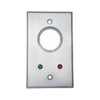
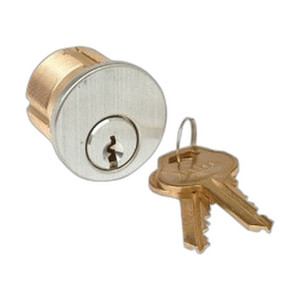
Camden CM-2090 DPDT Maintained Key Switch 30VDC
The Camden CM-2090 is a DPDT (double-pole double-throw) maintained key switch designed for 30VDC hardwired control of electric strikes, electromagnetic locks, and access control bypass circuits. Unlike networked credential readers, the CM-2090 operates as a latching relay switch — once the key is turned to the active position, electrical contact is maintained continuously until the key is returned to the off position. This maintained-contact behavior eliminates the need for momentary-pulse control logic and simplifies integration into legacy door control systems, emergency override installations, and multi-circuit activation scenarios where a single key turn must trigger two independent 30VDC loads simultaneously.
Key Features
- DPDT Maintained Contact: Switching configuration allows simultaneous control of two independent 30VDC circuits (e.g., primary strike and auxiliary lock or signal line). Contact remains engaged as long as the key is in the active position.
- 30VDC Operation: Operates on standard low-voltage access control power, compatible with UPS-backed strike supplies and hardwired relay control panels without external power conditioning.
- Mortise Cylinder Design: Accepts standard 1", 1 1/8", or 1 1/4" mortise key cylinders (sold separately), allowing integrators to specify keying strategy and master-key compatibility independently of the switch mechanism.
- Flush-Mount Installation: Die-cast 1/4" aluminum housing fits single-gang or multi-gang wall boxes with countersunk cylinder opening — no additional drilling or surface-mount adapters required.
- Hardwired Integration: No network dependency, no credential verification delay — physical key insertion and turn is the only activation path. Ideal for high-traffic override applications and environments where network outages cannot block manual access.
- High-Cycle Durability: Engineered for frequent use and outdoor/harsh mounting conditions. Tamperproof hardware (countersunk screws) included to prevent unauthorized removal.
- Dual-Circuit Activation: DPDT topology enables simultaneous striking of primary and secondary doors, release of dual magnetic locks, or strike + status-signal routing in a single key turn — reducing installation complexity in multi-access scenarios.
The CM-2090 is a hardwired control device, not a networked access reader. It integrates with existing door control wiring and 30VDC strike supplies through standard terminal blocks. The physical key is the credential; no TCP/IP authentication or access control platform enrollment is required. This makes the CM-2090 the appropriate choice for manual override and emergency egress applications where key-based operator authority must remain functional independent of software state.
Installation requires verification that your strike or lock circuit is rated for 30VDC and can support the contact rating of the switch. Standard control wire (18–14 AWG recommended) connects the CM-2090 terminals to the 30VDC strike supply. The DPDT configuration provides flexibility: use one pole for the primary strike and the second pole for a secondary lock, status relay, or monitoring circuit. No external power module or credential encoder is needed.
The physical mortise cylinder (1", 1 1/8", or 1 1/4" options) is sourced separately, allowing you to select keying strategy — standard pin tumbler, master-key control, or restricted keyway — without being bound to a single manufacturer's credential ecosystem. Brass cylinder lock ring and tamperproof mounting hardware are included; the one-piece aluminum die-cast body resists corrosion in outdoor and semi-outdoor installations.
The CM-2090 is compatible with all hardwired access control platforms and door-control relay panels that accept 30VDC maintained-contact switches. No software driver, network module, or VMS integration is required — the switch operates as a passive relay element in your control circuit. This simplicity and independence from network infrastructure make it a reliable choice for emergency override, area-supervisor unlock, and multi-access coordination in large facilities where manual authority must always be available.
Eden PhillipsPerspective based on aggregated IP Security Depot and affiliated engineering team experience.
We've installed the CM-2090 across a wide range of access control deployments — from facility override stations to outdoor emergency egress applications — and it remains one of the most straightforward hardwired key switches available. The critical distinction is that this is not a credential reader; it's a latching relay activated by physical key insertion. In environments where network outages, software crashes, or credential database corruption cannot be tolerated (hospital surgical-suite override, data-center emergency egress, power-plant control-room manual unlock), the CM-2090 delivers absolute mechanical reliability. We've seen it used in tandem with networked readers at the same door — the keyed switch as primary entry, the card reader as secondary convenience path. The DPDT configuration is the real operational win: on multi-access scenarios (two-door suites, airlock vestibules, coordinated strike-and-latch unlock), a single key turn activates both circuits simultaneously, eliminating the operational burden of sequential manual unlocks. That said, the mortise cylinder must be sourced and keyed separately, which adds a small administrative step during procurement. Ensure your strike supply is indeed 30VDC and can sustain contact closure for the duration of door actuation; some UPS-backed strike supplies drift slightly in voltage under sustained load, so field-verify before final commissioning. The maintained-contact design means the key must remain turned throughout the unlock cycle — this is intentional (continuous strike hold) but unfamiliar to users accustomed to momentary card-reader behavior. Training facility staff on that mechanical requirement prevents false support calls.
Technical Highlights:
- DPDT Maintained Switching: Two independent pole pairs allow simultaneous control of primary and secondary circuits. Once the key is turned, contact remains engaged until the key returns to off — no timing logic or momentary-pulse sequencing required. Simplifies control panel wiring and eliminates relay cascade complexity.
- 30VDC Hardwired Operation: No power module, no network module, no credential platform dependency. Operates directly off 30VDC strike supply (UPS-backed or hardwired). In environments with frequent network outages or security policies that demand offline override capability, this is the right architecture.
- Mortise Cylinder Modularity: Standard 1", 1 1/8", or 1 1/4" mortise cylinders (sold separately) decouple the key strategy from the switch mechanism. Allows independent specification of key blanks, master-key control, and rekeying without swapping the switch itself.
- Tamperproof Hardware & Outdoor Durability: Die-cast aluminum 1/4" body, countersunk screws with bit driver, brass lock ring. No plastic mounting clips or exposed fasteners — built for high-cycle use and semi-outdoor weathering (covered overhangs, vestibules).
- Flush-Mount Fit: Countersunk cylinder opening fits standard single-gang or multi-gang wall boxes; no surface-mounted bezel or trim ring needed. Integrates cleanly with existing door-control cabinetry.
Deployment Considerations:
- Mortise cylinder is not included — source 1", 1 1/8", or 1 1/4" cylinder separately and specify keying strategy (standard pin tumbler, master-key, restricted keyway). Lead time for custom-keyed cylinders can add 2–3 weeks to project schedule.
- Maintained-contact operation requires the key to remain in the turned position for the entire unlock duration. If your strike cycle is slow (hydraulic damper, low-speed motor), the operator must hold the key throughout. Verify strike actuation time in field testing before full deployment.
- Verify 30VDC availability and polarity at the strike or lock circuit; some older hardwired panels or UPS-backed supplies may drift. Use a DC volt meter at the switch terminals under load before final sign-off. Sustained voltage below 28VDC may reduce contact reliability.
- The DPDT topology is powerful for dual-circuit control, but only if both circuits are truly independent. If you need sequenced activation (strike first, latch second, with time delay), you'll need external relay logic or a networked access control panel — the CM-2090 alone cannot provide that logic.
- Install in a protected or semi-outdoor location. While die-cast aluminum resists corrosion, direct rain exposure over time will degrade the mortise cylinder lock mechanism. Use a weatherproof escutcheon or vestibule covering if the switch is on an exterior wall.
The CM-2090 is the right choice for facility operations teams who need manual key-based override authority that does not depend on network infrastructure or software state. It's also ideal for multi-access coordination and emergency egress stations where simplicity and mechanical reliability outweigh networked credential convenience. For more options in key-switch and hardwired access control, explore the Camden catalog.