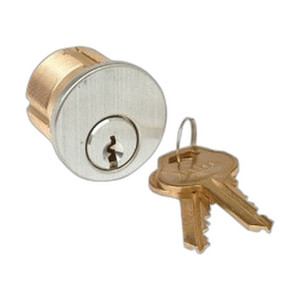
Camden CM-1190 DPDT Maintained Key Switch
The Camden CM-1190 is a double-pole double-throw (DPDT) maintained key switch designed for 30VDC access control systems requiring stable, key-held contact closure. Unlike momentary switches, the CM-1190 holds its switching state as long as the key remains in position — no automatic release on power fluctuation or accidental contact bounce. Deploy it in door strike panels, electromagnetic lock circuits, auxiliary relay control, or hybrid access systems where manual key override and held switching logic are critical to the operation.
Key Features
- DPDT Maintained Action: Double-pole double-throw contact topology with maintained (latching) behavior. Switching state persists until the key is manually withdrawn — ideal for strike activation and signal routing that must remain stable during credential verification or unlock cycles.
- 30VDC Rated: Operates on standard 30VDC access control power supply. Contact rating supports electric strikes, electromagnetic locks, and auxiliary solenoid circuits without external relays.
- Mortise Cylinder Compatible: Accepts standard 1", 1 1/8", or 1 1/4" mortise cylinders (sold separately). Integrates with HID and other OEM credential assemblies for key-based access override.
- Die-Cast Aluminum Housing: 1/4" thick one-piece die-cast aluminum body with tamperproof screw hardware. Withstands outdoor mounting, mechanical stress, and physical tampering attempts in commercial and industrial deployments.
- Surface and Flush Mount Options: Supplied with socket, slotted, and tamperproof fasteners for surface-mounted or flush-mounted installation in access control cabinets and door modules.
- Manual Override Integration: Direct key-operated switching eliminates dependency on networked credential readers or powered solenoid logic during power loss — manual unlock capability persists as long as the key and cylinder are intact.
The maintained switching action is the defining operational characteristic: once the key is turned and the switch is in position, both poles remain closed (or open, depending on wiring intent) until the key is manually returned to the neutral position. This eliminates the need for a separate latch relay and simplifies wiring in standalone door control circuits or hybrid systems where both electronic and manual access are required.
Integration is straightforward in 30VDC architectures. Wire the common (COM) contacts to the strike solenoid and auxiliary circuits; the maintained closure holds power through the strike for the duration of the key turn. In hybrid setups combining HID readers with manual key backup, the CM-1190 allows facility personnel to unlock a door if the electronic system is offline. The die-cast aluminum construction resists environmental stress and physical attack — typical deployments include exterior door control cabinets, gate access panels, and mechanical override stations in parking structures and secured perimeters.
Confirm your 30VDC supply is stable and properly fused before connection; the maintained action means any wiring error will hold contacts until manual key reset. Verify the switch behavior (maintained closure vs. momentary) matches your application logic — if your door control module expects a momentary pulse rather than held contact, the CM-1190 is unsuitable without an intermediary timer relay. Standard mortise cylinder compatibility and modular fastening make retrofit or upgrade simple in existing access control infrastructure.
The CM-1190 carries manufacturer warranty and meets commercial access control standards for manual key switching. It integrates directly into 30VDC control architectures and is fully compatible with electric strike assemblies and auxiliary relay circuits used across commercial security systems. For integrators requiring reliable mechanical key override without programmable solenoid logic, this switch provides proven, tamper-resistant operation in high-traffic and outdoor environments.
Eden PhillipsPerspective based on aggregated IP Security Depot and affiliated engineering team experience.
We've installed the Camden CM-1190 across parking structures, mechanical override stations, and hybrid access control cabinets where the maintained switching behavior is a genuine operational requirement, not just a convenience feature. The key differentiator versus solenoid-based systems is simplicity and resilience: there's no coil to energize, no pilot relay to fail, and no dependency on power regulation beyond basic 30VDC supply stability. When the key is turned, both poles lock in their switched state mechanically — power loss or electrical noise won't release the strike mid-unlock cycle. In our experience, this reliability matters most in outdoor cabinets and high-traffic doors where ground loops and supply ripple are common. The die-cast aluminum housing has proven robust against vandalism attempts and environmental stress; we've deployed units in coastal and industrial settings without corrosion issues. One important caveat: the maintained action means the switch does exactly what it's told until the key is manually withdrawn. If your door control logic expects a momentary pulse (say, a 500ms unlock trigger), you'll need to introduce a timer relay or use a different switch entirely. We've seen integrators overlook this and wire the CM-1190 directly into systems that latch strikes on rising edge — result is the strike stays energized until the key is removed, which can trap occupants or create nuisance unlock cycles. Know the behavior of your downstream circuit before installation.
Technical Highlights:
- DPDT Topology: Two independent pole-pairs allow simultaneous strike activation and auxiliary signal routing (status indication, alarm input, second solenoid circuit). Both poles switch together when the key turns — no separate relay needed for strike + sensor logic.
- 30VDC Solid-State Safe: Rated for low-voltage DC circuits common in commercial access control. No AC isolation transformer, no high-voltage isolation concern — wiring directly into strike power and control loops is straightforward and minimizes component count.
- Mortise Cylinder Modularity: Standard 1", 1 1/8", 1 1/4" cylinder bores mean you can swap credential types (pin tumbler, HID-compatible, restricted keyway) without replacing the entire switch body. Future-proofs retrofits when credential security posture changes.
- Manual Override Resilience: Key-mechanical actuation is independent of electronic credential readers or networked systems. If your HID reader, controller, or power supply fails, facility personnel with a physical key can still unlock the door — true fallback access.
- Tamper-Resistant Hardware: Socket, slotted, and tamperproof fasteners reduce casual disassembly. Die-cast housing design eliminates exposed solder or thin-wall sections where attackers might pry or drill.
Deployment Considerations:
- Maintained action is non-negotiable — if your control module requires a momentary pulse, insert a 500ms-1s timer relay between the switch commons and strike solenoid to convert the held contact into edge-triggered events.
- Mount in a lockable cabinet or recessed door control box if exposed to public areas; the cylinder itself is secure, but external wiring and screw terminals should be protected from casual tampering or water intrusion.
- Verify 30VDC supply current capacity before wiring strike loads; a typical electric strike draws 0.5–1.5A at 12VDC or 24VDC (use a buck converter if your supply is 30V). The CM-1190 itself draws zero standby current and acts as a pure contact switch.
- Test key withdrawal behavior under load — confirm the switch returns to neutral when the key is removed and the strike de-energizes cleanly. If the strike solenoid is slow to release, add a diode across the solenoid coil to prevent back-EMF damage to the switch contacts.
- In hybrid systems mixing electronic readers with key-mechanical backup, label the key clearly and store spares in a secure location; loss of the physical key eliminates manual override capability until a replacement is cut and installed.
The CM-1190 is the right choice for integrators building resilient access control in environments where power redundancy, mechanical reliability, and manual fallback are as important as electronic credential logic. Its straightforward design and proven durability make it a standard component in parking structures, mechanical override stations, and door control cabinets where key-based switching drives strikes or auxiliary circuits. For hybrid systems or outdoor deployments requiring stable, tamper-resistant contact closure, this switch delivers. Explore more key-switching and access control components in the Camden catalog.