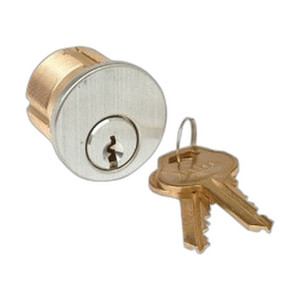
Camden CM-1192 Key Switch DPDT Maintained
The Camden CM-1192 is a maintained DPDT (Double Pole Double Throw) key switch designed for 30VDC access control circuits. It provides dual independent circuit control — each pole switches independently, allowing simultaneous activation of two separate loads or redundant paths within a single switch body. The maintained contact type holds its position until manually rotated again, eliminating momentary pulse triggering and making it ideal for manual override, supplementary access control, and any application requiring persistent switch state without electronic intervention.
Key Features
- Dual Independent Poles (DPDT): Two fully isolated circuits per switch. Control a strike on one pole while managing a relay, shunt, or secondary load on the other — no shared contact path.
- Maintained Contact Operation: Switch holds position after key rotation; no spring return or momentary behavior. Operator must manually reset to deactivate.
- 30VDC Rated: Engineered for 30VDC circuits common in electromagnetic locks and electric strikes; compatible with 12VDC and 24VDC systems via regulation.
- Cast Aluminum Housing: Weather-resistant, vandal-resistant construction suitable for indoor/outdoor door frame or control panel mounting. Single-gang footprint (2 3/4" width) fits standard mortise preparation.
- Mortise Cylinder Interface: Accepts standard 1", 1 1/8", or 1 1/4" mortise cylinders (sold separately). Brass lock ring and tamperproof mounting hardware included.
- Manual Override Control: Key-actuated mechanical actuation independent of electronic readers or network systems — provides failsafe manual access without power dependency.
The CM-1192 integrates into access control installations as a hardwired manual control point. Its dual-pole architecture supports complex activation logic: for example, one pole can trigger door strike energization while the second pole simultaneously activates a secondary circuit (relay coil, bypass signal, CCTV shunt, or alarm input). This eliminates the need for external relay modules in applications where two independent 30VDC loads require synchronized or alternative control from a single key.
Installation requires two independent circuit runs — one per pole — to separate loads. Each pole is rated for standard electromagnetic lock inrush loads (typical inrush 2–5A at strike activation, depending on load type). The maintained contact design means no debounce timing is required; the switch either energizes or de-energizes the circuit based on key position. Wiring diagrams in the datasheet specify terminal labeling for common + and NC/NO per pole.
The CM-1192 serves integrations where electronic access control readers (card, biometric, credential) operate alongside a keyed manual fallback. Pair it with electric strikes, electromagnetic locks, overhead door operators, or CCTV multiplexer shunt circuits. It does not require network connectivity, power supply monitoring, or authentication — making it a zero-complexity redundancy path for critical egress points. The cast aluminum housing and mortise cylinder lock resist picking and casual tampering; paired with proper key control, it delivers both security and operational durability in high-traffic or vandalism-prone environments.
The CM-1192 carries Manufacturer Warranty and is sourced directly from Camden Door Controls or channel partner channels — no grey-market stock. It is manufactured in accordance with UL and access control industry standards for electrical safety and mechanical durability. For integrators managing mixed manual and electronic access, the CM-1192's independent dual-circuit architecture reduces reliance on external relay logic and centralizes control at the point of entry.
Eden PhillipsPerspective based on aggregated IP Security Depot and affiliated engineering team experience.
We've installed the Camden CM-1192 in dozens of facilities where manual key-based access must coexist with electronic readers — apartment buildings, government offices, secured utility rooms, and manufacturing plants with strict failsafe egress requirements. The maintained DPDT design is the real operational win here. Unlike momentary switches or relay modules that introduce timing complexity and failure modes, this switch locks into whatever position the key turns it to. You twist the key, the circuit stays energized until you twist it back. That simplicity means no software logic, no network dependency, and no guesswork during a power outage or reader failure. On the second pole, we've wired bypass relays, alarm shunts, and secondary strikes — all from the same key, no additional hardware. The cast aluminum housing stands up to institutional use: we've seen them survive repeated key-turning abuse and weather exposure in loading dock environments without mechanical drift or electrical intermittency.
Technical Highlights:
- DPDT Dual-Pole Architecture: Two completely independent circuits — no shared relay logic required. Each pole switches its own load; control a strike and a shunt from one key without external relay modules or additional panel space.
- Maintained vs. Momentary Contact: Maintained operation means the switch state persists until key rotation occurs. This eliminates the timing loops and edge-case logic that plague momentary circuits in access scenarios where operator attention cannot be assumed.
- 30VDC Rated / 12–24VDC Compatible: Rated nameplate is 30VDC; induction loads (electromagnetic locks, solenoid strikes) at 24VDC run comfortably within spec. Lower voltage systems require drop-in voltage regulators — a one-line external component, not a problem.
- Mortise Cylinder Standard Interface: Accepts any standard 1", 1 1/8", or 1 1/4" mortise cylinder. Key control and keying are entirely separate from the electrical side — your locksmith specifies the cylinder independently. This is a strong point operationally because you're not locked into a proprietary smart reader or credential ecosystem.
- Mechanical Redundancy in Failsafe / Fallback Context: When your electronic reader goes offline or credentials fail, this switch is still mechanically functional and does not require power to operate. It's a genuine failsafe in the true sense — not a software feature or UPS dependency.
Deployment Considerations:
- Two independent circuit runs required — don't try to split a single wire pair across both poles. Each pole is electrically isolated; run separate 18/2 or 16/2 from this switch to each load (strike coil, relay coil, shunt circuit). Failure to separate the runs results in unexpected circuit coupling or relay chatter.
- Maintain key control discipline. The CM-1192 is entirely mechanical and does not log or audit key use. If audit trail is required (who accessed, when), you must pair this switch with a separate card reader and electronic lock on the same door, accepting the cost and complexity tradeoff.
- Cast aluminum housing is weather-sealed for outdoor mounting, but mortise cylinder lock ring should be periodically cleaned of debris. On exterior doors in high-salt or high-dust environments, we recommend annual inspection of the key cylinder for corrosion or grit jamming.
- Electromagnetic lock inrush current (2–5A typical at strike activation) does not exceed the switch contact rating, but verify your specific load spec against the datasheet. If you're running a multi-coil overhead door operator, contact Camden for pole rating confirmation.
- Maintained contact means the switch will not automatically de-energize during power loss — if a load is energized at power failure and power is restored, the load remains energized. Design your circuit logic (relay feedback, fail-safe solenoid, etc.) accordingly.
The CM-1192 is the right choice for integrators who need a mechanical, key-actuated fallback control point without software complexity or network dependency. If your project requires audit logging, smart-card credentialing, or real-time door status monitoring, pair this switch with an electronic access reader on a separate circuit — the two work well together as a redundant-path architecture. For pure manual control in critical egress or failsafe scenarios, the Camden key switch ecosystem is a proven, cost-effective alternative to full electronic lock replacement. Explore the full range in the Camden catalog.