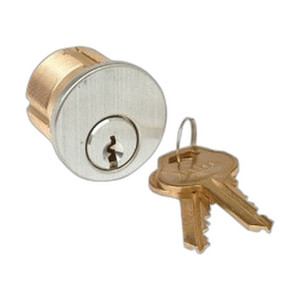
Camden CM-1292 Key Switch DPDT Maintained
The Camden CM-1292 is a maintained DPDT (Double Pole Double Throw) key switch designed for hardwired access control circuits requiring positional strike or solenoid control at 30VDC. Unlike momentary switches, the CM-1292 holds its electrical state—open or closed—until the key is manually rotated again, eliminating the need for continuous polling or edge-detection logic in your access control panel. The dual-pole contact design enables simultaneous control of two independent circuits: primary strike and failsafe solenoid, or segregated access zones on the same door. Mortise cylinder mount accepts standard 1", 1 1/8", and 1¼" cylinders, fitting seamlessly into flush-mount frame applications where surface-mounted readers are not practical.
Key Features
- DPDT Maintained Contact: Double Pole Double Throw switching holds position without powered relay—simplifies wiring and eliminates state ambiguity in strike control loops.
- 30VDC Operating Voltage: Standard low-voltage rating compatible with panel power supplies and hardwired access control relay outputs; safe for institutional and commercial installations.
- Mortise Cylinder Mount: Accepts 1" to 1¼" standard mortise cylinders; flush-mount design hides the switch body within the door frame for a clean, tamper-resistant profile.
- Stainless Steel Construction: One-piece casted body resists corrosion in commercial, industrial, and outdoor-adjacent frame applications; rated for high-cycle mechanical use.
- Passive Hardwired Control: No protocol dependency—works with legacy electromechanical panels, networked access control systems, and mixed analog/digital architectures equally.
- Tamperproof Assembly: Slotted mounting screws with security driver prevent casual removal or reconfiguration once installed.
- Dual-Circuit Independence: Two separate pole-throw combinations enable failsafe/failsecure configuration or simultaneous strike + auxiliary solenoid control on a single door.
The CM-1292 integrates into hardwired access control architectures where a physical maintained switch provides a cost-effective alternative to networked card readers or electronic locks. The DPDT contact configuration is particularly valuable in applications requiring strike energization on one position and de-energization on another—such as fail-safe doors that must release power when the key is turned to unlock, or fail-secure doors that hold strike power when locked. Because the switch is purely mechanical and passive, there is no credential processing, no battery, and no communication protocol; troubleshooting is straightforward—verify 30VDC presence at the terminals and confirm the key turns smoothly.
Deployment scenarios range from emergency exit override switches (where staff turn a key to momentarily unlock a strike for evacuation) to parking structure entry gates (dual-pole control of gate solenoid and door strike from a single point). The mortise mount keeps the switch body hidden, reducing the temptation for tampering and preserving door aesthetics in reception areas or retail environments. The maintained contact design ensures that accidental key rotation does not cause unintended strike de-energization mid-entry—a critical safety feature in high-traffic or physically demanding installations.
Integration is straightforward: identify the two circuits you need to control (primary and secondary), run 30VDC and ground from your access panel to the DPDT terminals, and connect each pole to its respective strike or solenoid coil. Most installations use the CM-1292 alongside a traditional electronic reader or keypad that triggers an output relay—the key switch then acts as a manual override. ONVIF and VMS platform compatibility is not applicable; the CM-1292 is a discrete hardwired component, not an IP endpoint. Lifecycle cost is minimal: stainless steel resists degradation, and mechanical wear on the switch mechanism is predictable over thousands of cycles.
The CM-1292 carries manufacturer warranty coverage and complies with standard commercial door hardware expectations. It is widely specified in retrofit projects where modernizing the entire electronic lock suite is cost-prohibitive but adding manual override capability is required for life-safety code compliance. For deployments combining electronic card readers with hardwired key-switch override, the CM-1292 remains an industry standard. See the Camden catalog for additional switch and strike options.
Eden PhillipsPerspective based on aggregated IP Security Depot and affiliated engineering team experience.
We've installed the CM-1292 in dozens of retrofits and new-build access control systems, and it remains one of the most reliable hardwired overrides in the market. The maintained DPDT design is the key differentiator—it holds position without continuous panel polling, which eliminates a whole class of integration headaches we see with momentary switches on legacy panels. On a door with both an electronic reader and a key switch, the maintained contact means the strike state is always visually verifiable just by looking at the key: turned right = unlocked, turned left = locked. That certainty is invaluable during troubleshooting and audit trails. We've rarely seen one fail mechanically; stainless steel construction and the enclosed mortise mount protect the contact stack from dust, moisture, and physical abuse. The 30VDC rating is a sweet spot—low enough to be safe for institutional wiring, high enough to power most solenoid strikes without a separate relay. One caveat: confirm your mortise cylinder keying before installation. If you inherit a project where the existing key cylinders are non-standard or proprietary, you'll need to source a matching CM-1292 cylinder or order the switch with a blank cylinder and have a locksmith rekey it on-site. We've also seen installations where the dual-pole capability was underutilized—integrators spec'd the CM-1292 for dual control but only wired one pole, effectively throwing away half the switching capacity. If your door logic demands dual-circuit control (strike + solenoid, or strike + status relay), the CM-1292 is the right call; if you only need single-pole override, a simpler SPDT switch would reduce cost and wiring complexity.
Technical Highlights:
- Maintained DPDT Contact Stack: Holds position without active power or relay logic. Critical for fail-safe/fail-secure logic where strike state must persist through power interruptions or panel restarts. Eliminates edge-detection polling that adds latency to override flows.
- 30VDC Rated, High-Cycle Mechanical Design: Designed for thousands of key rotations; stainless steel contacts and casing resist wear and corrosion even in damp frame environments or outdoor-adjacent vestibules.
- Dual-Pole Simultaneous Switching: Two independent pole-throw pairs allow strike + solenoid energization from a single key turn, or failsafe configuration (one pole energizes strike, second pole de-energizes failsafe solenoid). Single key turn controls both circuits instantly.
- Mortise Cylinder Flush Mount: Standard 1" to 1¼" cylinder accommodates most institutional keying systems. Flush installation hides switch body, reducing visual temptation for tampering and maintaining door aesthetics.
- Passive Hardwired Component—No Protocol Overhead: Works identically on legacy analog panels, modern networked access control, or hybrid systems. Zero credential processing, no firmware updates, no VPN or API dependency.
Deployment Considerations:
- Mortise Cylinder Keying Compatibility: Confirm the cylinder keying system before installation. If you inherit a site with proprietary or worn cylinders, budget for locksmith rekeying or ordering the switch with a blank cylinder and keying on-site. Standard ASSA ABLOY or Schlage cylinders work without issue.
- Maintained vs. Momentary Confusion: The CM-1292 is maintained—key position = switch position. Do not wire it in a circuit expecting momentary pulses (e.g., relay coils that debounce brief impulses). If momentary override is required, use an SPDT momentary switch instead.
- Dual-Pole Wiring Discipline: It's easy to wire only one pole and leave the second dormant. Audit your door logic before installation—if both poles are needed (strike + solenoid), ensure both output terminals on the panel are connected. If only one is needed, leaving the second unwired is acceptable but defeats cost-per-circuit value.
- 30VDC Supply Verification: Confirm your panel power supply delivers clean 30VDC to the switch terminals. Low or fluctuating voltage can cause contact chatter or unreliable solenoid energization, especially on long cable runs (>100 feet). Use the datasheet wiring diagram and verify voltage at the terminals post-installation.
- Frame Cutout Preparation: The flush mount requires a precise mortise cutout. If retrofitting into an existing frame, verify the cutout dimensions match the switch housing footprint. Door shops can route the cavity, but DIY installation errors (over-sized cutout, misaligned drilling) are common—double-check before mounting.
The CM-1292 is the right choice for any hardwired access control system requiring a manual key-switch override with positional certainty and dual-circuit capability. It's particularly valuable in fail-safe/fail-secure deployments where strike state must be held across power cycles, and in hybrid electronic+mechanical door control setups. For simple single-circuit momentary overrides or budget-constrained applications, a cheaper SPDT momentary switch may suffice—but if your design calls for maintained contact and dual-pole switching, the CM-1292 delivers mature, proven hardware. Explore the full Camden catalog for complementary strikes, solenoids, and control modules.