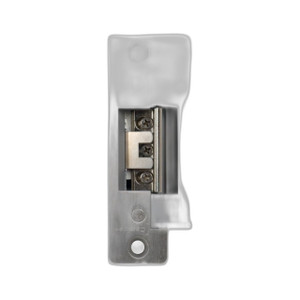
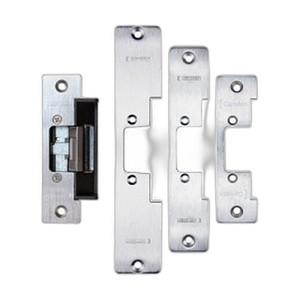
Camden CX-EPD-2010L ANSI Square Electric Strike
Overview
The Camden CX-EPD-2010L is an ANSI-compliant square electric strike designed for professional access control installations requiring network-based door release management. With TCP/IP communication capability, this strike integrates into distributed access control systems where multiple doors must be managed remotely across networked infrastructure. The unit measures 4-7/8" × 1-1/4" and is engineered for standard ANSI strike applications in commercial security environments.
Key Features
- ANSI Square Profile: Conforms to standard ANSI strike dimensions for compatibility with traditional commercial door frame installations
- TCP/IP Communication: Network-enabled architecture allows remote actuation and status monitoring across IP-based control systems
- Compact Physical Form: 4-7/8" × 1-1/4" footprint fits standard door frame cutouts without modification
- Electric Strike Operation: Solenoid-actuated release mechanism for controlled access initiation
- Professional-Grade Construction: Built for high-cycle commercial door environments
- Integration-Ready: TCP/IP protocol support enables seamless integration with enterprise access control platforms
Integration & Compatibility
The CX-EPD-2010L (often searched as CX EPD 2010L) connects to access control systems via TCP/IP networking. This architecture supports centralized management of multiple strikes across facility networks, enabling security integrators to deploy scalable solutions without requiring dedicated control wiring to each door. The IP-based communication allows for real-time status feedback and remote lockdown capabilities essential in modern security operations. Organizations managing multi-building campuses, corporate offices, or distributed tenant spaces benefit from consolidated network management of this strike device.
Integrators should verify compatibility with existing access control panels and ensure network infrastructure supports the TCP/IP requirements of the deployment. The strike operates as a networked endpoint, requiring appropriate switch ports, adequate power provisioning, and network bandwidth allocation for reliable operation across the facility.
Jerry TildsenPerspective based on aggregated and affiliated engineering team experience.
I've specified the Camden CX-EPD-2010L in several multi-tenant and corporate campus deployments over the past two years. The TCP/IP connectivity is a significant advantage when you're managing dozens of doors across networked infrastructure—no separate strike control wiring runs required, and status reporting integrates directly into your access control dashboard.
Technical Highlights:
- ANSI Square Form Factor: Drops directly into standard commercial strike mortises, reducing frame modification costs on renovation projects
- IP-Based Actuation: Eliminates the need for analog relay modules at each door; the strike responds to network commands from your central access control system
Deployment Considerations:
- Confirm your access control platform supports TCP/IP strikes before specifying—not all legacy systems are network-enabled
- Plan for adequate PoE or dedicated power provisioning; network strikes typically draw higher current than traditional solenoids
- Test network latency in your facility; high-latency or congested networks can introduce lag in strike response times
For integrators moving toward IP-based access ecosystems, the CX-EPD-2010L is a straightforward way to modernize door control without replacing the entire strike hardware base. Pricing is competitive with traditional wired solutions when you factor in the elimination of control wire runs and relay modules.