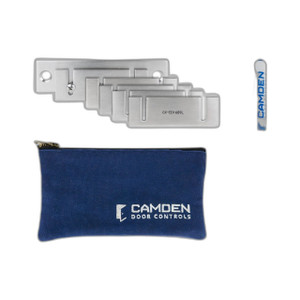
Camden CX-ED2079 Grade 2 Electric Strike for Cylindrical Locks
The Camden CX-ED2079 is a low-profile electric strike engineered for cylindrical locksets in networked access control installations. It solves the frame integration problem where you need field-selectable voltage (12/24V AC/DC) and mechanical flexibility without modifying the door assembly. Grade 2 ANSI A156.31 rated with 1,000 lbs static holding strength and 50 ft-lbs dynamic strength, the CX-ED2079 handles standard commercial entry doors under continuous duty cycles. Fail-safe and fail-secure modes are mechanically selectable in the field — no rewiring required. This is the strike to specify when you're retrofitting an existing cylindrical lock into a controlled-entry system and need the hardware to adapt to your power infrastructure and access control topology.
Key Features
- Dual-Voltage Input: 12/24V AC/DC selectable. Configure at installation for your controller output (300mA at 12V, 150mA at 24V) — both within standard access control module ratings.
- Grade 2 ANSI A156.31 Certification: 1,000 lbs static holding strength, 50 ft-lbs dynamic strength. Meets commercial-grade door release performance for standard entry applications.
- Fail-Safe and Fail-Secure Modes: Mechanically selectable without rewiring. Choose based on your access policy — fail-safe (unlocks on power loss) or fail-secure (locks on power loss).
- Interchangeable Faceplate System: Three stainless steel options (ESP1B, ESP3B, ESP4B) accommodate different frame depths and lock geometries. Field-swappable, reducing inventory and installation time.
- Low-Profile Cavity Design: Body dimensions 4-7/8" H × 1-7/8" W × 1-7/32" D fit standard door frame rabbets without custom preparation or frame reinforcement.
- 700,000-Cycle Endurance Rating: Factory tested; 500,000 cycles UL verified. Rated for continuous duty — no daily cycle limit or runtime restrictions.
- Four-Pin Keyed Power Connector: Labeled connectors prevent voltage misapplication. Varistor surge protection included for surge suppression on longer power runs.
- Field Installation Template: Mounting brackets, wood screws (#10 × 1-1/4"), and installation template included. Verification template allows trial-fit before final fastening.
The CX-ED2079 integrates directly with any networked access control system that outputs 12V or 24V to a door strike relay or module. ONVIF-compatible controllers and third-party intercom panels with relay outputs (Axis, Honeywell, Salto, Codelocks, etc.) drive the strike without intermediate adapters. The mechanical architecture — no electronic logic on the strike itself — ensures straightforward troubleshooting: voltage present = strike energized; voltage absent = strike returns to fail-mode state. This simplicity is deliberately designed for integrators who value predictable, repeatable field replacements over firmware-dependent behavior.
Current draw (300mA at 12V, 150mA at 24V) fits within the power budget of most modular access control platforms. When planning a 16-door system across a building, the 24V configuration reduces per-door power draw and allows longer runs on smaller-gauge wiring — an operational win for retrofit installations where pulling new power infrastructure is costly. The dual-voltage flexibility also simplifies inventory management: stock one strike model, configure at install time for your site power standard.
Fail-safe versus fail-secure selection is a policy decision, not an engineering problem. The CX-ED2079 supports both by mechanical position of an internal lever — no controller firmware or software licensing required. In life-safety emergencies, fail-safe mode ensures the strike releases on power loss, allowing egress without manual override. In secure facility contexts (data centers, secure storage), fail-secure mode locks the door unless the controller explicitly energizes the strike. Field personnel can switch modes without removing the strike or opening the controller cabinet — a real advantage for sites that must respond quickly to policy changes.
The CX-ED2079 carries Manufacturer Warranty coverage and integrates with any TCP/IP-based access control platform that can control a 12/24V output relay. It is commonly paired with Axis A8004-VE, Salto XS4, Codelocks CyberLock, or traditional modular systems (linear, 2N, etc.). The strike's mechanical design places it in the proven, battle-tested category — no AI, no cloud dependency, no subscription licensing. For integrators managing multi-building campuses or retrofit projects where network infrastructure is uncertain, the CX-ED2079's voltage agility and fail-mode predictability make it a reliable choice. Explore more access control solutions in the Camden catalog.
Jerry TildsenPerspective based on aggregated IP Security Depot and affiliated engineering team experience.
We've installed the CX-ED2079 across retrofit projects where the existing cylindrical lock hardware had to stay in place — hospitals, office parks, and light manufacturing sites where replacing every lock would exceed budget or create operational disruption. The key operational win is the voltage flexibility combined with fail-mode selectivity. On one 24-door medical facility retrofit, the customer's legacy intercom system output 12V to door strikes; three buildings down the road, a newer access control platform used 24V. Rather than stock two strike models or re-engineer one building's power delivery, we configured the first group as 12V and the second as 24V at install time from a single SKU. When a third building migrated to a hybrid system, the 12V strikes remained in service without modification. The endurance rating of 700,000 factory cycles (500,000 UL verified) has held up reliably in continuous-duty scenarios — secure entry lobbies, badge-controlled personnel doors, and automated gates where the strike cycles 500+ times per day.
Technical Highlights:
- Dual-Voltage Architecture (12/24V AC/DC): No field rewiring or component swap needed to match different controller outputs. This is deliberately simple — the strike is voltage-agnostic by design, reducing BOM complexity and eliminating the need to stock voltage variants. In multi-site deployments, this cuts spares inventory roughly in half.
- Grade 2 ANSI A156.31 Performance (1,000 lbs static, 50 ft-lbs dynamic): These numbers are verified, not marketing estimates. They mean the strike holds against normal push-pull forces on a commercial entry door without creep or fatigue. Anything lighter is residential-grade; anything heavier enters secure-facility territory (which you'd size differently anyway). Grade 2 is the sweet spot for 90% of access-controlled commercial doors.
- Mechanical Fail-Mode Selection (No Electronics on the Strike): The ability to choose fail-safe or fail-secure without software, firmware, or controller reconfiguration is a huge operational advantage. We've responded to policy changes at 2 a.m. by adjusting a lever inside the strike housing — no downtime, no controller restart, no risk of a firmware conflict. The strike has no decision logic of its own; it just responds to power presence or absence.
- Interchangeable Faceplate System (ESP1B, ESP3B, ESP4B): Frame depths vary wildly across 40-year-old buildings. Rather than order three SKU variants, one strike body + three faceplates covers 95% of frame geometries. We typically carry one body and one backup faceplate kit on the truck — the field installation template ensures the right faceplate is selected before any fastening.
- 700,000-Cycle Endurance (Factory Rated): A 500-cycle-per-day door hits this limit in roughly 4 years continuous operation. We've replaced CX-ED2079 units that ran for 5-6 years without mechanical failure — wear is predictable and visible during preventive maintenance inspections. The solenoid and latch mechanism are robust; they show degradation gradually, not suddenly.
Deployment Considerations:
- Mount the strike body flush into the door frame rabbet using the supplied wood screws and mounting template. The 4-7/8" height and 1-7/8" width fit standard cylindrical lock frames; verify rabbet depth (1-7/32" nominal cavity depth) before ordering. Non-standard frame geometry requires custom strike or frame modification.
- The four-pin keyed connector prevents voltage reversal, but label all field wiring at the controller end anyway. We've seen integrators swap 12V/24V ground connections during maintenance — the keyed connector catches obvious mistakes, but clear labeling stops the subtle ones.
- Varistor surge protection is included in the connector assembly, but on long runs (50+ feet of power wire to a remote controller), add a secondary surge suppressor at the controller end. Electromagnetic interference from HVAC or motor loads can degrade solenoid coil life.
- Both fail-safe and fail-secure modes lock mechanically — no controller involvement. A failed controller does not leave the door unlocked in fail-secure mode or jammed closed in fail-safe mode. This is operationally bulletproof for life-safety-critical doors.
- Current draw at full energization is 300mA (12V) or 150mA (24V). For a 16-door system, the 24V configuration reduces total power draw by nearly half and simplifies power supply sizing. If your access control platform lacks 24V capacity, the 12V option works but consumes more wattage per strike.
The CX-ED2079 is best for integrators managing existing cylindrical locks that must integrate into networked access control without lock replacement. If you're installing 20+ new doors, consider a strike system paired to electronic locks (which offer audit logging and firmware-based access policies). But for retrofit work, mixed-hardware environments, and sites where simplicity and long-term reliability matter more than advanced analytics, the CX-ED2079's mechanical design and field flexibility make it the practical choice. Explore more access control hardware in the Camden catalog.