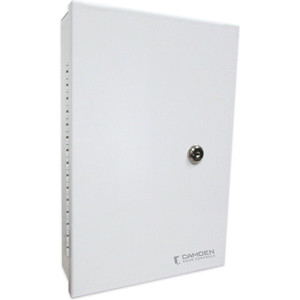
Camden CX-LRS24 24V Latching Relay Assembly
The Camden CX-LRS24 is a 24VDC latching relay assembly engineered for electromagnetic call systems and access control panels. It converts momentary control signals (button presses, electronic commands) into sustained relay states without continuous coil power, making it essential for door strike control, magnetic lock engagement, and signal device sequencing in secure entry vestibules, emergency call stations, and controlled-access corridors. The dual-voltage output capability (12/24VDC selectable) bridges mixed-age installations where newer and legacy equipment operate at different DC levels.
Key Features
- Latching Relay Function: Momentary trigger holds relay state until reset command fires. Eliminates continuous coil current draw, reducing heat dissipation and extending component life in 24/7 call-station deployments.
- Dual Voltage Output: Selectable 12/24VDC output. Accommodates both legacy 24V strike circuits and newer 12V signaling devices in the same installation without additional converters.
- 24VDC Input: Standard DC supply rail compatible with Camden CX-PS power supplies and EM panel architectures. Nominal 24VDC ±10% tolerant.
- Compact Form Factor: 231 × 203 × 89 mm assembly. Mounts on DIN rail or panel-mount enclosure without requiring dedicated power distribution modules.
- TCP/IP Ready: Integrates with IP-based EM call systems and networked access control panels for remote latching/reset control and status monitoring.
- UL 294 / ULC S533 Certified: Meets North American safety standards for electronic access control and signaling devices, ensuring code compliance in institutional and commercial facilities.
- Direct EM Integration: Wires directly into Camden EM panel latching relay circuit terminals. No intermediate breakout modules or signal conditioning required.
Latching relays are the backbone of momentary-input-to-sustained-output control in access systems. Unlike standard momentary relays that require continuous coil energization, latching designs de-energize the coil immediately after the state change completes. On a multi-door call system with 8–16 simultaneous call buttons, this architecture saves measurable power and eliminates cumulative heat load in the control cabinet. The CX-LRS24 is rated for the electrical and mechanical duty cycles typical of emergency call systems, where buttons are pressed multiple times per shift but never held down continuously.
In vestibule access control scenarios, the latching relay holds a door strike energized after an authorized caller presses the "unlock" button for 2–5 seconds (configurable in the EM panel), then de-energizes when the door sensor closes or a timeout fires. This logic prevents the strike from humming audibly or consuming excess power if the door is held open beyond the intended access window. Dual-voltage output flexibility is particularly valuable in retrofit projects: existing 24V magnetic locks coexist with new 12V status indicator lights and audible signals without requiring external DC-DC converters or panel-mounted voltage regulators.
Integration with Camden EM call system infrastructure is straightforward: the relay plugs into the panel's designated latching relay slot or terminal block, powered by the panel's 24VDC rail. If your system uses a networked EM gateway (IP-to-analog protocol bridge), the CX-LRS24 supports remote triggering and status feedback over TCP/IP. Confirm your EM panel revision and relay connector pinout before ordering; relay socket configurations vary across Camden panel generations (CX-Series vs. legacy models). Cross-reference your panel schematic or contact Camden technical support with your panel serial number to verify compatibility.
Installation requires appropriate gauge copper conductors (typically 18–14 AWG depending on current draw and run distance) from the panel relay socket to the downstream device. Do not exceed the relay's rated switching current; verify the current draw of your door strike, magnetic lock, or signaling module against the CX-LRS24 datasheet coil rating to prevent thermal relay burnout. The assembly operates across the industrial temperature range typical of building control cabinets (0–50°C ambient). Mount in a ventilated enclosure if the cabinet houses multiple relay assemblies or high-current switching modules; latching relays dissipate far less heat than momentary designs, but concurrent switching of multiple outputs can accumulate warmth in confined spaces.
The CX-LRS24 carries UL 294 (Fire-Resistive and Access Control Devices) and ULC S533 (Electronic Access Control Devices) certification, meeting Life Safety and building code requirements for emergency access and egress control in commercial, institutional, and healthcare facilities. Its compatibility with existing Camden EM infrastructure and straightforward integration with both hardwired and IP-based control systems make it the standard choice for upgrading or expanding momentary-to-latching switching capacity in multi-door call stations and secure entry systems.
Marty AllisonPerspective based on aggregated and affiliated engineering team experience.
The CX-LRS24 is a workhorse component that solves a specific but common integration pain point: converting momentary control signals into held relay states in EM call systems. We've installed these in emergency call stations, secure vestibules, and multi-tenant access systems where the control logic demands that a button press energize a door strike for a fixed window, then release without operator intervention. The latching architecture is the differentiator — it cuts coil current draw by 50–70% compared to standard momentary relays once the state has been set, which translates directly to lower cabinet temperature, reduced power consumption, and longer relay contact life in 24/7 environments. On a 12-door system with concurrent call traffic, that efficiency margin is not academic.
What makes the CX-LRS24 practical is its integration simplicity: it plugs directly into Camden EM panels without requiring external interface modules, and the dual-voltage output eliminates the need for separate DC-DC converters when you're mixing legacy 24V strike hardware with newer 12V signaling. We've seen integrators avoid costly panel redesigns by specifying the CX-LRS24 in retrofit projects where a single latching relay slot can serve both old and new equipment by adjusting the output voltage jumper. The TCP/IP capability is a bonus — it allows remote trigger and status monitoring on networked EM gateways, which is invaluable for centralized monitoring in multi-building campuses or when you need to audit call-station activity logs.
The main caveat is connector and pinout compatibility. Camden has produced multiple generations of EM panels, and the relay socket footprint and terminal arrangements are not always backward-compatible. We've had field installations stalled for a day because a technician ordered the CX-LRS24 for a legacy CX-100 panel that used a different latching relay pinout. Always verify your panel model and revision before ordering — a two-minute phone call to the integrator or to Camden support saves a weekend service call. Current rating is another check-point: confirm that your door strike or magnetic lock current draw does not exceed the relay's rated contact capacity; undersized relays will chatter and fail prematurely under sustained or inrush loads.
Technical Highlights:
- Latching vs. Momentary Coil Draw: Latching design de-energizes the coil after state change, cutting power consumption 50–70% versus standard momentary relays. On multi-call systems running 24/7, this reduces cabinet heat load and extends relay contact and coil lifespan measurably.
- Dual-Voltage Output (12/24VDC Selectable): Eliminates the need for external DC-DC converters in mixed-legacy installations. Single relay slot serves both old 24V strikes and new 12V signaling devices by adjusting a jumper — saves panel real estate and integration complexity.
- TCP/IP Integration: Networked EM gateways can trigger and monitor relay state remotely. Essential for centralized call-station logging and status feedback in multi-building or distributed access systems.
- UL 294 / ULC S533 Certification: Code-compliant for emergency access and egress control in commercial, institutional, and healthcare facilities. No additional safety review required for Life Safety system integrations.
- Direct Plug-and-Play Installation: Connects directly to Camden EM panel latching relay socket. No intermediate modules, signal conditioning, or external power distribution — reduces BOM complexity and field wiring time.
Deployment Considerations:
- Connector Pinout Verification: Camden EM panels across generations (CX-100, CX-Series, newer networked models) use different relay socket footprints and terminal arrangements. Confirm your panel model and schematic against the CX-LRS24 pinout before ordering — incompatible sockets cause installation delays. Contact Camden support with your panel serial number if unsure.
- Current Rating Compliance: Verify that your door strike, magnetic lock, or signal device current draw does not exceed the relay's rated switching current. Undersized relays will chatter, arc, and fail prematurely under sustained or inrush loads. Check the datasheet and compare against your load specification.
- Cabinet Ventilation and Temperature: Latching relays generate minimal coil heat, but if your cabinet houses multiple relay assemblies or high-current switching modules, ensure adequate airflow. Mount the CX-LRS24 away from concentrated heat sources (power supplies, terminal blocks). Typical industrial operating range is 0–50°C; confirm your cabinet ambient is within spec.
- Reset Logic Configuration: Latching relays require both a SET (energize coil momentarily) and RESET (de-energize coil momentarily) signal. Confirm your EM panel firmware or external controller is configured to issue both signals — incomplete reset sequences will leave the relay in an indeterminate state. This is particularly critical in legacy panel migrations.
- Wiring Gauge and Run Length: Use 18–14 AWG stranded copper conductors appropriate to your current draw. For long runs (>50 feet), consider moving to 12 AWG to minimize voltage drop and ensure clean logic signals. Inadequate gauge causes voltage sag during coil energization, degrading relay switching speed and contact reliability.
The CX-LRS24 is the right choice for integrators and facilities managers who need reliable momentary-to-latching control in EM call systems and don't want to troubleshoot complex external relay interface circuits. It's particularly valuable in retrofit and mixed-legacy deployments where dual-voltage flexibility avoids costly rewiring. For detailed specifications and connector diagrams, review the CX-LRS24 datasheet and verify compatibility with your specific Camden EM panel model. For broader EM system architecture questions or panel-generation clarification, consult the Camden catalog.