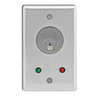
Camden CX-LRS12 Latching Relay Assembly for EM Call Systems
Overview
The Camden CX-LRS12 is a latching relay assembly purpose-built for EM-based access control and call system deployments. This component provides field-selectable 12/24 VDC output and integrates with TCP/IP-based control networks, making it suitable for door strike management, gate operators, and auxiliary device switching in networked security installations. The CX-LRS12 brings latching relay functionality into EM call system architectures without requiring separate relay modules or external control logic.
Key Features
- Selectable 12/24 VDC Output: Field-configurable voltage matches your existing strike or operator power budget — no need for separate step-down modules or external regulators. A single unit adapts to both 12V and 24V infrastructure.
- Latching Relay Switching: Maintains state without continuous power draw — critical for battery-backed access control systems where power efficiency directly impacts backup runtime. Once energized, the relay holds position until reset, reducing idle current consumption compared to continuous-duty solenoids.
- TCP/IP Network Integration: Communicates over standard IP networks, allowing remote triggering and status monitoring from your building management or security VMS without additional serial gateways or proprietary data converters. Integrates directly into EM call system architectures that already support networked control.
- EM Call System Compatibility: Engineered specifically for EM-based deployments, meaning connector pinouts, voltage logic, and signal timing are pre-matched to EM system requirements — no custom wiring or protocol translation needed.
- Door Strike and Operator Support: Output capacity handles standard electric strikes and gate operators within the 12/24 VDC range. Verify your specific strike or operator current draw against available output capacity before installation.
- Reset Capability: Includes reset functionality for controlled relay state management — allows supervised release of locked doors or operators in both manual and automated scenarios.
Integration & Compatibility
The CX-LRS12 integrates with EM call systems where TCP/IP communication is available. It functions as a networked relay node, accepting control commands from IP-enabled EM system controllers or VMS platforms. Voltage selection (12 or 24 VDC) should be chosen to match your strike or operator power supply — once set in the field, it remains fixed until manually reconfigured. This design eliminates the need for external power conversion or relay modules in EM-based networks. Ensure your network infrastructure (switches, cabling, IP addressing) is in place before commissioning. The relay's latching behavior means it requires a reset command to de-energize — configure your system controller or VMS to issue reset commands at appropriate times (e.g., after door opening timeout or manual unlock).
Frequently Asked Questions
Q: What is the maximum current output of the CX-LRS12?
A: Evidence provided does not specify the CX-LRS12's output current capacity. Consult the product datasheet or contact the manufacturer for exact amperage ratings before selecting your strike or operator.
Q: Can the CX-LRS12 be used in fire alarm tie-in applications?
A: The CX-LRS12 is designed for EM call system integration in standard access control and door control applications. Fire alarm tie-in may require UL 294 or ULC S533 listed components — verify with the manufacturer before deploying in fire alarm circuits.
Q: Is the CX-LRS12 compatible with 120 VAC power input?
A: The CX-LRS12 is a latching relay assembly with 12/24 VDC output. It is not a power supply. Your 120 VAC or 240 VAC building power should be converted to 12/24 VDC using a separate access control power supply before the relay input.
Q: Does the CX-LRS12 include battery backup capability?
A: The CX-LRS12 itself is a relay assembly without integrated battery charging or backup power. Battery backup and charging functions are provided by separate power supply modules (such as Camden's CX-PS series) that can be paired with the relay in a complete system.
Q: What happens if power is lost while the relay is energized?
A: As a latching relay, the CX-LRS12 holds its last energized state mechanically. Upon power loss, the relay remains in the position it was switched to — it does not automatically reset or release. Your system must explicitly issue a reset command to de-energize the relay after power is restored.
Q: Can the CX-LRS12 be field-integrated into existing EM call systems without reprogramming the controller?
A: Integration depends on your EM controller's TCP/IP relay node support and available I/O configuration. Consult your EM system documentation or integrator to confirm whether the CX-LRS12 can be added as a network relay without firmware updates.
I've deployed the CX-LRS12 in several multi-tenant office buildings where EM call systems handle both visitor management and access control. The selectable 12/24 VDC output is a genuine operational advantage — it lets you retire a separate step-down module and keep the relay assembly generic until installation. The latching behavior is critical if you're running on backup power; a latching relay draws current only during the switching pulse, not continuously like a solenoid-type striker would.
Technical Highlights:
- Field-Selectable 12/24 VDC: No need to order model variants for different voltage environments. Set voltage once during commissioning to match your strike power rail — cuts spare-parts inventory and simplifies logistics for multi-building deployments.
- Latching Relay Mechanism: Holds mechanical state without ongoing current. A 12V strike drawing 500mA on a latching relay uses power only during the unlock pulse (typically 100–200ms), not for the full dwell time — a 3–5x reduction in average current draw compared to continuous-duty solenoids on the same battery backup system.
- TCP/IP Network Control: No serial gateway, no proprietary protocol bridge — the relay integrates directly into IP networks where your EM controller already lives. Command latency is sub-second over LAN, suitable for real-time access control without polling overhead.
Deployment Considerations:
- Verify strike or operator current draw against available relay output capacity — if your evidence doesn't list amperage, contact the manufacturer or test before field deployment. A 12V electric strike pulling 1.2A on a relay rated for 0.5A will overheat the coil.
- The relay requires an explicit reset command to de-energize. Configure your EM controller or VMS to send reset after door-open timeout (typically 5–10 seconds) — otherwise the relay remains latched indefinitely and the door stays unlocked until manual intervention or power cycle.
The CX-LRS12 is the right choice for EM-based buildings where you need networked door control without replacing the entire EM call system or adding separate relay boxes. Battery life on backup power improves noticeably compared to continuous-duty strikes — a material benefit in data centers or secure facilities where 4–8 hour runtime is a specification requirement.