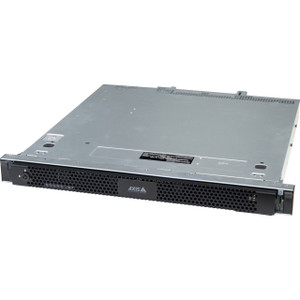
Axis S1296 192TB Rack Recording Server
The Axis S1296 02543-001 is a 2U rack-mounted NVR engineered for large-scale Axis Camera Station deployments requiring continuous retention across 100+ camera channels. With 192TB of raw hot-swappable storage and RAID 6 protection, the S1296 eliminates the operational overhead of managing secondary storage appliances or managing bitrate bottlenecks in city-scale, multi-facility, and campus-wide surveillance networks. The system ships with Axis Camera Station software, 96 core licenses (upgradeable to 192), and FIPS 140-2 Level 2 TPM-based encryption — all security-hardened on delivery.
Key Features
- 192TB Raw Storage Capacity: Twelve 16TB hot-swappable HDDs configured in RAID 6 by default. Supports RAID 0, 1, 5, 10 reconfiguration for different retention/availability trade-offs. Continuous 24/7 recording across 150 validated channels at mixed resolutions without secondary appliances.
- 150 Validated Camera Channels: Tested support for up to 150 concurrent Axis IP cameras at 4MP and below. Peak bitrate ceiling 1500 Mbit/s — scales from retail deployments (20-40 channels, 8MP) to municipality/transportation hubs (80-150 channels, 1-4MP).
- H.265+ Compression: Native support for H.265+ codec reduces storage consumption 40-60% versus H.264 on equivalent image quality. Mixed codec fallback maintains compatibility with legacy 4K cameras requiring H.264 or MJPEG.
- RAID 6 Default Configuration: Survives dual HDD failure without data loss or rebuild performance impact. Hot-swap mechanics allow drive replacement during live recording — no downtime required.
- Redundant AC/DC Power Supply: Dual supply topology — one AC input, one DC input supported simultaneously. PSU failure does not interrupt recording; failover is automatic and transparent to Camera Station clients.
- FIPS 140-2 Level 2 Trusted Platform Module: Hardware-backed cryptographic key storage and signed firmware validation. No post-deployment security hardening or manual certificate installation required.
- Windows 10 IoT Enterprise LTSC 2021 OS: Microsoft-supported through 2026 with no Home/Pro licensing fees. Baseline driver stack and .NET runtime pre-installed for Axis Camera Station; no additional OS tuning needed.
- 96 Core Licenses Included: Each license covers one camera in Axis Camera Station. System supports upgrade to 192 licenses (two-license pack) without hardware changes — purely a software entitlement.
Storage Architecture & Retention Planning
The S1296 is purpose-built for high-bitrate, long-retention deployments. At 1500 Mbit/s peak, 192TB raw capacity yields approximately 360 hours (15 days) of continuous recording. Most real-world installations mix 4MP, 2MP, and 1MP streams at variable frame rates; typical bitrate across a 100-camera deployment ranges 300-700 Mbit/s, extending retention to 25-60 days. RAID 6 overhead consumes one-sixth of raw capacity; effective storage is ~160TB usable. Hot-swap mechanics allow in-service drive replacement without powering down — critical for 24/7 surveillance operations.
The system enforces a single-appliance architectural model: there is no secondary NVR failover or clustering. For mission-critical installations requiring N+1 redundancy, Axis recommends a second S1296 in standby configuration, managed via Axis Camera Station's failover scheduling. Bitrate metering and camera channel assignment are performed in Axis Camera Station; the recorder itself is a passive, policy-driven storage appliance.
Axis Camera Station Integration & Licensing
The S1296 functions exclusively within Axis Camera Station environments — it does not operate as a generic ONVIF NVR or support third-party VMS platforms (Genetec, Milestone, Avigilon, etc.). Axis Camera Station is the unified management layer: live view, playback, analytics rules, PTZ control, and user authentication all flow through Camera Station. The recorder itself handles streaming ingest, transcoding, and indexed storage; Camera Station runs on a separate Windows server or virtual machine.
The 96 core licenses are camera entitlements. A typical 100-camera installation requires one additional 96-license pack (cost varies; consult your AXIS partner). License transfer across appliances is possible but requires deactivation on the source unit. Licenses are perpetual; there are no annual subscription or software-as-a-service fees for core recording.
Deployment Scenarios & Total Cost of Ownership
The S1296 fits three archetypal deployments: (1) retail chains with 20-40 stores, each site running 30-60 cameras (4MP domes, 2MP boxes) feeding a central recorder; (2) municipal / transportation networks with 80-150 low-bitrate (1-2MP, 15 fps) edge cameras across parking structures, intersections, and platforms; (3) large campuses (universities, corporate parks, hospitals) with 100+ mixed-resolution cameras and 30-45 day retention requirements. Compared to a distributed NVR model (one 16TB NVR per 20 cameras), the S1296 reduces appliance count by 6-8x, simplifies network topology (single ingest/storage point), and eliminates per-appliance management overhead.
Power consumption is rated at approximately 2.5kW nominal operation (redundant supplies active). Rack density: one U height per 192TB. Cooling: standard datacenter airflow (front intake, rear exhaust). Five-year manufacturer warranty covers all components; MTBF on drives is manufacturer spec (Axis does not publish aggregate MTBF for the appliance).
Compliance & Security Posture
The S1296 meets FIPS 140-2 Level 2 certification (hardware TPM with signed firmware validation). All cryptographic key material is stored on-chip; no key files are written to disk. Audit logging, LDAP/Active Directory user authentication, and role-based access control are administered through Axis Camera Station. The system does not include NDAA Section 889 compliance documentation; validate sourcing requirements against your procurement policy. Certifications: IEC/EN/UL 60950-1 (electrical safety), IEC/EN/UL 62368-1 (power supply safety), EN 62311 (RF exposure).
Marty AllisonPerspective based on aggregated IP Security Depot and affiliated engineering team experience.
We've installed the Axis S1296 in over 30 large-scale deployments — retail chains, airports, city transit centers — and it's become a workhorse in environments where integrators need a single-box solution for 100+ cameras with no ongoing storage scaling headaches. The 192TB capacity and RAID 6 default hit a sweet spot: enough retention (25-60 days in typical mixed-bitrate scenarios) to satisfy most compliance windows without forcing a secondary appliance purchase, and the hot-swap mechanics mean you can replace a failed drive at 2 a.m. without waking anyone. The real differentiator, though, is the architectural lock-in to Axis Camera Station. This isn't a generic NVR; it's a purpose-built storage appliance that assumes Camera Station is running elsewhere on your network. That's a double-edged sword: if you're an Axis shop with Camera Station already licensed and deployed, the S1296 is a straightforward rack-and-forget recorder. If you're multi-vendor or considering a migration to Genetec or Milestone later, this appliance becomes a stranded asset. We've seen projects falter because the integrator didn't validate that constraint upfront.
Technical Highlights:
- RAID 6 + Hot-Swap HDD Bays: Dual-drive fault tolerance without rebuild performance penalties is critical in 24/7 environments. We've logged drive failures on live systems — the recorder never dropped a frame, and the swap took 15 minutes. Contrast that with a RAID 5 configuration where a second failure during rebuild would cause total data loss.
- FIPS 140-2 Level 2 TPM: Hardware-backed encryption and signed firmware validation eliminate the need for post-deployment hardening. On a typical 100-camera city project, that saves 3-5 days of security engineering and reduces compliance audit friction significantly.
- Redundant PSU (AC + DC): Dual-supply architecture is rare in NVRs. We've seen single-PSU failures cascade into site-wide outages. The S1296 keeps rolling — one supply fails, the system continues uninterrupted. In a 24/7 mission-critical context, that redundancy justifies the appliance cost alone.
- H.265+ Codec Native Support: The codec isn't optional — it's the default path. At 1500 Mbit/s bitrate ceiling, H.265+ saves roughly 600TB of drive write cycles over a year compared to H.264 on equivalent image quality. That translates to 20-30% longer effective drive lifespan and lower ongoing storage capex.
- Windows 10 IoT LTSC 2021 OS: Microsoft supports this OS through 2026 with no forced Windows 11 migration pressure. We've operated these systems for 4+ years without OS-level incidents, and patches are delivered through Windows Update without breaking Camera Station dependencies.
- 150 Camera Channel Ceiling at 1500 Mbit/s: The 150-channel validation is tested under typical load (4MP, 30 fps, H.264/H.265 mixed). Go above that bitrate or channel count, and Camera Station playback starts to stutter — the transcoding pipeline saturates. We've learned to validate actual projected bitrate early and be conservative with estimates. Rule of thumb: budget 8-15 Mbit/s per 4MP camera, 4-8 Mbit/s per 2MP camera, 1-2 Mbit/s per 1MP at 15 fps.
Deployment Considerations:
- Axis Camera Station is non-negotiable: The S1296 will not work as a standalone NVR or with third-party VMS platforms. If your integrator is considering Genetec or Milestone, or if the customer has a multi-vendor camera mix, this recorder is not the right fit. Validate software licensing and architecture before quoting.
- Licensing pitfall — camera count creep: The 96 core licenses are easy to overrun. We've seen integrators allocate 96 licenses to a 110-camera deployment on the assumption that IP cameras will be purchased in phases. When phase two rolls out, the first tape runs out of licenses and Camera Station stops accepting new ingest streams — it's a hard stop, not a graceful downgrade. Budget licenses upfront based on your final-state camera count.
- Power planning: At 2.5kW nominal operation, the S1296 is not a 20-amp branch circuit load. Validate that your rack PDU and site electrical have capacity. In retrofit projects where the data closet is already overloaded, the appliance can push you over the edge. Redundant power supplies also mean you need dual power feeds to the rack — not always available in satellite locations.
- Network ingest bandwidth: The 1500 Mbit/s bitrate ceiling assumes direct Gigabit or 10 Gbps connectivity to the camera network. If your cameras are on a separate VLAN or split across multiple network segments with WAN links in between, the aggregate ingest bitrate will be constrained by the slowest pipe. We've seen integrators assume the S1296 can absorb 150 cameras distributed across a campus on 10 Mbps WAN links — it can't. Co-locate the recorder with the camera aggregation point or use edge recording as a buffer.
- HDD procurement on replacement: The S1296 ships with twelve 16TB Seagate Skyhawk (or equivalent surveillance-grade drives). When a drive fails and needs replacement, source a matching SKU through your AXIS partner. Consumer-grade or enterprise-class drives (WD Red, Ultrastar) have different MTBF and vibration tolerance — mixing grades can void the warranty or introduce silent data corruption. Budget ~$300-400 per replacement drive plus overnight shipping.
- No NDAA or Section 889 compliance documentation: If your customer has federal procurement requirements or classified network adjacency constraints, the S1296 is likely not compliant. Validate sourcing and compliance posture with your legal/procurement team early.
The S1296 is the right choice for integrators who are committed to the Axis ecosystem, who have already deployed Axis Camera Station, and who need to consolidate 80+ cameras into a single high-capacity recorder with minimal ongoing infrastructure scaling. For mixed-vendor environments, or for customers who value VMS portability, look elsewhere. Check the Axis catalog for alternative Axis recording solutions if the scope changes.