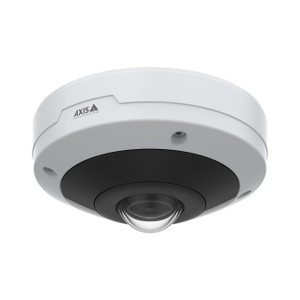
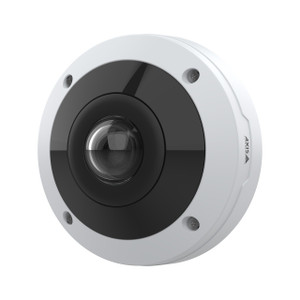
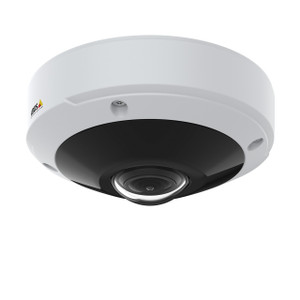
Frame Rate:
30fps
Type:
Dome
Sensor Type:
CMOS
Image Sensor Size:
1/1.8"
Features:
Lightfinder
Wide Dynamic Range:
Forensic WDR
Min illumination/ light sensitivity (Color:
0.16 lux
Min Illumination:
0.16 lux
Max Resolution:
2016x2016
Max frames per second:
50/60
Day and Night:
PoE
Focal Length:
1.56 mm
Horizontal Field of View:
183°
Vertical Field of View:
183°
Zipstream:
Yes
Video Compression:
H.264
Audio Support:
Yes
Signed Firmware:
PoE
Secure Boot:
PoE
Built-in IR:
Yes
Local Storage:
PoE
Operating Temperature:
-40 to 50 °C
Outdoor Ready:
Yes
Vandal Rating:
IK10
IP Rating:
IP66
Sustainability:
PVC free
Product Type:
Dome
Connectivity:
Wired
Power Type:
PoE
Resolution:
5MP
Night Vision:
IR
Housing Color:
White
Environment Rating:
Outdoor
Warranty:
5-year warranty
Package Contents:
Axis M3077-PLVE Camera Installation Guide Windows® decoder 1-user license Drill hole template Cable gaskets Connector guard I/O connector RESISTORX® TR20 bit Mounting bracket Cable hole lid View protector The Axis M3077-PLVE Mini-Dome IP Came
Poe Power:
PoE+ (802.3at)
Wdr:
Forensic WDR
Ir Lowlight:
OptimizedIR; 850nm; Lightfinder; Day/Night
Compression:
H.265; H.264; Zipstream
Onvif:
Yes
Audio:
Built-in mic
Mount Type:
Pendant; Corner; Rack
Camera:
ARP,SOCKS,SSH,SIP,LLDP,CDP,MQTTv3.1.1,Syslog,Link-Local
Lens:
1.56mm,F2.0 Systemintegration
Memory:
1024MBRAM,512MBFlash MQTTsubscribe
Storage:
SupportformicroSD/microSDHC/microSDXCcard
Approvals:
EMC
Nema Rating:
250Type4X,NEMATS2(2.2.7-2.2.9) Chinese,Japanese,Korean,Portuguese,Polish,TraditionalChinese
Weight:
700g(1.5lb)
Lightfinder:
Lightfinder
H.264:
Baseline, High, Main
H.265:
Yes
Signed OS:
Yes
OptimizedIR:
Yes
Minimum Illumination Color:
0.16 lux at 50 IRE, F2.0
Minimum Illumination B/W:
0.03 lux at 50 IRE, F2.0 0 lux with IR illumination on
Shutter Speed:
1/16000 s to 1 s
Model:
ARTPEC-7
Double Panorama:
2560x1920 to 384x288
Corner Right/left:
2368x1184 to 384x288
Video Streaming:
Multiple, individually configurable streams in H.264, H.265 and Motion JPEG Axis Zipstream technology in H.264 and H.265 Controllable frame rate and bandwidth VBR/ABR/MBR H.264/H.265 Low latency mode
Multi-view Streaming:
360° overview, dewarped panorama, corridor, corner left/right and quad views. Up to 4 individually cropped out and dewarped view areas. All different views can be streamed simultaneously. When streaming 4 dewarped view areas and one 360° overview in
Image Settings:
Compression, color saturation, brightness, sharpness, contrast, local contrast, white balance, day/night threshold, tone mapping, exposure control (including automatic gain control), exposure zones, Forensic WDR: up to 120 dB depending on scene, fine
Pan/Tilt/Zoom:
Digital PTZ of view areas, digital PT of panorama, corner, corridor and quad views, preset positions, guard tours
Network Protocols:
IPv4, IPv6 USGv6, ICMPv4/ICMPv6, HTTP, HTTPS a , HTTP/2, TLS b , QoS Layer 3 DiffServ, FTP, SFTP, CIFS/SMB, SMTP, mDNS (Bonjour), UPnP , SNMP v1/v2c/v3 (MIB-II), DNS/DNSv6, DDNS, NTP, NTS, RTSP, RTP, SRTP/RTSPS, TCP, UDP, IGMP, RTCP, ICMP, DHCPv4/v6,
Application Programming Interface:
Open API for software integration, including VAPIX® and AXIS Camera Application Platform; specifications at axis.com AXIS Guardian with One-Click Connection ONVIF® Profile G, ONVIF® Profile M, ONVIF® Profile S, ONVIF® Profile T specification at onvif
Onscreen Controls:
Day/night shift Wide dynamic range Video streaming indicator IR illumination
Event Conditions:
Analytics, edge storage events, virtual inputs through API, supervised external inputs, open casing, audio detection MQTT subscribe
Event Actions Notification:
email, HTTP, HTTPS, TCP and SNMP trap
Event Actions PTZ:
PTZ preset, start/stop guard tour Overlay text, external output activation, play audio clip, zoom preset, day/night mode
Built-in Installation Aids:
Pixel counter, digital roll, repositioning of quad views, digital PTZ of view areas, digital PT of panorama, corner, corridor and quad views
Applications Included:
AXIS Video Motion Detection, AXIS Motion Guard, AXIS Fence Guard, AXIS Loitering Guard, active tampering alarm, audio detection Support for AXIS Camera Application Platform enabling installation of third-party applications, see axis.com/acap
Edge Security Software:
Signed OS, brute force delay protection, digest authentication and OAuth 2.0 RFC6749 OpenID Authorization Code Flow for centralized ADFS account management, password protection, AES-XTS-Plain64 256bit SD card encryption
Edge Security Hardware:
Axis Edge Vault cybersecurity platform Secure element (CC EAL 6+), secure keystore, secure boot
Network Security:
IEEE 802.1X (EAP-TLS, PEAP-MSCHAPv2) e , IEEE 802.1AE (MACsec PSK/EAP-TLS), IEEE 802.1AR, HTTPS/HSTS f , TLS v1.2/v1.3 g , Network Time Security (NTS), X.509 Certificate PKI, host-based firewall
Documentation:
AXIS OS Hardening Guide Axis Vulnerability Management Policy Axis Security Development Model AXIS OS Software Bill of Material (SBOM) To download documents, go to axis.com/support/cybersecu- rity/resources To read more about Axis cybersecurity suppor
Casing:
IP66-, NEMA 4X- and IK10-rated Polycarbonate hard coated dome Aluminum
Connectors:
Shielded RJ45 10BASE-T/100BASE-TX PoE
IR Illumination:
OptimizedIR with with power-efficient, long-life 850 nm IR LEDs Range of reach 20 m (66 ft) or more depending on scene
Operating Conditions:
-40 °C to 50 °C (-40 °F to 122 °F)
Start-up Temperature:
-30 °C to 50 °C (-22 °F to 122 °F) Maximum temperature (intermittent): 55 °C (131 °F) Maximum temperature according to NEMA TS 2 (2.2.7): 74 °C (165 °F) Humidity 10–100% RH (condensing)
Cybersecurity:
ETSI EN 303 645
Dimensions Height:
66 mm (2.5 in) ø 149 mm (5.8 in)
Included Accessories:
Installation guide, Windows decoder 1-user license, drill hole template, cable gaskets, connector guard, I/O connector, RESISTORX® TR20 bit, mounting bracket, cable hole lid, view protector
Optional Accessories:
AXIS T94T02D Pendant kit with weathershield AXIS Surveillance Cards AXIS TM3808-E Skin Cover Black AXIS Mounts & Cabinets AXIS T6101 Audio and I/O Interface AXIS T6112 Audio and I/O Interface For more accessories, see axis.com
Video Management Systems:
Compatible with AXIS Camera Station Edge, AXIS Camera Station Pro, AXIS Camera Station 5, and video management software from Axis’ partners available at axis.com/vms .
Languages:
English, German, French, Spanish, Italian, Russian, Simplified Chinese, Japanese, Korean, Portuguese, Polish, Traditional Chinese English, German, French, Spanish, Italian, Russian, Simplified Chinese, Japanese, Korean, Portuguese, Polish, Traditiona
Sensor Resolution:
6 MP
Field of View:
180 degree or 360 degree
Microphones:
Two built-in
Shipping Weight:
2.150 lb
Country Of Origin:
TH
UNSPSC:
45121600