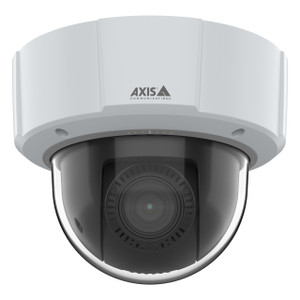
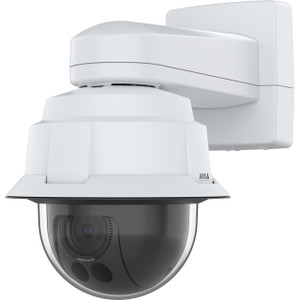
Axis 02769-021 M5526-E 4MP PTZ Camera Four Pack
The Axis 02769-021 is a four-unit PTZ deployment designed for security integrators and IT architects who need zoom coverage across multiple outdoor zones without running separate power lines. Each unit delivers 4MP (2688×1512) resolution with a 10x optical zoom lens (4.7–47mm focal length), meaning you capture detail at distance without relying on digital zoom artifacts. The continuous 360° pan and 0–90° tilt capability enables perimeter sweeps and target tracking from a single unit—eliminating blind spots in parking lots, retail perimeters, and traffic corridors.
Key Features
- 10x Optical Zoom with Autofocus Across Full Range — The 4.7–47mm lens delivers a 59.1° wide field of view for area coverage, then narrows to 6.5° telephoto for forensic-grade detail at distance. Autofocus tracks continuously as you zoom, eliminating the focusing delay that plagues cheaper PTZ cameras. 12x digital zoom extends total magnification to 120x, though optical zoom is where image quality remains forensic-grade. Real-world impact: read a license plate from 50+ meters without a second camera.
- Continuous 360° Pan and Precision Tilt — Endless pan rotation and tilt from 0–90° at pan/tilt speeds up to 150°/s allow rapid repositioning without mechanical dead zones. 100 preset positions enable scheduled tours or security protocols that repeat consistently across shifts. Deployment benefit: no gap coverage while repositioning—an operator sweeping a perimeter sees continuous motion, not mechanical pauses.
- Day/Night WDR Processing — Wide dynamic range (WDR) handles backlit scenes and mixed lighting (e.g., dawn/dusk retail entrances). Automatic IR-cut filter switches between color (daylight) and monochrome (low-light) modes. Minimum illumination reaches 0.20 lux in color and 0.01 lux in monochrome, so moderate ambient light or supplemental fixtures eliminate the need for active IR in many outdoor scenarios. Matters because active IR adds cost, draws power, and can wash out color at close range.
- IP66 Sealed Housing for Outdoor Durability — IP66 rating means dust and direct rain don't penetrate the optics or electronics. Operating temperature range of −20° to +50°C covers most North American and temperate climates. Skip this camera if you need full submersion (IP67) or arctic deployment below −40°C—those demand a different model.
- H.265 and H.264 Codec Support — H.265 (HEVC) reduces file size roughly 40–60% compared to H.264 at equivalent quality, directly cutting NVR storage costs and network bandwidth when deploying four cameras on a shared recorder. Four simultaneous streams at 4MP demand significant throughput; H.265 makes that manageable on gigabit infrastructure. H.264 fallback ensures compatibility with older VMS platforms.
- PoE+ (Class 3) Single-Cable Installation — Draws standard PoE+ power via a single RJ45 Ethernet run, eliminating the need for separate 12VDC power supplies. Real benefit: one cable per camera instead of two, simpler conduit runs, fewer points of failure. Standard PoE (802.3af) will not work—verify your switch supports PoE+ (802.3at minimum, typically 30W per port). Four cameras require four PoE+ ports; confirm your access switch has headroom.
- Built-in Microphone and MicroSD Local Storage — Two-way audio via the microphone enables remote communication or emergency announcements. MicroSD card slot (up to 512GB typical) provides edge storage backup if the NVR fails or loses connection, valuable for compliance and incident review without relying solely on central recording.
- ONVIF Profile S/T/G Compliance — Standards-based protocol integration with Milestone XProtect, Genetec, Bosch, and other third-party VMS platforms reduces vendor lock-in. Verify specific version compatibility with your NVR before deployment; ONVIF compliance is necessary but not a guarantee of flawless integration.
- Signed Firmware and Secure Boot — Firmware validation prevents unauthorized code injection. HTTPS encryption protects credential transit and stream access, meeting baseline cybersecurity requirements for enterprise deployments. No mention of TPM or advanced hardening—treat this as standard network hygiene, not hardened-appliance security.
Integration & Compatibility
The four-pack format simplifies specification and procurement for system designers deploying identical coverage across a single perimeter or facility. Each camera requires a dedicated gigabit network run and PoE+ power; four units on a single switch segment will saturate bandwidth if all streams run simultaneously at full 4MP resolution and high frame rates. Plan for NVR channel capacity and storage retention: 4MP at 30 fps with H.265 codec yields roughly 2.5–3.5 MB/sec per camera depending on scene complexity, totaling 10–14 MB/sec for the four-pack. A 4TB NVR with aggressive codec optimization retains roughly 3–5 days of 24/7 recording. Confirm your VMS supports ONVIF PTZ commands (pan, tilt, zoom, preset recall) before specifying; some platforms implement ONVIF but drop PTZ control.
When to Choose a Different Model
The 02769-021 targets mid-range zoom and outdoor perimeter use. If your deployment requires 360° panoramic coverage or multi-sensor analytics (license plate recognition, face detection), examine higher-resolution variants or multi-sensor Axis cameras in the same product family. If you need NDAA compliance or domestic supply chain certification, confirm Axis availability in your region. If your sites are below −20°C or require active cooling (above +50°C), request a thermal-rated variant.
Frequently Asked Questions
Q: Does the Axis 02769-021 require a separate PoE injector, or will a standard PoE+ switch work?
A: A standard PoE+ switch (802.3at, minimum 30W per port) will power the 02769-021 directly. No separate injector needed. Verify your switch has four available PoE+ ports and confirm the total power budget on the upstream PSU; four cameras at 30W each require 120W reserved capacity.
Q: Can the 02769-021 integrate with Milestone XProtect or Genetec?
A: Yes, via ONVIF Profile S/T/G. Both platforms support ONVIF-compliant PTZ cameras. Test preset recall, zoom, and tilt commands in your lab environment before full deployment to verify VMS-camera handshake stability.
Q: What's the actual frame rate at 4MP resolution, and does H.265 encoding impact latency?
A: The 02769-021 supports 30 fps at 4MP with both H.265 and H.264. H.265 encoding uses more CPU cycles than H.264, but on-camera encoding occurs in real-time; typical latency is 100–300 ms depending on network jitter. Verify your NVR can decode H.265 streams before specifying; older systems may require H.264 fallback.
Q: Is MicroSD recording encrypted, and how does it sync to the NVR?
A: MicroSD recordings are stored unencrypted on the card. Sync to the NVR is manual via network access; there is no automatic failover if the NVR becomes unreachable. Treat MicroSD as a backup convenience, not a failsafe for mission-critical recording.
Q: What's the minimum ambient light for usable color video?
A: 0.20 lux is the stated threshold; in practice, recognizable color video requires 0.5–1.0 lux minimum. Below 0.20 lux, the camera switches to monochrome IR-assisted mode (0.01 lux). If your site has streetlights or perimeter floods, 0.20 lux is achievable; dark parking lots may require supplemental IR or additional lighting.
Q: Does the four-pack come with mounting hardware for wall or corner installation?
A: The four-pack contains four cameras and power/network accessories. Wall mounts, corner brackets, and junction boxes are typically ordered separately or bundled with site-specific installation packages. Confirm mount hardware availability before specifying.
Marty AllisonPerspective based on aggregated IP Security Depot and affiliated engineering team experience.
The Axis 02769-021 (also searched as 02769 021) is a pragmatic choice for multi-camera perimeter deployments where optical zoom and continuous pan/tilt motion are non-negotiable. The four-pack format cuts procurement overhead, but don't let the bundled count fool you—each camera is an independent device with its own network and power requirements. The real strength here is the 10x optical zoom paired with 4MP resolution and 0.01 lux monochrome sensitivity; you get forensic detail at distance without the power and cost penalty of active IR on every camera.
Technical Highlights:
- 10x Optical Zoom (4.7–47mm Autofocus) — Covers wide area surveillance at 4.7mm (59.1° FOV) and forensic-grade telephoto at 47mm (6.5° FOV). Autofocus eliminates manual focus hunting. For parking lot or perimeter work, this zoom range eliminates the need for a second fixed-lens camera at the same location—cost savings upstream.
- H.265 Compression (40–60% file reduction vs. H.264) — Four simultaneous 4MP streams demand serious storage. H.265 cuts that bandwidth by half, so a 4TB NVR extends retention from 3 days to 6 days. Verify your NVR and VMS support H.265 decode before assuming savings; some older platforms choke on HEVC.
- PoE+ Power Delivery (802.3at, ~30W) — Four cameras require four dedicated PoE+ ports on your switch. Total power draw is ~120W reserved; confirm your access layer PSU has capacity before deployment. Don't underestimate conduit and cable runs—four cameras across a perimeter mean four independent Ethernet runs or a properly spec'd trunk with patch panel at each location.
- Continuous 360° Pan + 150°/s Speed — No mechanical dead zones. Useful for automated tours or operator-driven tracking, but keep in mind that 150°/s is fast—use software rate-limiting if you want smooth video output rather than jerky repositioning.
Deployment Considerations:
- Network Planning is Non-Optional — Four 4MP 30fps streams at H.265 average 10–14 MB/sec total throughput. If you're running these on the same VLAN as office traffic or without QoS marking, the NVR will experience lag and dropped frames during peak usage. Segment the cameras to a dedicated surveillance network or apply strict bandwidth QoS. Also: confirm your NVR can handle four simultaneous 4MP decode streams; entry-level recorders struggle here.
- PoE+ Port Exhaustion — The four-pack demands four PoE+ ports. Access layer switches often have 24–48 ports, but not all are PoE+. A 24-port PoE+ switch is not cheap. If you're deploying 02769-021 cameras alongside other infrastructure, verify switch capacity early—retroactive upgrades are costly.
- MicroSD as Convenience, Not Failsafe — The built-in MicroSD slot sounds like redundancy, but sync is manual. If your NVR dies, you access the card by physically removing it from the camera. Don't design your retention strategy around it unless you have a field tech protocol to retrieve cards daily.
- ONVIF PTZ Control Varies by VMS — Milestone and Genetec support PTZ over ONVIF, but Axis-specific features (like advanced preset scheduling or geotagging) may not translate. Test in a lab environment first. Some integrators prefer Axis Camera Station for native support; others mandate third-party VMS. Know your constraint before quoting.
Position the 02769-021 for perimeter and traffic applications where zoom detail matters and you have gigabit network infrastructure. It's not a fixed-lens economy play—it's a proper PTZ with enough resolution to forensically identify individuals at range. If you're padding a system with a few utility cameras, look at cheaper fixed-lens models instead.