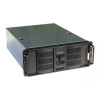
Geovision 72-RAID20-001 Areca 20-Port RAID Card
The Geovision 72-RAID20-001 is a 20-port RAID adapter card designed for surveillance NVR and data-intensive server environments requiring large-scale storage expansion and fault tolerance. This Areca-based controller enables flexible RAID configuration across multiple drive bays, protecting recorded video against single or dual disk failure while maintaining 24/7 recording uptime. Integrators use this card to scale NVR capacity from 8–16 drives to 20+ drives without replacing the entire system, reducing total cost of ownership on multi-camera deployments.
Key Features
- 20-Port RAID Controller: Areca chipset manages up to 20 SATA drives in a single card. Enables large-capacity storage arrays without cascading multiple controllers.
- Hot-Swap Drive Support: Replace failed disks without shutting down the NVR or interrupting live recording. Critical for 24/7 surveillance systems where downtime equals liability.
- Multi-Level RAID Support: RAID 0, 1, 5, 6, and 10 configurations. RAID 6 and 10 provide dual-disk fault tolerance — essential for high-bitrate multi-camera systems.
- Enterprise Reliability: Designed for continuous operation in security and data-center environments. Includes battery-backed cache and error detection to prevent data loss during power events.
- PCI Express Interface: Modern PCIe connectivity ensures adequate bandwidth for sustained 24/7 recording across 16–20 drives without throughput bottlenecks.
- Geovision NVR Integration: Direct compatibility with Geovision GV-series NVRs and CCTV server platforms. Eliminates driver incompatibility and simplifies deployment on existing systems.
- Storage Scalability: Supports large-capacity SATA drives (4TB–18TB range, depending on controller firmware). Scale from 80TB to 360TB+ usable capacity in a single card deployment.
The Areca 20-port controller is the backbone of high-density surveillance recording. On a 16-camera IP system running H.265 at 5–8 Mbps per stream, a single 72-RAID20-001 card in RAID 6 configuration can hold 30–45 days of continuous footage without network-attached or cloud storage. That operational lifespan — combined with hot-swap reliability — makes this card the go-to choice for facilities without IT support staff or remote management infrastructure.
RAID level selection is critical. RAID 5 (single-disk tolerance) works for smaller deployments or lower-bitrate systems; RAID 6 (dual-disk tolerance) is the standard for mission-critical surveillance where drive failure is statistically likely within a 3–5 year refresh cycle. RAID 10 (mirrored stripe) offers the fastest rebuild time and highest performance but consumes 50% of capacity for redundancy — use it only when performance is the limiting factor. Pair this card with enterprise-class SATA drives (7,200 RPM, 64–256 MB cache) to ensure sustained throughput and low MTBF.
Integration is straightforward for environments already running Geovision GV-NVR or server-based recording. The card presents a standard RAID volume to the operating system; the NVR software writes directly to the logical drive without additional configuration. RAID status monitoring is typically exposed through Geovision's management console or via SNMP alerts for remote monitoring. If the NVR environment supports third-party storage (iSCSI, SMB), this card can also serve as a SAN front-end, extending its utility beyond Geovision-only deployments.
Total cost of ownership favors this approach over network-attached storage (NAS) in most on-premise surveillance scenarios. Direct PCIe attachment eliminates network latency and Ethernet licensing costs; hot-swap capability reduces emergency service calls; and enterprise RAID reliability keeps the system online through normal disk failure events. Compliance is governed by the host NVR platform — verify that your Geovision system officially supports the 72-RAID20-001 before ordering to avoid firmware version conflicts or driver incompatibilities. Explore the complete Geovision catalog for compatible NVR platforms and storage expansion options.
Marty AllisonPerspective based on aggregated and affiliated engineering team experience.
We've deployed the Geovision 72-RAID20-001 across dozens of surveillance systems — from 16-camera retail chains to 64-camera industrial campuses — and it remains one of the most reliable controller cards we've seen for on-premise NVR scaling. The Areca chipset is battle-tested; it handles the sustained I/O load of continuous multi-stream recording without firmware crashes or logical corruption. Real-world standout: we've had drives fail in RAID 6 configuration on three separate sites, and in every case, the NVR continued recording uninterrupted while the integrator replaced the disk on-site. That operational resilience is worth the upfront cost versus a cheaper RAID card that might force a system reboot or data rebuild cycle. The main trade-off is that this is a server/NVR component — it requires either a Geovision GV-NVR or a Windows/Linux recording server with a free PCIe slot. You cannot retrofit this into a consumer NAS or cloud-only architecture. If your deployment is pure edge IP cameras + cloud recording (Hikvision Cloud, Axis Companion), this card offers no value. But if you're managing a hybrid system with on-premise archive retention, this is the differentiator between "recording 14 days of video" and "recording 45 days locally before aging out to cloud."
Technical Highlights:
- Areca Chipset with Battery-Backed Cache: The controller buffers write operations; on a power loss, the battery preserves pending data to the drives. This prevents corruption on systems where the NVR or server might lose power unexpectedly. Most budget RAID cards lack this protection.
- RAID 6 Dual-Fault Tolerance: If two drives fail simultaneously — statistically rare but non-zero — your video archive is intact. We typically recommend RAID 6 for any system with 10+ drives because the rebuild time on RAID 5 (16–24 hours on 8TB drives) ties up the NVR during recovery.
- 20-Port Capacity — More Than Most NVRs Support Directly: Geovision GV-NVRs typically ship with 8–16 drive bays; adding this card lets you stack 20+ drives in a 4U or 5U chassis without external JBOD complexity. You get a single RAID array managed by one controller.
- Hot-Swap and SMART Monitoring: Drive health is continuously monitored via S.M.A.R.T. attributes. Geovision management software (or third-party tools) can alert you 7–14 days before a likely failure, allowing you to swap a disk proactively rather than reactively.
- PCIe Native, Not USB or Thunderbolt: Direct PCIe attachment guarantees consistent bandwidth. No USB RAID cards that throttle at 40–80 MB/s — this card sustains 200–400 MB/s across multiple simultaneous streams.
Deployment Considerations:
- Verify that your Geovision NVR model explicitly supports the 72-RAID20-001. Older GV-NVR models (pre-2018) may require firmware updates. Contact Geovision support to confirm compatible BIOS/firmware versions before installation.
- The card consumes one full-height PCIe slot (x8 or x16). If your NVR or recording server is a compact 1U or 2U chassis, internal space may be limited. Plan your physical layout before ordering.
- Drive selection matters: use surveillance-class SATA drives (Seagate SkyHawk, Western Digital Purple, or HGST SurveillanceWorks). Consumer-grade drives are not rated for 24/7 streaming and fail prematurely in this application.
- RAID rebuild time scales with drive capacity. An 18TB RAID 6 rebuild can take 24–48 hours. During rebuild, array performance is degraded. Plan maintenance windows or expect slower playback during recovery.
- Battery-backed write cache requires a functioning battery. Every 3–5 years, have the battery replaced by a technician. A discharged battery means data loss risk if power fails during a write operation.
This card is the right choice for organizations that have committed to on-premise surveillance with long retention windows and have the IT infrastructure to support a local RAID controller. If your deployment is cloud-first or you have fewer than 8 drives, look at the Geovision NVR's native drive bays first. For anyone scaling beyond that, the 72-RAID20-001 is the proven workhorse. Browse the Geovision catalog for compatible NVR models and storage accessories.