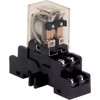
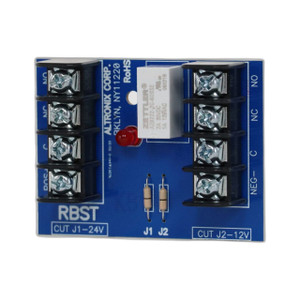
Altronix RDC24 24VDC DPDT Relay Base Module
The Altronix RDC24 is a DIN rail-mounted relay module designed to handle 24VDC control signals and switch higher-voltage loads in security infrastructure. This is a straightforward switching tool: it takes a low-voltage logic signal and uses it to control 220VAC or 28VDC circuits at up to 10A per contact. In practice, that means you can trigger door strikes, lock solenoids, alarm relays, or distributed power switching from a low-voltage control backbone without mixing signal and power wiring in your control panel.
Key Features
- DPDT (Double-Pole, Double-Throw) relay configuration: One relay gives you two independent switching circuits per module — each can be wired as normally open, normally closed, or changeover depending on your logic. Useful when you need one control signal to manage multiple outputs (e.g., a single access event triggering both a strike and an auxiliary relay).
- 10A maximum current rating: Handles the load envelope for most door strikes, solenoid locks, and signaling circuits. Door strike coils typically draw 0.5–2A, so you won't hit the ceiling on typical access control gear. Plan for inrush current if switching inductive loads; consider derating if you're running continuous duty above 7A.
- Supports both 220VAC and 28VDC output switching: Gives you flexibility in what you switch — you're not locked into AC or DC. Useful in mixed-voltage infrastructure (some older alarm panels use 24VDC aux outputs, some systems use 220VAC signaling). Check your coil voltage against the RDC24 rating before wiring.
- 24VDC input voltage: Matches standard security system power supplies and PLC outputs. If your control logic is coming from a 12VDC source, you'll need a relay or driver stage first — the RDC24 expects the full 24V to energize reliably.
- DIN rail mounting: Snaps onto standard 35mm DIN rail for compact enclosure integration. Takes minimal panel space — good for retrofit work or cramped electrical cabinets. Avoid stacking too many modules in a confined space without ventilation if you're switching high-current loads; heat dissipation is passive.
- UL-recognized construction: Meets UL standards for electrical safety in certified installations. Simplifies code compliance and insurance validation. Verify with your AHJ that UL recognition is sufficient for your jurisdiction's fire/life-safety requirements — some jurisdictions require full UL listing, not just component recognition.
Integration & Compatibility
The RDC24 is a passive relay — it integrates with any 24VDC control signal source: access control panels, PLCs, microcontrollers, or low-voltage logic circuits. No programming, no communication protocol. Wire 24VDC logic in, wire your load out. It's entirely agnostic to system architecture. Works in power infrastructure deployments where you need isolation between control and power planes. Pair this with 24VDC power supplies for a complete distributed switching setup.
When to Choose a Different Model
If you need higher current capacity (above 10A per contact), consider stepping up to a heavier-duty industrial relay or a contactors in the Altronix ecosystem. If you need multiple independent relay channels, module stackability or a larger relay bank may be more efficient than daisy-chaining individual RDC24 units. If your control signal is variable voltage or low-current logic from a microcontroller, you may need a driver transistor or opto-isolator stage before the RDC24 coil — this module expects clean 24VDC input.
Frequently Asked Questions
Q: Can the RDC24 switch AC and DC simultaneously on the same relay?
A: No. Each contact pair is rated for either 220VAC or 28VDC — not both at the same time on the same pair. You have two relay circuits; wire one for AC and one for DC if you need both.
Q: What's the hold-in voltage for the 24VDC coil?
A: The source evidence does not specify dropout voltage. Before deploying in a system with marginal 24VDC supply (e.g., end of a long power run), confirm coil voltage drop under load with the manufacturer or test on your actual power rail.
Q: Is the RDC24 suitable for emergency egress strike control?
A: Yes, provided your control logic and interlocking logic are certified for life-safety. The RDC24 itself is UL-recognized, but the overall door control system must meet your AHJ's egress and release requirements. Do not assume the module alone is sufficient.
Q: Can I parallel multiple RDC24 relays to increase current capacity?
A: Not recommended without external load-balancing. Contact closure delay between relays will cause uneven current distribution, potentially overloading one contact. Use a single larger relay or contactor instead.
Q: What's the expected relay contact lifespan?
A: The source documentation does not specify contact cycle life. Electromagnetic relays typically handle 100,000–1,000,000 cycles depending on load current and duty cycle. For high-frequency switching (>10 cycles/minute), consult the manufacturer for longevity data.
Q: Does the RDC24 include suppression diodes or snubbers for inductive loads?
A: The source evidence does not specify onboard suppression. When switching solenoids or large inductive loads, add external freewheeling diodes (DC side) or varistors (AC side) at the load to protect contacts from inductive spikes.
Ted PerryPerspective based on aggregated IP Security Depot and affiliated engineering team experience.
The Altronix RDC24 is a workhorse for anyone building modular security infrastructure on 24VDC rails. Its DPDT configuration and 10A current rating position it squarely in the mid-range for access control and alarm auxiliary switching — not overkill for simple door strikes, not undersized for heavier solenoid loads. The real win is the dual-output flexibility: one control signal, two independent switching circuits.
Technical Highlights:
- DPDT relay with 10A per contact: Two separate relay circuits give you true flexibility — one contact can go to a strike, the other to an alarm relay or auxiliary light, all from a single 24VDC logic signal. The 10A rating handles door strike coils (typically 0.5–2A) with headroom, though you'll want to derate above 7A continuous duty.
- 220VAC and 28VDC output compatibility: Rare to find this flexibility in a simple relay base. Lets you control both legacy 220VAC signaling circuits and modern 28VDC aux outputs without separate modules — one RDC24 can bridge different voltage domains in the same infrastructure.
- DIN rail form factor: Compact mounting saves panel real estate and simplifies retrofit work. Stack multiple modules for distributed switching without sprawling over half the enclosure. Key constraint: passive cooling only — don't jam 6 RDC24s into a sealed cabinet and run them at full 10A each.
Deployment Considerations:
- Coil dropout voltage is not specified in the evidence. If your 24VDC supply is marginal or long-run (over 100 feet), measure actual voltage at the module under full load before commissioning. A voltage drop below the relay's minimum hold voltage will cause chatter and unreliable switching.
- No integrated suppression for inductive loads. When switching door strike solenoids or large motor loads, budget for external freewheeling diodes (DC) or varistors (AC) at the load. Inductive kickback can pit relay contacts and shorten lifespan if unprotected.
- UL recognition (not full listing) is valid for most jurisdictions, but verify with your AHJ if this is a life-safety application or fire-alarm auxiliary. Some codes require full UL listing of the complete assembly, not just the component.
Best fit: distributed access control cabinets where you're already standardized on 24VDC logic, need simple relay switching without programmable logic overhead, and can manage your own inductive load protection. Less suitable for high-frequency switching (>10 cycles/minute) without contact replacement planning, or for single-channel high-current applications where a larger contactor makes more sense.