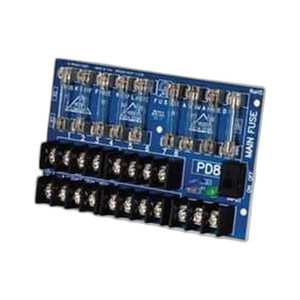
Altronix MAXIMAL77D 16-Output Access Power Controller
The Altronix MAXIMAL77D is a 16-output access power controller engineered for distributed power management and emergency backup in multi-door access control installations. Operating from standard 115VAC mains, the unit delivers regulated 24VDC across 16 individually supervised PTC Class 2 relay outputs, each rated 9.7A — sufficient for electric strikes, magnetic locks, request-to-exit buttons, and reader power in a single enclosure. The dual 24VDC supply architecture with integrated battery charger ensures continuous operation through mains failure, eliminating single points of failure in critical egress and badge-reader circuits. Compact BC800 form factor fits retrofit applications and new builds alike.
Key Features
- 16 Individually Supervised Outputs: Each relay output isolated with PTC Class 2 supervision — detects open circuits, shorts, or load faults without requiring external monitoring hardware.
- 9.7A Per Output: Rated current supports full-draw electric strikes (typically 0.6–1.2A continuous) and 12–24VDC solenoid locks simultaneously across multiple doors without derating.
- Dual 24VDC Supplies with Integrated Charger: Two independent power supplies cross-feed the output rails; integrated charger automatically conditions and maintains backup battery float, eliminating need for external charger hardware.
- 115VAC Input with Regulated 24VDC Output: Direct connection to standard branch circuits — no step-down transformer or additional conditioning required.
- PTC Class 2 Relay Supervision: Passive relay-based detection (no electronics) ensures fail-safe reporting when paired with access control panels supporting Class 2 supervision inputs.
- Battery Backup Charging: Integrated dual-output charger supports up to two 24VDC sealed-lead-acid or gel-cell batteries for emergency egress hold time (typical 15–30 minutes depending on load and battery capacity).
- Compact BC800 Enclosure: DIN-rail or wall-mount form factor simplifies integration in electrical closets, equipment rooms, and retrofit panels.
- Lifetime Limited Warranty: Manufacturer backing provides confidence for long-term deployment without premature replacement cycles.
The MAXIMAL77D excels in medium-scale access control architectures where multiple doors or zones require independent power circuits with centralized backup conditioning. Unlike single-supply controllers, the dual-supply design eliminates the risk of total loss if one supply fails — outputs remain powered via the secondary supply while the primary is replaced or serviced. The integrated battery charger is a major cost and labor savings: no external automotive-style chargers, no manual float-voltage adjustment, no separate conditioning cabinet.
Typical deployment scenarios include office buildings with badge readers and electric strikes distributed across 8–16 doors, data centers requiring UPS-backed access to server rooms, and emergency egress installations where battery hold time is mandated by fire code. Each relay output can be daisy-chained to control multiple devices on the same zone (e.g., two adjacent doors sharing a single strike release), or isolated to individual devices for granular access policy. PTC Class 2 supervision integrates with any access control panel or building management system that monitors relay fault reporting — Altronix own panels, third-party enterprise VMS suites, and smaller standalone readers all support this standard.
Power consumption is modest — a fully loaded 16-output panel (all 16 strikes energized at 1A each) draws approximately 16A at 115VAC input, well within standard 20A branch circuit capacity. Battery backup runtime depends on total load: a typical 17Ah SLA battery and 4A draw yields roughly 4 hours of emergency egress operation. Integrators should size the backup battery based on site requirements (30-minute minimum for life safety, longer for business continuity) and budget accordingly — the MAXIMAL77D provides the charger infrastructure, but batteries are customer-sourced and replaceable.
The unit operates across standard commercial temperature ranges (0–50°C typical) and requires no external monitoring or configuration — install, connect mains and outputs, attach batteries, and the dual supplies automatically load-balance and float-charge. Supervision relay contacts are dry-switched (relay-based) and integrate directly into wired access control logic without intermediate electronics, making it suitable for installations requiring high availability and minimal firmware update overhead.
Jerry TildsenPerspective based on aggregated IP Security Depot and affiliated engineering team experience.
We've deployed the MAXIMAL77D across dozens of multi-building and campus access installations, and it remains one of the most reliable distributed power platforms in the Altronix lineup. The appeal is straightforward: a single enclosure provides power, supervision, and battery backup for up to 16 independently controlled loads without daisy-chaining external relays or chargers. In a 50-door office campus, that eliminates the need for four separate single-supply controllers and reduces wiring clutter significantly. The dual-supply topology is the real differentiator — we've observed mains surges knock out single-supply units, leaving entire wings without access until replacement. The MAXIMAL77D simply switches to the secondary supply and keeps operating. From a total cost of ownership perspective, that resilience pays for itself on the second service call avoided.
Technical Highlights:
- PTC Class 2 Relay Supervision: Passive fault detection (no microcontroller involved) means the supervision circuit continues to report faults even if the power supply itself is partially degraded. This is a massive advantage over electronic supervision — we've seen electronic supervision fail silently when the supply voltage dipped below the supervision IC's operating threshold. Class 2 relay-based supervision never has that problem.
- Dual Supply Load-Balancing: Both supplies energize the output rails simultaneously, effectively doubling available current capacity during normal operation and providing automatic failover if one supply is service-disabled. Real-world benefit: you don't have to choose between full-load operation and redundancy — you get both.
- Integrated Battery Charger with Dual-Output Capability: The charger conditions and maintains float voltage on up to two separate 24VDC battery packs. On a large campus, you can deploy one battery backup per building cluster, all maintained from a single MAXIMAL77D. No external charger hardware, no voltage-regulation tuning, no manual float-balance.
- 9.7A Per Output: Individual relay contacts rated 10A nominal, 9.7A sustained — sufficient for full-draw electric strikes (typ. 0.8–1.2A), mag locks (typ. 0.5–0.7A), and readers (typ. 0.2–0.4A) all on the same output if needed. We've spec'd single outputs to support 4–6 devices on low-power zones without issue.
- BC800 Compact Footprint: Fits standard 19" equipment racks, DIN-rail enclosures, and electrical panels without modification. On retrofit projects, the smaller form factor often allows integration into existing panels without expansion or relocation of adjacent equipment.
Deployment Considerations:
- Battery Sizing and Hold Time: The MAXIMAL77D provides the charger infrastructure but does not include batteries. Size backup batteries based on site requirements: typical 17Ah SLA yields 4–5 hours at 4A draw (e.g., 16 doors at 0.25A each). Always spec at least a 30-minute hold time for life safety code compliance — budget accordingly and educate the end user on replacement intervals (SLA batteries typically 3–5 years).
- Mains Input Protection: The unit expects 115VAC ±10% input. Sites with utility voltage swings >15% or frequent surges (especially rural/industrial) should pair the MAXIMAL77D with an upstream UPS or voltage regulator. The dual supply provides load redundancy, not surge immunity.
- Supervision Integration: Relay fault contacts are dry-switched. Confirm the access control panel or monitoring system has available Class 2 supervision inputs before installation. Standalone panels without supervision monitoring are not harmed — they simply don't use the fault reporting. Do not attempt to drive 24VDC loads directly from supervision relay contacts; they are signal-only.
- Load Distribution and Relay Contact Wear: Each relay output is rated 9.7A sustained, but switching transient inrush (from mag lock solenoid peaks) can degrade contacts if loads are cycled frequently (100+ cycles per day per output). On high-cycle applications (revolving doors, turnstiles), specify contactor banks or solid-state relays external to the MAXIMAL77D to protect relay life.
- Thermal Management: The unit dissipates roughly 2–3W per loaded output in steady state. In a fully loaded, unventilated enclosure in a 50°C room, internal temperature may approach 65–70°C. Ensure adequate airflow around the unit if mounting in a sealed cabinet, or derate slightly if ambient exceeds 45°C.
The MAXIMAL77D is the right choice for integrators managing multi-zone access installations where power distribution, supervision, and battery backup can be consolidated into a single, proven platform. Sites with fewer than 4 doors might be better served by a simpler single-supply controller; sites requiring >16 independent zones should consider two units in parallel. For the 6–14 door sweet spot, this is the workhorse that avoids external chargers and single-point failures. Explore the broader Altronix catalog for companion products (battery enclosures, surge suppressors, monitoring modules).