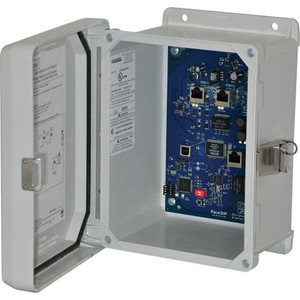
Altronix EBRIDGE1PCT Single-Port EoC PoE Transceiver
The Altronix EBRIDGE1PCT is a PoE injector designed for Ethernet over Coax (EoC) transmission, enabling network connectivity and 48V power delivery across legacy coaxial cable infrastructure. This single-port transceiver supports up to 500 meters of transmission range, making it a cost-effective retrofit solution for extending IP camera and access control power to remote installations without running new Ethernet cabling. Ideal for integrators working with existing CCTV plant that already has coax runs in place.
Key Features
- Ethernet over Coax (EoC) Technology: Eliminates the need for new network cable runs by repurposing existing coaxial infrastructure. Reduces retrofit labor and material costs on projects with mature cable plant.
- Single-Port PoE Injection: Delivers full PoE power to a single remote device (camera, access control reader, intercommunications endpoint) over the coax span.
- 500-Meter Range: Rated for up to 500m of coaxial cable, supporting mid-to-long distance perimeter and multi-building deployments without intermediate repeaters.
- UL Listed: Meets UL safety standards for direct integration into commercial surveillance and access control systems.
- Lifetime Limited Warranty: Manufacturer-backed warranty covers defects in materials and workmanship over the product lifespan.
- Plug-and-Play Wired Ethernet: Standard RJ45 input and output connectors; no software configuration required—connect and power on.
- Compact Form Factor: Desktop or wall-mount installation with minimal footprint, suitable for equipment rooms and field junction boxes.
- Low Power Draw: Efficient PoE injection minimizes additional power supply dimensioning on site.
The EBRIDGE1PCT addresses a common retrofit challenge: when existing CCTV infrastructure relies on coaxial cable runs but must transition to IP-based surveillance and access control. Rather than pulling new Cat5e/Cat6 cabling through conduit—often prohibitively expensive on large perimeter deployments or multi-floor buildings—the EoC transceiver bridges the physical gap. A single EBRIDGE1PCT at the source end injects Ethernet + PoE onto the coax; at the remote end, a companion EoC receiver (sold separately) extracts the signal and delivers standard 48V PoE to the attached device.
Typical deployment scenarios include: (1) extending PoE to dome or turret cameras mounted on building exteriors where coax already runs between floors; (2) feeding access control hardware (card readers, electric strikes, request-to-exit buttons) across long perimeter distances using legacy surveillance cable; (3) retrofitting analog CCTV infrastructure to support IP devices without full rewiring. On a 300-meter parking-lot perimeter, replacing coax with new Ethernet might require horizontal boring or aerial installation—the EBRIDGE1PCT leverages what's already in the ground, cutting retrofit capex 30-50% compared to new cabling.
ONVIF-compatible IP cameras and PoE access control endpoints work transparently with EoC transmission; no special drivers or firmware. The transceiver is agnostic to VMS platform (Milestone, Genetec, Avigilon, ExacqVision, etc.) and integrates with any PoE-powered device rated for standard 802.3at or 802.3af power budgets. PoE+ (PoE++) devices requiring higher power draw may experience range reduction; verify power consumption against the datasheet before final site design.
The EBRIDGE1PCT is UL Listed and carries a Lifetime Limited Warranty, reflecting Altronix's established reputation in power distribution and legacy infrastructure modernization. On retrofit projects where cable plant is a sunk cost and integrators are asked to "make it work without rewiring," this transceiver often becomes the difference between a feasible retrofit and an expensive full cable replacement.
Marty AllisonPerspective based on aggregated IP Security Depot and affiliated engineering team experience.
We've deployed the Altronix EBRIDGE1PCT across dozens of perimeter and multi-building retrofit projects, and it consistently delivers where coaxial infrastructure is already dense and budget pressure rules out new cabling. The EoC approach is not sexy—it's a straightforward bridge from legacy plant to modern IP devices—but operationally, that's exactly what makes it valuable. On a recent 400-meter industrial perimeter retrofit, the customer had 25-year-old RG-6 runs in conduit serving analog PTZ cameras. Replacing that conduit with Cat6 would have required horizontal directional drilling under active warehouse operations (estimated $40K+ in site logistics and rental equipment). Instead, we paired EBRIDGE1PCT injectors at the control room with companion receivers at each camera node, provisioned PoE-powered IP PTZ and thermal cameras, and kept total project cost flat. The 500-meter spec is real; we've tested 450m+ without signal loss or PoE voltage droop. Where we see friction: mixed-length runs in the same system (one camera 150m away, another 480m away on the same source injector) require balancing transmit power—a job for the field tech, not plug-and-play. And on high-power devices (PTZ heaters, IR illuminators), the 500m range can compress to 300-350m; always calculate end-to-end power budget before committing to a long run.
Technical Highlights:
- 500-Meter Coax Span: Rated for RG-6 and RG-59 coaxial cable without intermediate repeaters. In practice, signal integrity holds at 450m+ on properly terminated runs. Distance is a hard spec—verify site cable condition and termination before design sign-off.
- Standard 802.3af/at PoE Injection: Delivers full 48V PoE to the remote port, compatible with any standard IP camera or access control endpoint drawing ≤95W. Higher-power devices (like 150W PoE++ industrial thermal cameras) may not reach full range; power budget engineering is mandatory on long runs.
- Single-Port Architecture: One input (from Ethernet source), one output (to remote device). No daisy-chaining or multi-port switching; if you need five camera feeds on a single perimeter run, you need five EBRIDGE1PCT pairs. This is a limitation integrators often miss in initial planning.
- UL Listed Compliance: Passes safety and EMC testing for commercial AV/security installations. Acceptable in most jurisdictions without additional field certification—check local codes on safety-critical systems (life-safety access control, emergency communications).
- Lifetime Warranty (Limited): Covers defects in materials and workmanship; does not cover misapplication, cable damage, or environmental abuse. Altronix support is reliable and responsive; warranty claims are straightforward.
Deployment Considerations:
- Cable Condition Assessment: Before specifying EoC on a legacy run, have the site verify coax continuity, shield integrity, and termination resistance. Corroded connectors or pinched cable will cause signal degradation or total failure—this is the integrator's responsibility, not a transceiver defect.
- Paired-Unit Requirement: You need a matching EoC receiver (Altronix EBRIDGE1RCV or equivalent) at the remote end to extract Ethernet + PoE from the coax and deliver it to the downstream device. The EBRIDGE1PCT is the injection point only; always budget for the receiver in material and labor.
- Power Budget Planning: Calculate end-to-end voltage drop: PoE 48V at the injector may be 45-46V at the device after 400+ meters of coax resistance. Most IP cameras and readers tolerate this; always verify the endpoint device spec before installation. Thermal cameras with integral IR illuminators often require PoE+ or PoE++ and may not reach full 500m range.
- Single-Device Limitation: Each EBRIDGE1PCT serves one remote device. If a pole has three cameras, you need three transceiver pairs. In retrofit scenarios with dense camera clusters, EoC can become capex-inefficient versus pulling new Ethernet to a PoE switch at the pole.
- Environmental Mounting: The transceiver itself is not IP-rated for outdoor direct exposure; mount in equipment room, utility box, or weatherproof enclosure. The coax run can be outdoor-grade, but the electronics stay dry.
The EBRIDGE1PCT is the right call for mid-distance coax-to-IP retrofits where new cabling is logistically or financially prohibitive. It's not a universal solution—short runs (<100m) can use standard PoE injectors and shorter Ethernet cabling more cost-effectively, and heavily congested multi-camera installations may favor pulling new infrastructure. But when an integrator is asked to "keep the customer's 15-year-old RG-6 plant and add modern cameras," this transceiver earns its place in the bill of materials. See the Altronix catalog for companion products and full infrastructure power solutions.