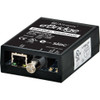
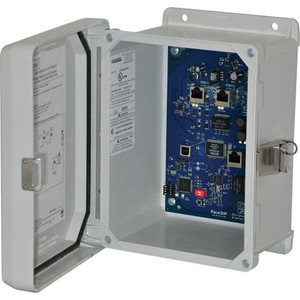
Altronix EBRIDGE1PCTX EoC Transceiver 25Mbps Coax Extension
The Altronix EBRIDGE1PCTX is an Ethernet-over-coax (EoC) transceiver designed to extend PoE and IP network signals over existing coaxial cable infrastructure up to 500 meters. PoE+ powered operation eliminates the need for separate AC supply at the remote end, making it ideal for retrofit installations where pulling new Ethernet cabling through walls or conduit is cost-prohibitive or architecturally impractical. This single-output transceiver bridges legacy coax runs and modern IP cameras, access controllers, and networked edge devices in a compact, UL Listed package.
Key Features
- 25 Mbps EoC Data Rate: Sufficient throughput for single or dual 1080p IP cameras or multiple access-control devices over coax. Coaxial backbone avoids the capex and labor of new Ethernet pulls in retrofit buildings.
- PoE+ Powered (802.3at): Draws power from a PoE+ switch or midspan injector—no AC outlet required at the remote camera or device location. Simplifies power distribution in outdoor or difficult-to-access installations.
- 500-Meter Maximum Range: Extends beyond standard PoE run limits (~100m on Ethernet); typical coax runs in commercial buildings support the full 500m reach without signal conditioning.
- Single Ethernet Output: One RJ45 port delivers PoE+ and IP traffic to a camera, access controller, or switch port. Clean 1:1 transceiver topology avoids the complexity of multi-port hubs.
- UL Listed Certification: Meets North American safety and performance standards for commercial security system integration.
- Lifetime Limited Warranty: Altronix-backed product longevity support.
The EBRIDGE1PCTX solves a specific retrofit challenge: many commercial buildings, especially older installations, have extensive buried or in-wall coaxial cable runs from legacy analog CCTV or cable TV distribution. Rather than excavate or re-cable entire buildings to reach IP cameras, an EoC pair (transmitter at the switch, transceiver at the remote end) repurposes that existing infrastructure. At 25 Mbps, the bandwidth is not suitable for 4K or high-motion applications, but for single-camera or low-bandwidth edge compute deployments, it delivers substantial capex and installation-time savings.
Integration is straightforward: connect the transmitter unit to a PoE+ port on an Altronix or third-party managed switch, run the coaxial cable to the remote location, and terminate the transceiver. The output Ethernet port carries both PoE+ power and IP data; no separate injector is needed if your NVR or VMS already supplies PoE+. Standard ONVIF-compliant cameras and controllers see the transceiver as transparent—no drivers or special configuration required. The single-output design means one camera or edge device per transceiver pair; larger deployments require multiple transceiver pairs distributed along the coax backbone.
Total cost of ownership favors EoC in retrofit scenarios: measuring the cost of excavation, conduit installation, or interior wall cutting against a pair of transceivers (one at HQ, one remote) and coax termination labor, the breakeven point is typically 3–4 cameras on a single run. For buildings with hundreds of meters of existing coax, the savings compound across dozens of endpoints. Maintenance is minimal—no power supplies to fail at the camera end, and coax itself is passive and long-lived.
Altronix transceivers are designed for commercial security integrations where legacy infrastructure is an asset, not a liability. The EBRIDGE1PCTX pairs well with Altronix PoE switches, power distribution units, and managed infrastructure in video surveillance and access-control deployments. UL listing ensures compliance with building codes and insurance requirements. For integrators managing buildings with extensive coax backbone, this transceiver eliminates the false choice between cabling capex and modern networked security devices. See the Altronix catalog for matching transmitter modules and switch infrastructure.
Marty AllisonPerspective based on aggregated IP Security Depot and affiliated engineering team experience.
We've deployed Ethernet-over-coax systems in a handful of retrofit scenarios, and the EBRIDGE1PCTX occupies a real (if narrow) niche. The core value proposition is simple: you have 500 meters of coaxial cable already buried in a building—often legacy analog CCTV backbone that's been abandoned but never removed. Rather than spend $40,000+ on excavation and new Ethernet trenching to place an IP camera at a remote gate or barn, a pair of EoC transceivers costs a fraction of that and reuses what's already there. That said, it's not a universal solution. The 25 Mbps limit is the constraint; it's enough for a single 1080p H.265 stream or two compressed 720p feeds, but anything broader (multi-camera per endpoint, 4K, or high-bandwidth edge analytics) requires native Ethernet. We've also seen integrators overestimate coax reliability in harsh outdoor runs—if the cable is 20+ years old and exposed to UV or rodent chew, signal quality degrades fast. Inspect the run before speccing transceivers.
Technical Highlights:
- PoE+ Powered (802.3at): No local power supply at the remote end. The transceiver extracts power from the PoE+ signal and re-injects it on the output Ethernet port—real advantage in camera mounts, utility poles, or attics where running AC is forbidden by code or impractical. Draw is modest enough that standard PoE+ switches handle multiple transceiver pairs without oversubscription.
- 25 Mbps Over 500m Coax: The throughput-to-distance ratio is engineered for legacy RG-6 or RG-59 cable runs. Older, thinner coax or heavily corroded connectors will degrade range; 500m assumes Grade-A cable condition and properly terminated BNC connectors. Budget for signal testing before final installation.
- Single Output (1:1 Topology): Unlike some EoC products that support multiple outputs or daisy-chaining, this is one camera or device per transceiver pair. Simplifies troubleshooting and avoids contention, but scales linearly with camera count—not ideal for large multi-camera pole deployments.
- ONVIF Transparent Pass-Through: The transceiver does not modify or inspect IP frames. ONVIF-compliant cameras, controllers, and NVRs communicate as if directly Ethernet-connected. No driver installation, no proprietary management dashboard—plug and forget.
- UL Listed, Lifetime Warranty: Commercial-grade approval and backing. Altronix stands behind the hardware; failures in field are rare but covered under warranty.
Deployment Considerations:
- Coax cable condition is critical—visually inspect the run for corrosion, UV damage, or rodent evidence before ordering transceivers. A compromised 20-year-old cable may only reach 200–300m before signal loss exceeds acceptable levels. Have a line tester on-site to validate before final payment.
- PoE+ injection point must be downstream of the transmitter unit. If your NVR does not supply PoE+, you'll need a separate midspan injector (often sold with Altronix transmitter kits). Verify power budget: PoE+ provides up to 30W; if the remote camera and any edge controller draw more than ~20W combined, you'll need additional local power.
- BNC termination at both ends must be clean and hand-tight. Loose or corroded connectors introduce reflections that drop throughput. Educate the installation crew on proper BNC technique—crimped connectors are preferable to screw-on.
- This is not a bandwidth extender for multi-camera or 4K workflows. If the building has more than 2–3 cameras per remote location, evaluate native Ethernet infrastructure instead. The EoC approach shines only when camera count is low and coax already exists.
- Redundancy and failover are not supported in a single transceiver pair—it's a point-to-point link. If the coax run is the single point of failure, plan accordingly (dual runs, fiber backup, or hybrid Ethernet + EoC topology).
The EBRIDGE1PCTX is right for integrators managing older commercial or industrial buildings where renovation budgets are tight and coax infrastructure is already in place. It's not a shiny feature play—it's a pragmatic cost-control measure for retrofit camera deployments. Choose it when excavation, re-cabling, or conduit running is not feasible and camera count per endpoint is low. Explore the Altronix catalog for matching transmitter units and power infrastructure.