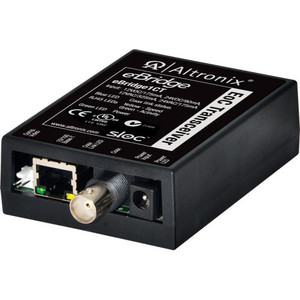
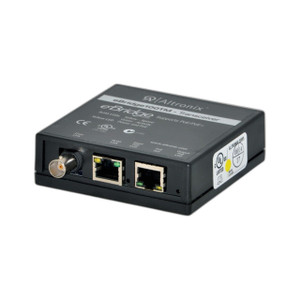
Altronix EBRIDGE100ST 100Mbps Ethernet Extender over Coaxial Cable
The Altronix EBRIDGE100ST is a single-channel Ethernet-over-coax transceiver that solves a recurring problem: you have coaxial cable runs already in place (often from legacy analog camera or RF distribution), but you need to move IP data across them. The EBRIDGE100ST converts Ethernet to a signal that rides on standard coax up to 300 meters, then converts back to Ethernet on the far end — no new cable pulls required. Data rate: 100Mbps, sufficient for multiple cameras or sensors per run, depending on codec and frame rate.
Key Features
- 100Mbps Ethernet over coax: Achieves full 100Mbps throughput on existing coaxial infrastructure, eliminating the need for expensive fiber or CAT6 trenching in retrofit scenarios. Real benefit: cut months off a facility expansion where conduit runs are full or campus distances demand impractical cable budgets.
- Single-channel transceiver design: One Ethernet port pair per unit (transmit and receive on the same coax run). Simplifies provisioning — you're not managing multiple simultaneous streams on a single device, reducing complexity in smaller deployments.
- Up to 300-meter transmission range: Covers most warehouse floors, campus buildings, and multi-story facilities without intermediate amplification. At 300m, signal degradation is within spec — measure your actual run length first to confirm adequate margin.
- PoE and PoE+ pass-through: Power flowing through the Ethernet port on the source side passes through the EBRIDGE100ST unchanged, reaching the far-end device (camera, access point, etc.) without a separate power supply at the transceiver. Draws power from the same PoE source. Verify your PoE switch has sufficient budget for both the EBRIDGE100ST and the downstream device.
- Compact rack-mountable form factor: Small footprint suitable for hub or telecom room installation. Occupies minimal shelf space and integrates into standard 19-inch rack rails if needed.
- UL Listed for safety compliance: Meets UL electrical safety standards, required for many enterprise and industrial facility certifications. Mandatory for areas subject to code inspection.
Typical Deployment Scenarios
The EBRIDGE100ST excels in three situations: (1) Legacy coax modernization — you're upgrading analog camera infrastructure to IP but the coax plant is sound and runs are already stubbed to camera locations; (2) Long-distance sensor or camera networks — a warehouse, parking structure, or campus perimeter where new cabling is prohibitively expensive and coax already exists; (3) Facility expansion without infrastructure changes — adding IP surveillance or IoT to a building where internal coax distribution is in place. Each transceiver pair (one at source, one at load) supports one Ethernet circuit, so multi-camera deployments require multiple EBRIDGE100ST units.
Integration & Compatibility
The EBRIDGE100ST is passive from an Ethernet perspective — it does not require DHCP, does not enforce MAC address filtering, and does not need firmware updates. Any standard Ethernet device (IP camera, network switch, access control reader, access point) connected to the far-end port will behave as though it is directly cabled to the source. Coaxial connectors are standard F-type (RG-59, RG-6, or RG-11); verify your existing runs use compatible impedance. If in doubt, run a test pair before committing to a full installation.
Warranty & Support
Backed by Altronix's Lifetime Limited Warranty, covering defects in materials and workmanship. As with all Altronix power and infrastructure products, support is available through specialty retailer and integrators familiar with the Altronix surveillance line.
Frequently Asked Questions
Q: Will the EBRIDGE100ST work with any coaxial cable already in my facility?
A: Yes, as long as the cable is standard RG-59, RG-6, or RG-11 coax. Higher-impedance or heavily damaged runs may cause signal loss or intermittent connectivity. If you're uncertain about cable condition, test a short run first before deploying across the entire system.
Q: How much bandwidth does a single EBRIDGE100ST consume for its own operation?
A: The device is transparent to Ethernet traffic — it passes all 100Mbps available to the connected device (camera, switch, etc.). There is no bandwidth overhead or heartbeat traffic that consumes link capacity.
Q: Can I daisy-chain multiple EBRIDGE100ST units to extend distance beyond 300m?
A: No. Each pair must be deployed on its own coax run. Stacking units in series will degrade or fail signal transmission. Plan your coax routes to keep any single run under 300 meters.
Q: Does the EBRIDGE100ST require manual configuration or setup?
A: No. It is a passive device with no IP address, web interface, or configuration menu. Connect Ethernet on one side and coax on both ends, and it operates immediately. Power via PoE from the source.
Q: What happens if I exceed the 300-meter range on my coax run?
A: Signal attenuation increases, causing packet loss, intermittent connectivity, or complete link failure. Always measure your installed coax run and verify it is within 300 meters before deployment. If your run is longer, consider a fiber extender or new CAT6 infrastructure instead.
Q: Is the EBRIDGE100ST suitable for high-vibration or outdoor environments?
A: The EBRIDGE100ST is designed for indoor rack or shelf mounting. It is not rated for outdoor weathering (no IP67, no wide operating temperature range specified). Deploy it in a climate-controlled equipment room and run the coax to outdoor cameras or sensors instead.
Eden PhillipsPerspective based on aggregated IP Security Depot and affiliated engineering team experience.
The Altronix EBRIDGE100ST is a niche but valuable tool for integrators dealing with existing coax infrastructure and IP modernization mandates. The 100Mbps throughput and 300-meter range mean you can often avoid costly infrastructure replacement projects — a significant advantage when budgets are tight or conduit is already congested.
Technical Highlights:
- 100Mbps per channel: Sufficient for 1–2 concurrent 5MP streams at 15–20 fps, or 4–6 lower-resolution (1–2MP) camera feeds per coax run. Verify bitrate expectations with your camera vendor before committing unit count.
- 300-meter maximum range: Covers most indoor facility distances without amplification, but signal loss is cumulative — every 100 meters adds attenuation. Measure actual coax run length and factor in cable age and condition into margin calculations.
- PoE+ pass-through: Eliminates the need for a separate 12VDC or 24VAC supply at the remote end, as long as your PoE source has sufficient budget. Most modern PoE switches allocate 30W per port, which covers both the EBRIDGE100ST and a typical IP camera with IR illumination.
Deployment Considerations:
- One circuit per pair: Multi-camera installations require multiple EBRIDGE100ST units and separate coax runs. Factor this into cost comparisons against fiber or CAT6 alternatives.
- Cable condition is critical: Kinked, corroded, or water-damaged coax will degrade signal quality silently. Request cable health certification (TDR or visual inspection) from the facility before installation. A failed coax run is harder to diagnose and replace than a new CAT6 pull.
- No onboard intelligence: The EBRIDGE100ST is purely a transport layer device — no VLAN tagging, no QoS, no encryption. If you need traffic segmentation or security on the extended circuit, implement it upstream at the switch or source device.
The EBRIDGE100ST is your answer when a warehouse, campus, or retrofit facility has solid coax plant already in place and you need to avoid the months-long effort (and expense) of new cable runs. For greenfield sites or locations where coax is degraded or absent, fiber or CAT6 extenders are usually a better long-term investment. Deploy this unit where it solves an existing infrastructure constraint, not as a default choice for every distance challenge.