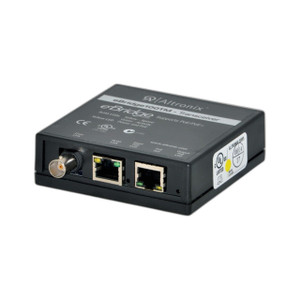
Altronix EBRIDGE1CT Ethernet over Coax Transceiver
The Altronix EBRIDGE1CT is a single-port Ethernet over Coax (EoC) transceiver designed to extend network connectivity over existing coaxial cable infrastructure without requiring new cabling runs. On retrofit deployments where analog security systems already have coax in the walls or overhead, the EBRIDGE1CT converts Ethernet signals for transmission over those legacy runs — a significant cost and labor advantage when upgrading to IP cameras on established infrastructure.
Key Features
- Ethernet over Coax Transmission: Converts standard Ethernet signals to travel over single coaxial cable, eliminating the need to pull new Cat5e/Cat6 runs through existing conduit or walls. In retrofit scenarios, this translates directly to labor cost savings and faster deployment timelines.
- Flexible Power Input (12/24VDC or 16/24VAC): Accepts multiple voltage sources, so you can integrate with existing power supplies or PoE injectors already on-site. This flexibility reduces the need to source additional power infrastructure for the transceiver pair.
- Single Coax Port: One input/output for the coaxial connection. This is a point-to-point link — each run requires a pair of EBRIDGE1CT units (one at each end of the coax).
- UL Listed and CE Approved: Certified for commercial security applications, meaning it meets recognized safety and electromagnetic compatibility standards. This is critical if your end customer has compliance requirements or if the system integrates into a larger commercial infrastructure audit.
- Lifetime Limited Warranty: Altronix backs this unit with a lifetime warranty against defects in materials and workmanship under normal use, reducing risk on long-term retrofit installations.
Integration & Compatibility
The EBRIDGE1CT is compatible with any networked device that operates over standard Ethernet — IP cameras, network video recorders (NVRs), encoders, and managed switches. It works transparently in the network stack, requiring no special driver or configuration beyond power and coax connection. This makes it well-suited for integrators upgrading analog systems to IP without disturbing the existing coaxial backbone.
Each EoC link requires two transceivers (one at the camera or device end, one at the central point). Plan your architecture around the number of coax runs available and the devices you need to support on each run.
Typical Deployment Scenarios
The EBRIDGE1CT is most effective in three situations: (1) retrofit projects where coax runs already exist and Cat5e/Cat6 installation is impractical; (2) older facilities with extensive coax backbone where recabling would disrupt operations; (3) remote or outdoor sites where coax is already run and you want to avoid the cost of parallel copper or fiber installation.
It is not a substitute for new installations. If you're designing a system from scratch, standard Ethernet cabling will almost always be faster to install and simpler to troubleshoot.
Frequently Asked Questions
Q: Do I need two EBRIDGE1CT units per coax run?
A: Yes. Ethernet over Coax transmission requires one EBRIDGE1CT at each end of the coaxial cable — one near the camera or networked device, one at the central switch or PoE injector.
Q: What coax cable types does the EBRIDGE1CT support?
A: The transceiver works with standard coaxial cable (RG-59, RG-6). Consult the datasheet for maximum distance specifications based on cable type and gauge.
Q: Can I mix EBRIDGE1CT with other Ethernet extenders?
A: No. Use matched pairs of EBRIDGE1CT units. Mixing different EoC transceiver brands or models is not supported.
Q: Is PoE power available through the coax link?
A: No. The EBRIDGE1CT extends Ethernet data signals only. Power to the remote device (camera, encoder, etc.) must be supplied separately — either by a local power supply at the far end or by a PoE injector positioned appropriately in the network.
Q: What is the maximum distance for the EBRIDGE1CT?
A: Consult the product datasheet for specific distance ratings based on coax cable type. EoC performance degrades over very long runs; plan accordingly for sites exceeding typical indoor/warehouse distances.
Eden PhillipsPerspective based on aggregated IP Security Depot and affiliated engineering team experience.
The EBRIDGE1CT fills a real gap in retrofit scenarios where pulling new copper is prohibitively expensive or disruptive. On warehouse automation and legacy facility upgrades, I've seen this pay for itself in labor savings alone — avoiding the cost of electricians running new runs through existing conduit or populated racks. The dual voltage input (12/24VDC or 16/24VAC) is practical; it means you can often leverage existing power infrastructure rather than adding new circuits.
Technical Highlights:
- UL Listed and CE Approved: Commercial-grade certifications mean this will pass security audits and compliance reviews without friction. You're not working around unverified gear.
- Point-to-Point Topology: Each transceiver pair is independent — you're not sharing bandwidth across multiple runs on the same coax, so performance per link is predictable and not affected by upstream congestion.
- Lifetime Limited Warranty: On retrofits that live for 5–10 years, lifetime coverage reduces risk. If a transceiver fails, you get replacement at no cost (within warranty terms).
Deployment Considerations:
- You must account for two units per coax run — budget accordingly. A 20-camera retrofit with 10 coax runs means 20 transceivers (one pair per run).
- Power at the far end is not bundled over the coax. Budget a separate PoE injector or 12/24VDC supply at each remote location. This adds complexity and cost if power isn't already present near the camera.
- Maximum distance depends on coax gauge and quality. Older RG-59 runs in walls may have higher attenuation; test or consult the datasheet before committing to very long runs.
The EBRIDGE1CT is the right call for warehouse and retail retrofit projects where coax backbone exists and new copper installation is impractical. It won't speed up a greenfield deployment, but on a 50-year-old manufacturing facility with established coax runs, it's a labor-cost win.