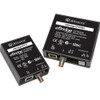
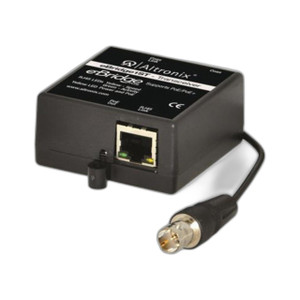
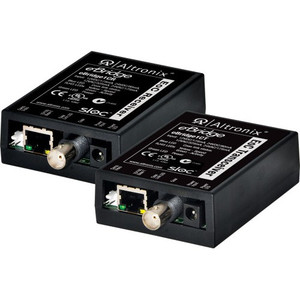
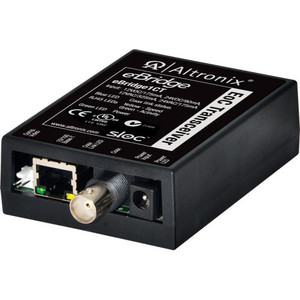
Altronix EBRIDGE1PCRMT Ethernet over Coax Adapter Kit
Overview
The Altronix EBRIDGE1PCRMT is a single-port Ethernet over Coax (EoC) adapter kit purpose-built for retrofitting IP security infrastructure over legacy coaxial cabling. Instead of replacing runs of RG-59 or RG-6 already installed through walls and conduits, the EBRIDGE1PCRMT converts standard Ethernet signals to coax-compatible format and back, preserving network connectivity over distances up to 500 meters without active repeaters or intermediate power injectors. The kit ships with both a transceiver (head-end) and receiver (remote) unit, meaning you have everything required to bridge one endpoint per kit.
Key Features
- 25 Mbps Data Rate: Sufficient for standard-definition and HD IP cameras (typically 2–5 Mbps per stream), access control panels, and intercom systems. Higher bitrate devices or multiple simultaneous streams on a single coax run will be constrained; plan for one high-bandwidth camera or device per EBRIDGE1PCRMT pair.
- 500-Meter Transmission Range: Eliminates the need for active repeaters or intermediate powered hubs on long runs, reducing both equipment count and power budget strain at the installation site.
- PoE and PoE+ Passthrough: Power delivered from your PoE switch or injector passes through the adapter pair and reaches the remote device (camera, reader, intercom) without requiring a second power supply at the far end. This simplifies wiring and reduces power infrastructure costs.
- Transceiver and Receiver Architecture: Kit includes both units—mount the transceiver at your central switch or PoE injector location and the receiver at the remote endpoint. Single-port design keeps configuration straightforward: one pair per remote device.
- UL Listed: Meets North American electrical and safety standards, qualifying for use in commercial security installations, institutional facilities, and enterprise deployments subject to code compliance inspection.
- Coaxial Compatibility: Works with existing RG-59, RG-6, or similar coaxial infrastructure already in place. No need to run new category Ethernet cable through established conduit routes, saving labor and project timeline, particularly in multi-building campuses or retrofit scenarios.
Integration and Deployment Context
The EBRIDGE1PCRMT is ideal for projects where running new Ethernet cabling is logistically difficult or cost-prohibitive. Common scenarios include extending IP camera feeds from a central NVR or VMS to remote building wings, parking areas, or perimeter locations using existing coax plant; bridging access control readers to a central door controller; and connecting outdoor intercoms or emergency call stations to central management systems.
Installation flow is direct: connect Ethernet from your PoE source (switch or injector) to the transceiver RJ-45 port, run coaxial cable from transceiver to receiver location, and connect the receiver via a short Ethernet patch cable to your endpoint device. Power flows through the entire chain—source to transceiver to coax link to receiver to endpoint—without requiring intermediate power supplies or injectors.
Because the EBRIDGE1PCRMT operates at 25 Mbps, design your remote endpoints accordingly. A single HD camera at 4–5 Mbps leaves room for system traffic and ACK packets; multiple cameras on one run will saturate the link. For multi-camera deployments over coax, allocate one adapter pair per camera or install additional coaxial pairs and transceiver/receiver sets.
Package Contents
Each kit includes one transceiver unit (head-end), one receiver unit (remote endpoint), and all necessary mounting hardware and connectors for immediate deployment.
Frequently Asked Questions
Q: Can the EBRIDGE1PCRMT work with both PoE (802.3af) and PoE+ (802.3at) power sources?
A: Yes. The EBRIDGE1PCRMT passes through both PoE (13W) and PoE+ (30W) power standards, allowing you to match your power budget to your remote device requirements. Standard PoE works for typical IP cameras and readers; PoE+ supports higher-draw devices like pan-tilt-zoom cameras or powered intercoms.
Q: What happens if my coaxial run exceeds 500 meters?
A: The EBRIDGE1PCRMT is not rated beyond 500 meters. Longer distances require active repeaters or fiber-based solutions. Consult installation documentation or contact the manufacturer for range extension options.
Q: Can I daisy-chain multiple EBRIDGE1PCRMT kits on one coaxial run?
A: No. Each kit is a point-to-point transceiver and receiver pair. For multiple endpoints, install separate coaxial runs and dedicated adapter pairs, or consolidate endpoints and use a managed PoE switch or additional infrastructure at the remote hub location.
Q: Does the EBRIDGE1PCRMT introduce latency that would affect real-time video or access control?
A: Latency is minimal and inherent to the Ethernet protocol—not a factor in live video playback or access control reader response. Record-and-playback via NVR/VMS will experience no perceptible delay.
Q: Is the EBRIDGE1PCRMT compatible with ONVIF cameras and standard VMS platforms?
A: The EBRIDGE1PCRMT is a transparent network bridge—it passes standard Ethernet frames unchanged. Any ONVIF-compliant camera or access control device that works over standard Ethernet will work over the adapter pair without additional configuration.
Q: What environmental rating does the EBRIDGE1PCRMT have?
A: The transceiver and receiver units are designed for indoor head-end and protected remote enclosure installation. If mounting at outdoor locations or in harsh environments, house both units in weatherproof cabinets or conduit. Consult the datasheet for detailed operating temperature range.
Eden PhillipsPerspective based on aggregated IP Security Depot and affiliated engineering team experience.
I've specified the EBRIDGE1PCRMT on several multi-building campus installations where running new Ethernet infrastructure would have doubled the project timeline and cost. The 500-meter range with PoE passthrough is a real differentiator—you eliminate the need for intermediate power injectors, which simplifies both the power budget and the on-site troubleshooting when something needs adjustment months after commissioning.
Technical Highlights:
- 25 Mbps throughput at 500 meters: Adequate for a single HD stream or access control panel traffic, but not for multi-camera aggregation. This is the key constraint to communicate to the customer upfront—it's not a limitation, it's a design choice that keeps cost low and installation simple for single-endpoint retrofits.
- PoE+ passthrough without intermediate injection: Power delivered from your head-end switch reaches the remote camera or reader directly. Saves both equipment cost and the labor of installing a second power supply at the remote location, especially in outdoor or rooftop scenarios where power access is limited.
- UL listed for commercial/institutional deployment: Meets code requirements for security system integrators and enterprise IT buyers conducting compliance audits. Eliminates the risk of field rejection during final inspection.
Deployment Considerations:
- The 25 Mbps ceiling is real. If you have multiple cameras or high-bandwidth devices on the same coax run, this adapter will become a bottleneck. Plan one EBRIDGE1PCRMT per remote endpoint, not as a hub.
- Existing coax quality matters. Old, poorly terminated, or heavily corroded runs will degrade throughput and range. Before specifying, have a site tech walk the cable routes and visually inspect connectors. Budget for re-termination if the plant looks questionable.
Best-fit scenario: retrofit IP camera to a remote parking area or building perimeter where a coax cable already runs from the central head-end, and you can justify PoE+ at the source to power a mid-range dome or turret. Avoid it for multi-camera consolidation points unless you're willing to install parallel coax runs and additional adapter pairs per endpoint.