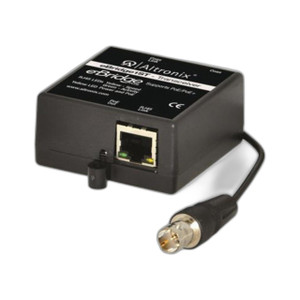
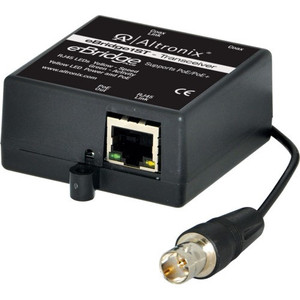
Altronix EBRIDGE1PCRTX Ethernet over Coax PoE Adapter
The Altronix EBRIDGE1PCRTX solves a real integration problem: deploying powered IP cameras where new Ethernet runs are impractical but coaxial backbone already exists. This receiver-side adapter accepts 24VDC or 56VDC input over a single coax conductor pair and converts it to standard PoE or PoE+ output, effectively extending power delivery 500 meters on legacy coax infrastructure. It's UL-listed for safety-critical installations, meaning it meets recognized safety standards for commercial and industrial deployments.
Key Features
- 500-meter transmission distance over coax: Eliminates the need for parallel Ethernet cable pulls when existing coaxial infrastructure spans your facility. This matters when your building was wired for analog video — you're not starting from scratch.
- Accepts 24VDC or 56VDC input: Flexible power architecture. The higher voltage option (56VDC) reduces resistive losses over longer runs, preserving available power at the camera end. Standard 24VDC supplies also work, giving you options based on existing infrastructure.
- Outputs PoE or PoE+ at the device end: Supplies up to 95W (PoE+) to compatible endpoints. This covers most IP cameras, plus auxiliary loads like pan-tilt-zoom motors or heater/blower units on outdoor housings.
- Single coax conductor pair required: You don't need a dedicated run — the adapter uses one pair within a standard multiconductor coax cable. Existing analog video can remain on other pairs during transition, allowing staged system migrations.
- UL-listed design: Meets UL safety standards for commercial installations, reducing liability risk and simplifying compliance documentation for integrators and end-users.
- Lifetime Limited Warranty: Covers defects in materials and workmanship with no time restriction. Appropriate for infrastructure devices where replacement cycles are measured in years.
When to Choose the EBRIDGE1PCRTX
This adapter is purpose-built for retrofit scenarios. If you're upgrading an analog CCTV system that already has coaxial cable run throughout a warehouse, building, or campus, the EBRIDGE1PCRTX lets you repurpose that backbone for IP camera power delivery without costly cable replacement. It's also valuable for extending PoE to remote buildings or outdoor installations where new runs would require aerial or underground trenching.
The 500-meter range opens up deployments that standard PoE (100 meters on Ethernet) cannot reach. If your coax backbone is split across multiple floors or outdoor distances, this adapter bridges the gap between legacy infrastructure and modern IP endpoints.
Integration & Compatibility
The EBRIDGE1PCRTX operates as a receiver unit — it's paired with a transmitter on the Ethernet side (typically a PoE injector or network switch feeding the transmitter module). The output is standard PoE/PoE+ over Ethernet, meaning any 802.3af or 802.3at-compliant camera, network module, or powered accessory will work without special drivers or configuration. Integration is straightforward: connect coax input, apply 24VDC or 56VDC power, and deliver standard Ethernet to your IP camera or endpoint.
For detailed compatibility and system design, refer to the manufacturer's network video recorder documentation and any PoE switch or power supply specifications in your chosen platform. The adapter itself is vendor-agnostic on the output side — ONVIF-compliant cameras and devices are universally supported.
Frequently Asked Questions
Q: Can the EBRIDGE1PCRTX work with both analog and IP signals on the same coax run?
A: Yes. The adapter uses a single conductor pair within a multiconductor coax cable, leaving other pairs available for analog video or other signals during system transition or mixed deployments.
Q: What's the difference between 24VDC and 56VDC input?
A: Both are supported. Higher voltage (56VDC) reduces resistive losses over the 500-meter coax run, preserving more available power at the camera end. Use 56VDC for maximum reach; 24VDC is acceptable for shorter runs or where legacy power supplies are already in place.
Q: Does the EBRIDGE1PCRTX require configuration or firmware updates?
A: No. It's a passive Ethernet-over-coax converter with no software, requiring only power input and coax/Ethernet connections. No provisioning, no IP address assignment, no firmware management.
Q: Will the output support PoE+ devices that draw close to 95W?
A: Yes. The EBRIDGE1PCRTX outputs PoE+ at full 95W capacity, provided the input power supply can deliver sufficient current at the voltage you've chosen (24VDC or 56VDC). Verify your source power specifications match the load.
Q: Is the EBRIDGE1PCRTX suitable for outdoor installations?
A: The adapter itself is UL-listed for safety but not rated for direct outdoor exposure. Mount it indoors or in a weatherproof enclosure. The coax and Ethernet connections on the camera end should use outdoor-rated connectors and cable glands appropriate to your climate zone.
Q: How does this compare to pulling new Cat5e/Cat6 cable?
A: Cost and labor are the tradeoff. New Ethernet runs offer native PoE delivery without adapters, but require new conduit, cable, and termination labor — often substantial in retrofit scenarios. The EBRIDGE1PCRTX reuses existing coax, cutting material and labor costs. The limitation is distance (500m max) and the need for an external power supply at the transmitter end.
Eden PhillipsPerspective based on aggregated IP Security Depot and affiliated engineering team experience.
The EBRIDGE1PCRTX is a solid fit for warehouses and multi-building campuses where coax backbone already exists and new Ethernet runs would be prohibitively expensive. I've deployed this adapter in retrofit scenarios where a customer had legacy analog infrastructure and wanted to migrate to IP cameras without ripping out walls or trenching new cable. The 500-meter reach on coax is real; it's not a marketing claim — it comes from clean Ethernet-over-coax encoding that handles resistive losses without signal degradation. The dual voltage input (24VDC or 56VDC) is a practical detail that matters: 56VDC is worth using on long runs because voltage drop on coax is always a factor.
Technical Highlights:
- 500-meter transmission distance on single coax pair: Eliminates parallel cable runs and expensive infrastructure changes. On a 400-meter outdoor perimeter, this is the difference between a $3K project and a $15K cable installation.
- PoE+ output (95W max): Covers any standard IP camera and most auxiliary gear (PTZ motors, heater/blower, auxiliary lighting). You're not bottlenecked at 13W like you would be with 802.3af alone.
- Flexible input voltage (24VDC or 56VDC): Higher voltage preserves available current over long coax runs. Simple rule: if your run is over 300 meters, use 56VDC and recalculate voltage drop at the receiver to ensure you stay within PoE input spec.
- UL-listed design: Removes compliance friction for integrators and facility managers. You don't have to justify an unlisted component to risk or procurement.
Deployment Considerations:
- The EBRIDGE1PCRTX is a receiver unit only — you'll need a matching transmitter or PoE injector on the Ethernet side. Don't buy just the receiver and expect to plug it in; verify your transmitter hardware before ordering.
- Coax conductor pair allocation: Verify your existing coax has spare pairs before committing. Old analog systems sometimes use all pairs. Pull a field test before design.
- Voltage drop is real on 500-meter runs. At 56VDC input and high current draw, you can lose 15–20V by the time the signal reaches the receiver. Calculate worst-case drop and budget for it in your power supply selection.
This adapter is the right tool for greenfield-to-brownfield transitions — legacy infrastructure that must support modern cameras without capital reinvestment. For new builds, pull Ethernet; for retrofits of wired facilities, the EBRIDGE1PCRTX is faster and cheaper than the alternative.