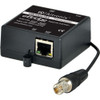
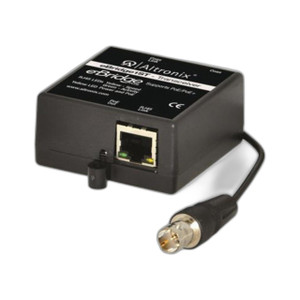
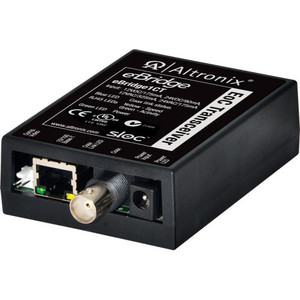
Altronix EBRIDGE1ST Ethernet Over Coax PoE Injector
The Altronix EBRIDGE1ST is a compact PoE injector that extends Ethernet connectivity and power delivery over existing coaxial cable infrastructure to distances of 500 meters at 25 Mbps. This mini transceiver solves a critical retrofit problem: upgrading legacy surveillance systems to IP-based cameras without tearing out installed coax runs. When cable replacement is cost-prohibitive or logistically impractical—common in large warehouses, industrial facilities, and multi-building campuses—the EBRIDGE1ST lets you reuse what's already in the walls.
Key Features
- 500-meter transmission over coax at 25 Mbps: Pushes Ethernet and power down existing cable plants without rewiring. Useful for perimeter monitoring, remote gatehouse installations, and warehouse bays where running new copper is disruptive or expensive.
- Integrated PoE injection: Supplies power to remote IP cameras through the coax infrastructure. Eliminates the need for a separate power supply at the far end, reducing field labor and potential single points of failure.
- Single-output configuration: Designed for point-to-point links—one camera or appliance per transceiver pair. If you need multiple remote devices, deploy multiple EBRIDGE1ST units or run separate coax drops.
- Compact mini form factor: Takes up minimal rack or wall space. Fits into cramped server closets and equipment shelves where space is tight.
- UL Listed: Meets North American electrical safety standards, a requirement for most enterprise and institutional deployments.
- Lifetime Limited Warranty: Covers defects in materials and workmanship for the operational life of the product. Standard Altronix coverage model.
Integration and Deployment Context
The EBRIDGE1ST operates as a matched transceiver pair: one unit at the source (connected to your network switch and power), one at the remote location (connected to the IP camera). Data throughput maxes out at 25 Mbps, which is adequate for a single 1080p or 2MP camera stream (H.265 compressed) but not suitable for 4K or high-frame-rate feeds. If you're upgrading multiple cameras on the same coax backbone, treat each run independently.
This transceiver is especially useful in retrofit scenarios where IP cameras must be installed on existing infrastructure. Warehouse automation engineers frequently encounter systems built around analog CCTV runs; the EBRIDGE1ST bridges that legacy coax to modern network video recorders and NVR-based architectures. Before deployment, verify your coax quality—heavily kinked, corroded, or heavily tapped runs may degrade range and throughput.
For projects involving extensive coax upgrades or high-bandwidth requirements, consider whether running new Ethernet cable might be cost-competitive. The EBRIDGE1ST pays for itself when you have miles of functional coax in place but no Ethernet infrastructure.
Frequently Asked Questions
Q: Can I run more than one camera over a single coax run using the EBRIDGE1ST?
A: No. The EBRIDGE1ST is a single-output transceiver designed for point-to-point links. Each camera or device requires its own EBRIDGE1ST pair and dedicated coax run.
Q: What's the maximum data rate, and will it work with 4K cameras?
A: The EBRIDGE1ST delivers 25 Mbps at 500 meters. This is sufficient for a single 1080p or 2MP stream with H.265 compression but not for 4K or multi-camera applications. 4K typically requires 50–100 Mbps depending on codec and frame rate.
Q: Does the EBRIDGE1ST supply enough power for high-power cameras?
A: The unit delivers PoE-class power through the coax. Check your camera's power consumption against the datasheet. Devices pulling over 15W may exceed the link capacity and require supplemental power.
Q: Is the EBRIDGE1ST suitable for outdoor coax runs?
A: The transceiver itself is compact and typically housed indoors. However, the coax runs can be outdoor-rated if properly terminated and shielded. Ensure connectors and terminations meet outdoor environmental standards.
Q: What happens if the coax is damaged or severely degraded?
A: Range and throughput will drop. Test the coax run before final installation. If signal quality is poor, the EBRIDGE1ST may not achieve the full 500-meter range.
Q: Is the EBRIDGE1ST compatible with standard RJ-45 network equipment?
A: Yes. The unit presents as a standard Ethernet link to your switch or NVR. Simply connect the Ethernet port to your network and PoE source, and the transceiver handles the coax-to-copper conversion transparently.
Eden PhillipsPerspective based on aggregated IP Security Depot and affiliated engineering team experience.
The EBRIDGE1ST solves a real infrastructure constraint: you have miles of coax in the ground but no Ethernet. This transceiver is not a general-purpose network extender—it's a targeted retrofit tool. At 500 meters and 25 Mbps, the EBRIDGE1ST works well for single-camera legacy upgrades where you're replacing old analog surveillance with a modern IP-based system and can't justify tearing out the existing coax plant.
Technical Highlights:
- 25 Mbps throughput at 500m range: Sufficient for one 1080p or 2MP H.265-compressed stream. Don't expect to daisy-chain multiple cameras or push 4K over a single transceiver pair—the bandwidth simply isn't there. Budget roughly 8–15 Mbps per camera depending on codec, scene complexity, and frame rate.
- PoE power delivery through coax: Eliminates a separate DC supply at the remote end. For cameras under 13W (standard 802.3af budget), this is transparent. Anything heavier will constrain you.
- UL Listed design: Meets NA safety standards, required for most institutional, commercial, and utility deployments. Matters for insurance and audit trails.
Deployment Considerations:
- Test the coax run before committing. Heavily kinked, poorly shielded, or corroded runs will fall short of 500 meters and may drop below usable throughput.
- The 25 Mbps ceiling is a hard limit. This is not a general-purpose Ethernet extension tool—it's designed for low-bandwidth, single-camera retrofit scenarios. Treat it as such.
- Each remote device gets its own EBRIDGE1ST pair. If your site has five legacy coax runs and you want to upgrade all five, budget five transceiver pairs.
Position the EBRIDGE1ST for perimeter upgrades in industrial facilities, warehouse monitoring, and gatehouse installations where legacy coax is already run and new Ethernet infrastructure is not in place. It's a cost-effective way to extend the life of older cable plants and avoid the disruption of rewiring large properties.