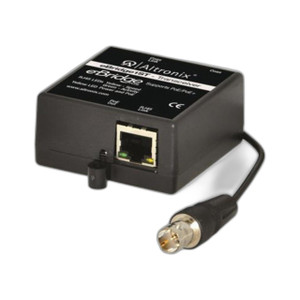
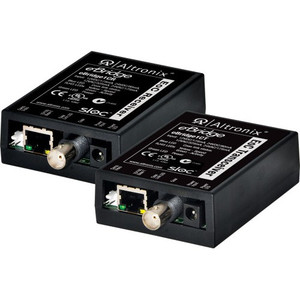
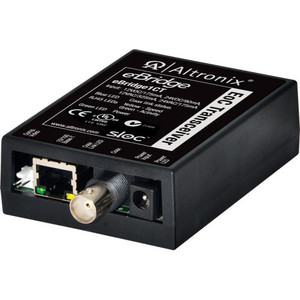
Altronix EBRIDGE100RMT Ethernet Over Coax Adapter Kit
Overview
The Altronix EBRIDGE100RMT is a long-range Ethernet over Coax (EoC) solution designed for security integrators and IT architects who need to extend IP connectivity across existing coaxial cable infrastructure without pulling new runs. This single-port adapter kit delivers 100Mbps bidirectional throughput—sufficient for HD and 4K IP cameras, access control readers, intercoms, and networked sensors—while simultaneously passing PoE and PoE+ voltage alongside data. The EBRIDGE100RMT includes both receiver and transceiver units in a ready-to-deploy kit format, eliminating separate component sourcing and reducing field commissioning time.
Key Features
- 100Mbps Full-Duplex EoC Bandwidth: Delivers sufficient throughput for concurrent HD/4K video streams, access control traffic, and two-way intercom signaling over a single coaxial run. This bandwidth ceiling means you can typically support 2–3 simultaneous 4K streams or 4–6 HD streams per line without queueing delays.
- Ethernet Over Coax Technology: Leverages existing coaxial cable infrastructure installed during analog CCTV deployments—eliminating costly conduit work, floor cuts, or rooftop cable runs in campus and multi-building environments. A genuine cost-saver on retrofit projects where new infrastructure budgets are constrained.
- PoE and PoE+ Pass-Through: Injects Power over Ethernet and PoE+ voltage on the same coax line as data. Remote cameras and networked devices draw power directly from the coax run—no intermediate power supplies, midspan injectors, or separate 120V drops required at the remote end. Reduces Bill of Materials by $50–$150 per camera location and simplifies electrical permit requirements.
- Bidirectional Single-Port Design: One receiver and one transceiver form a point-to-point pair. Compact form factor fits standard equipment racks or wall-mount enclosures without dominating panel real estate.
- Long-Range Architecture: Engineered for extended coaxial segments typical in surveillance and access control networks—specifically suited for outdoor campus deployments, warehouse perimeter monitoring, and multi-story facilities where runs exceed 300 feet.
- UL Listed: Meets UL safety and performance standards for commercial security installations, satisfying building codes and insurance underwriting requirements in most North American jurisdictions.
- Kit Format: Receiver and transceiver units ship together as a matched pair—no hunting for compatible units or managing separate orders. Reduces procurement friction and ensures field-ready deployment on day one.
Integration and Deployment Context
The EBRIDGE100RMT integrates into hybrid network architectures where coaxial cable already exists—particularly valuable during analog-to-IP camera system upgrades, multi-location surveillance expansions, and industrial or outdoor installations where running new Ethernet cable is cost-prohibitive or physically impractical. Wired connectivity via coax ensures reliability in RF-dense or electrically noisy environments common in manufacturing facilities, utility substations, and outdoor perimeter security applications.
Compatibility spans any standard IP device that operates on 802.3af or 802.3at PoE: IP cameras (fixed and PTZ), access control readers and intercoms, networked environmental sensors, and VoIP endpoints. The EBRIDGE100RMT passes through standard Ethernet frames—no protocol translation or vendor-specific gateways required. Works seamlessly with network video recorders, PoE switches, and standard management platforms that support ONVIF discovery.
What's in the Box
The EBRIDGE100RMT kit includes one receiver unit and one transceiver unit—a complete point-to-point Ethernet extension solution requiring only coaxial cable (RG-6 or RG-59) between locations and standard Ethernet connections at each end.
Frequently Asked Questions
Q: What coaxial cable types work with the EBRIDGE100RMT?
A: The EBRIDGE100RMT works with RG-6, RG-59, and similar 75-ohm coaxial cable installed in legacy analog systems. Existing runs do not require replacement or re-termination if connectors are in good condition and impedance is stable across the run length.
Q: Can I daisy-chain multiple EBRIDGE100RMT units to extend range further?
A: No. The EBRIDGE100RMT is a point-to-point adapter pair—each kit handles one transmit and one receive endpoint. Multiple runs require separate EBRIDGE100RMT kits (receiver and transceiver per location pair).
Q: Does the EBRIDGE100RMT support both PoE (802.3af) and PoE+ (802.3at) on the same line?
A: Yes. The adapter passes through both PoE (13W standard power) and PoE+ (25.5W extended power) simultaneously with data. Power budget is determined by the source injector—the EBRIDGE100RMT does not step down or regulate voltage, only transmit it alongside Ethernet.
Q: What is the maximum coax run length supported by the EBRIDGE100RMT?
A: The EBRIDGE100RMT is engineered for extended-distance runs. Consult the datasheet for specific attenuation and maximum length specifications based on cable type and environmental conditions.
Q: Is the EBRIDGE100RMT suitable for outdoor use?
A: The adapter itself is designed for indoor rack or enclosure mounting. However, coaxial cable runs can traverse outdoor conduit or aerial routes. Ensure outdoor endpoints (cameras, readers) have appropriate environmental ratings (IP66, IP67) for your deployment.
Q: Does the EBRIDGE100RMT require configuration or pairing before use?
A: The kit is pre-paired and ships ready to install. Connect receiver and transceiver via coax, connect Ethernet and power at each end, and IP devices discover and operate normally. No software configuration or commissioning steps required.
Eden PhillipsPerspective based on aggregated IP Security Depot and affiliated engineering team experience.
I have evaluated the Altronix EBRIDGE100RMT during multiple campus and multi-building surveillance upgrades where new cable infrastructure was cost-prohibitive. This adapter addresses a genuine pain point: leveraging existing coax runs to extend modern IP networks without disrupting operational facilities or incurring six-figure infrastructure budgets. The 100Mbps throughput and native PoE/PoE+ pass-through eliminate intermediate converters and power injectors—real field wins on retrofit projects.
Technical Highlights:
- 100Mbps Full-Duplex EoC Bandwidth: Sufficient for 2–3 concurrent 4K IP camera streams or 4–6 HD streams per coax run. No bandwidth bottleneck for typical multi-camera access control and intercom traffic on the same line.
- PoE/PoE+ Pass-Through on Coax: Eliminates separate midspan injectors or 120V drops at remote camera locations. A $50–150 Bill of Materials reduction per endpoint, plus simplified electrical permitting on retrofit jobs.
- Long-Range EoC Architecture: Engineered for extended coaxial segments (300+ feet typical in campus deployments). Stability and signal integrity across distance means fewer intermediate repeaters or active components in the field.
- UL Listed Safety Certification: Meets commercial code requirements—no special variances or risk assessments needed for building insurance or municipal sign-off on occupied facilities.
Deployment Considerations:
- Point-to-Point Topology Only: Each EBRIDGE100RMT kit is a single transmit/receive pair. Star or mesh topologies require separate kits and multiple coax runs—factor this into site planning if you're upgrading from analog hub-and-spoke architectures.
- Coax Condition Matters: Existing cable runs must have stable impedance and reliable terminations. Aged or poorly maintained coax may require re-termination or replacement sections before deployment—budget for pre-installation cable testing.
- No Protocol Translation: This is a dumb EoC bridge—no firewalling, VLANing, or protocol filtering. IP security and network segmentation are handled upstream by your switch and VMS architecture, not the adapter.
Best Fit: Multi-building campus surveillance upgrades where analog coax already runs between buildings or across outdoor perimeter routes; warehouse and industrial facilities where new cable runs conflict with active operations; retrofit projects where new infrastructure budgets are exhausted. Not ideal for greenfield deployments where new Ethernet can be installed—use standard PoE switches and Cat6A in those cases.