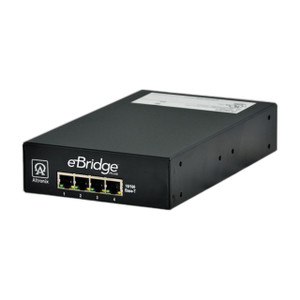
Altronix EBRIDGE1CR Ethernet Over Coax Receiver
The Altronix EBRIDGE1CR is an Ethernet extender that recovers data signals transmitted over existing coaxial cabling infrastructure, allowing you to deploy network cameras and sensors without running new cable. This is particularly valuable in warehouse, retail, and industrial facilities where coax runs already exist from legacy analog CCTV systems. The receiver accepts input from a paired transmitter and converts it into standard Ethernet output, making it a practical bridge between old infrastructure and modern IP-based surveillance.
Key Features
- Ethernet over coax transmission: Repurposes existing coaxial runs (RG-59, RG-6) for Ethernet delivery, eliminating the cost and disruption of pulling new network cable through walls, conduit, and ceilings — a meaningful savings in retrofit projects.
- 100-meter maximum range: Covers most interior and shorter exterior runs without signal degradation, suitable for typical facility layouts. Beyond 100m, you'll need a second pair of extenders or standard Ethernet infrastructure.
- Flexible power input (12/24VDC or 16/24VAC): Accepts either DC or AC voltage, so you can power it from existing power supplies, UPS systems, or backup generators already in place. This eliminates a separate power supply procurement and simplifies integration.
- Single Ethernet output: Delivers one RJ-45 port per receiver, enough for a single camera or small network device. If you need to connect multiple devices at one location, add a network switch downstream.
- UL Listed and CE marked: Meets North American and European safety and compliance requirements, reducing approval friction in regulated environments like healthcare, retail, and financial facilities.
- Lifetime Limited Warranty: Manufacturer stands behind the device for its serviceable life, providing long-term peace of mind in permanent installations.
Typical Deployment Scenarios
The EBRIDGE1CR works best when you're retrofitting an analog CCTV system to IP without infrastructure overhaul. Common use cases include converting legacy analog camera runs to IP, extending network to remote sensors in constrained environments, and cost-effective network extension in warehouse or parking structure applications. Pair it with a matching transmitter (typically located at your network switch or camera location) to form a complete point-to-point link.
Integration & Compatibility
The receiver outputs standard Ethernet (RJ-45), making it compatible with any standard IP camera, network device, or switch that accepts wired Ethernet input. There are no special drivers or VMS integration requirements — once the coax link is established and power is applied, the device is transparent to your network. Consult your transmitter and camera documentation for recommended coax gauge and condition; heavily damaged or very long coax runs may degrade signal quality.
Power and Environmental Considerations
The EBRIDGE1CR operates on either 12/24VDC or 16/24VAC input, drawing modest current — you'll typically need a small 24V power supply if one isn't already nearby. Verify that your power source is stable and properly fused. The device itself is intended for controlled or outdoor-protected mounting (e.g., inside an enclosure or weatherproof box); always verify environmental limits in the datasheet for temperature and humidity ranges before outdoor deployment.
When to Choose a Different Approach
If your coax infrastructure is degraded, severely corroded, or unknown condition, signal quality may suffer — in that case, consider standard network cable instead. If you need to extend beyond 100 meters, you'll need multiple extender pairs or IP-rated fiber/copper that supports longer distances. For applications requiring multiple Ethernet outputs at a single point, use a downstream network switch rather than multiple EBRIDGE1CR units.
Frequently Asked Questions
Q: What transmitter do I pair with the EBRIDGE1CR?
A: The EBRIDGE1CR is a receiver. It requires a matching Altronix EBRIDGE1CT transmitter at the source end. Consult the transmitter datasheet for specifications and power requirements.
Q: Can I run the EBRIDGE1CR outdoors without an enclosure?
A: The product is not rated for direct weather exposure. Mount it in a protected cabinet, weatherproof enclosure, or DIN-rail mounted inside a control box. Check the datasheet for operating temperature and humidity limits before outdoor deployment.
Q: What coaxial cable types does the EBRIDGE1CR support?
A: Standard video coax (RG-59, RG-6, or equivalent) is the typical medium. Quality and condition of existing coax affects range and data integrity. Inspect runs for physical damage, corrosion, or water ingress before installation.
Q: Is the EBRIDGE1CR compatible with any IP camera manufacturer?
A: Yes. The receiver outputs standard Ethernet (RJ-45), so it works with any IP-based camera or network device that accepts wired Ethernet input. No special drivers or configuration is required.
Q: What is the warranty coverage?
A: The EBRIDGE1CR includes a Lifetime Limited Warranty, covering manufacturing defects for the serviceable life of the device under normal operating conditions.
Q: Can the EBRIDGE1CR extend power to a remote camera?
A: No. The receiver delivers Ethernet data only. To power a remote camera, you'll need a separate PoE injector, PoE switch, or dedicated power supply at the camera location.
Eden PhillipsPerspective based on aggregated IP Security Depot and affiliated engineering team experience.
The Altronix EBRIDGE1CR is a practical retrofit tool, not a bandwidth miracle. If you're sitting on runs of existing coax and want to avoid the cost and mess of pulling Ethernet, this receiver does exactly that — it extends network connectivity up to 100 meters over coax. The key is understanding when coax infrastructure is salvageable and when it isn't.
Technical Highlights:
- 100-meter range on standard video coax: Typical warehouse and multi-story indoor runs fit within this envelope. Outdoor runs of similar distance work if the coax is intact and undamaged. Beyond 100m, signal integrity degrades — you're limited by the physics of copper and dielectric, not the device itself.
- AC/DC power flexibility (12/24VDC or 16/24VAC): This flexibility matters in facilities with distributed 24V power already in place. You're not adding a new power supply type; you're using what's there. DC is typically cleaner for electronics; AC is common in older installations. Both are supported, so integration cost is lower.
- Single Ethernet output with UL/CE approval: Standard RJ-45 out means zero VMS or driver hassle. The regulatory marks (UL Listed, CE) reduce approval friction in regulated sectors — financial, healthcare, retail asset protection.
Deployment Considerations:
- Coax condition is critical. Corroded connectors, water-damaged cable, or crimped/pinched runs will degrade Ethernet signal and may drop frames or introduce jitter. Inspect before committing. If the coax is questionable, budget for new cable run or scheduled replacement.
- The EBRIDGE1CR is a data bridge only — no power delivery over the link. If your remote camera needs PoE, add a second power budget at the camera end (PoE injector, PoE switch, or local 12V supply). This is a real cost and planning point often missed in retrofit estimates.
- Pair this with a matching transmitter (typically Altronix EBRIDGE1CT). Confirm both units are present and commissioned before troubleshooting. Signal loss or intermittent connectivity almost always points to coax condition, not the extender pair.
Deploy the EBRIDGE1CR in retrofit surveillance upgrades where coax already exists and new cable runs are impractical or expensive. Warehouse expansions, multi-story retail, and parking structure conversions are typical fits. Avoid it on degraded or untested coax — new Ethernet is cheaper than troubleshooting a marginal link.