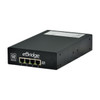
Altronix EBRIDGE4PCRM 4-Port Ethernet Over Coax Receiver
The Altronix EBRIDGE4PCRM is a 4-port Ethernet receiver module designed to extend network connectivity through existing coaxial cable infrastructure. This device converts coax-transmitted signals back to standard Ethernet, making it practical for installations where running new network cabling is cost-prohibitive or physically impossible. The EBRIDGE4PCRM pairs with the Altronix EBRIDGE transmitter to deliver a complete point-to-point or point-to-multipoint solution.
Key Features
- 4-Port Ethernet Output: Delivers four isolated Ethernet ports at the receiver end, so you can provision multiple remote devices (IP cameras, access controllers, sensors) from a single coax run instead of pulling multiple network cables.
- Coaxial Signal Recovery: Converts EBRIDGE-modulated coaxial signals back to standard Ethernet — no special decoders or proprietary hardware required downstream of the receiver.
- Compact Module Design: Fits in tight spaces and integrates into existing power infrastructure without consuming significant rack or wall space.
- Compatible with EBRIDGE4PC Transmitter: Operates as part of the Altronix EBRIDGE ecosystem, ensuring predictable signal integrity and standardized installation procedures across your deployment.
- Lifetime Limited Warranty: Long-term coverage gives you confidence in reliability during multi-year security or automation projects.
Integration & Compatibility
The EBRIDGE4PCRM works exclusively with the Altronix EBRIDGE4PC transmitter. This pairing allows you to repurpose existing coaxial cable runs (RG-59, RG-6, or similar) that may have been installed for analog CCTV systems, converting them into active Ethernet distribution points without trenching or conduit work. This approach is particularly valuable in warehouse automation, multi-building campuses, or retrofit security projects where new structured cabling would disrupt operations or exceed budget constraints.
Each of the four Ethernet ports on the receiver module operates independently, so you can assign different VLAN IDs, power budgets, or network policies to remote endpoints as needed. This modularity reduces the need for additional network switches in satellite locations.
Common Deployment Scenarios
- Legacy Coax Modernization: Convert old analog CCTV cable runs into Ethernet paths to deploy IP cameras, NVRs, or network printers without new cabling work.
- Multi-Building Campus Extension: Extend Ethernet connectivity across outdoor runs between buildings or structures where fiber is unavailable or cost-prohibitive.
- Warehouse Automation: Deliver network connectivity to remote access control readers, motion sensors, or mobile device charging stations via existing infrastructure.
- Cost-Constrained Retrofits: Avoid the labor and material cost of new cabling in mature facilities where coax is already in place and properly grounded.
Frequently Asked Questions
Q: What is the maximum distance the EBRIDGE4PCRM can transmit over coaxial cable?
A: Distance specifications depend on the specific coaxial cable grade and the EBRIDGE transmitter used. Consult the EBRIDGE4PC transmitter datasheet and installation guide for maximum coax run lengths in your application.
Q: Can I daisy-chain multiple EBRIDGE4PCRM receivers on the same coax run?
A: No. The EBRIDGE4PCRM is designed to operate at the end of a single coax run from a compatible transmitter. Multiple receivers require separate transmitter outputs or additional infrastructure.
Q: Does the EBRIDGE4PCRM require external power?
A: Power requirements for the EBRIDGE4PCRM are not detailed in the available product documentation. Verify power specifications and available supply options with the manufacturer or a pre-sales engineer before procurement.
Q: Is the EBRIDGE4PCRM compatible with third-party Ethernet-over-coax transmitters?
A: The EBRIDGE4PCRM is designed to pair with Altronix EBRIDGE transmitter systems. Compatibility with non-Altronix transmitters is not supported and should not be assumed.
Q: How does the EBRIDGE4PCRM handle VLAN or QoS traffic from remote endpoints?
A: Standard Ethernet QoS and VLAN tagging pass through the receiver transparently. Configure network policies on your upstream switch or controller, not on the receiver itself.
Q: What warranty period does the EBRIDGE4PCRM carry?
A: The EBRIDGE4PCRM includes Altronix Lifetime Limited Warranty coverage, providing long-term protection against manufacturing defects.
Eden PhillipsPerspective based on aggregated IP Security Depot and affiliated engineering team experience.
The Altronix EBRIDGE4PCRM solves a specific integration problem: how to deliver Ethernet to remote security or automation nodes when pulling new network cabling is impractical. The four-port design means a single coax run from your transmitter can service multiple endpoints — camera heads, access readers, or sensor clusters — without requiring a remote switch at each location. This reduces both hardware count and power overhead at satellite sites.
Technical Highlights:
- Four Independent Ethernet Ports: Each port operates as a discrete Ethernet interface, allowing you to assign separate IP ranges, VLANs, or QoS policies to each remote device without needing a downstream switch. Useful for security segmentation or traffic prioritization in larger deployments.
- Coaxial Signal Recovery: Converts modulated coax signals back to standard Ethernet — meaning your IP cameras, recorders, and controllers see standard 802.3 frames. No proprietary protocol handling required on the remote end.
- Lifetime Limited Warranty: Gives you long-term confidence in the receiver's reliability, critical for outdoor or difficult-to-access cable runs where field service is expensive.
Deployment Considerations:
- Power requirements for the EBRIDGE4PCRM are not detailed in the published spec sheet — confirm supply voltage, wattage, and available input options before finalizing your installation plan, especially in locations without nearby AC or PoE infrastructure.
- Distance performance depends on the EBRIDGE4PC transmitter paired with it and the grade of coaxial cable in your existing runs. Poor cable condition, kinks, or water ingress can degrade signal — inspect legacy runs before committing to this architecture.
- If you need to service multiple remote sites from a single transmitter, you'll need additional transmitter outputs or separate transmitter/receiver pairs — the EBRIDGE4PCRM cannot be daisy-chained.
The EBRIDGE4PCRM is best suited to retrofit projects in mature warehouse or industrial facilities where coaxial cabling is already installed, in-service, and properly grounded. It is not a replacement for structured cabling in new builds — it is a pragmatic workaround for cost and logistics constraints in brownfield deployments. Size your power budget carefully and validate coax integrity before installation.