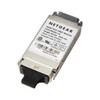
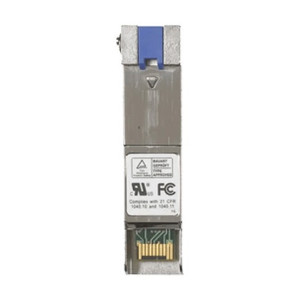
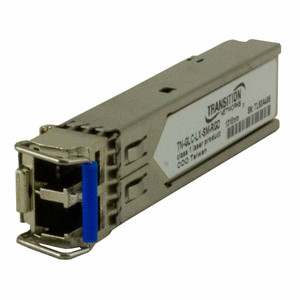
NETGEAR AGM722F 1000BASE-LX Single-Mode Fiber GBIC Module
The NETGEAR AGM722F is a 1000BASE-LX optical transceiver module designed to extend Gigabit Ethernet over single-mode fiber at distances up to 10 km. In surveillance and industrial networking, this module solves the core distance and isolation problem: copper cabling maxes out at 100 m (Cat6A), and ground loops from long runs degrade video quality or crash equipment. Single-mode fiber eliminates electromagnetic coupling entirely while reaching across campuses, between buildings, or through electrically noisy factory floors. The GBIC hot-swappable form factor plugs directly into compatible NETGEAR managed switches, avoiding the need for external media converters and their associated complexity and power draw.
Key Features
- 1000BASE-LX Standard: 1 Gbps Gigabit Ethernet over single-mode fiber. Supports distances up to 10 km — typical campus or large industrial site spans without intermediate repeaters.
- Single-Mode Fiber Optimized: Long-wavelength (1310 nm) laser transmission on single-mode cable. Eliminates multimode dispersion noise; delivers cleaner, more stable signal than multimode variants over extended runs.
- Hot-Swappable GBIC Form Factor: Plugs into NETGEAR managed Gigabit switches with GBIC slots. No downtime to replace or upgrade — live insertion and removal on most switch models.
- Dual Connector Support: Ships with LC connector; SC adapter available separately. Matches existing site fiber infrastructure without re-termination.
- Passive Optical Design: Draws power from switch backplane — no external power supply, no active cooling. Plug-and-play installation reduces cabinet clutter and operational overhead.
- EMI/RFI Immunity: Optical isolation breaks ground loops and shields video feeds from electrical noise common in industrial facilities, broadcast facilities, and data centers.
- NETGEAR Ecosystem Integration: Managed via standard NETGEAR CLI or web GUI; link status visible in switch port telemetry and SNMP traps. Integrates into existing NETGEAR management workflows without additional software.
Deploying single-mode fiber across a surveillance network requires forethought: fiber termination quality directly impacts reliability. Dust, micro-scratches, or misalignment at LC/SC connectors cause insertion loss (measured in dB) and link negotiation failure. Before mating any connector pair, inspect both the module port and patch cable ferrule under magnification — even particles invisible to the naked eye corrupt signal integrity. Fiber routing must respect minimum bend radius (typically 20 mm for single-mode cable) to avoid macrobend attenuation; run cable in conduit or along cable trays rather than tight spirals around equipment racks.
The operational benefit emerges quickly on large-scale projects. A 500-camera parking-lot surveillance system split across two buildings (600 m apart) cannot use copper — you'd need intermediate switches, power injection, and active cooling. Single-mode fiber from this module carries all 500 streams on two fiber strands (one per direction if you're using full-duplex architecture) with zero ground-loop risk and zero signal conditioning hardware. Total cost of ownership favors fiber for any span beyond 300 m in electrically noisy environments, or any span beyond 600 m in quiet environments. The AGM722F eliminates the media converter tax — one module per end, no external box, no fan noise.
Installation checklist: (1) Verify your NETGEAR switch model supports 1000BASE-LX GBIC modules — check the datasheet or contact support if unsure. (2) Source a matching 1000BASE-LX GBIC or compatible SFP transceiver on the far end. (3) Obtain single-mode LC or SC patch cable rated for your distance (10 km cable is standard; verify attenuation specs if you're near the distance limit). (4) Clean fiber connectors with lint-free wipes and isopropyl alcohol immediately before installation. (5) Insert the AGM722F into an open GBIC slot, mate the patch cable, and wait 10–15 seconds for optical lock. (6) Check link LED on the module (typically amber/red during sync, green when linked); confirm link status in switch CLI with show interfaces or equivalent. If link fails to establish, remove the module, re-clean the connectors, and retry — do not force connections or assume the module is faulty on first attempt.
NETGEAR manufactures the AGM722F to industry standards (ITU-T G.957 for 1000BASE-LX) and backs it with manufacturer warranty covering defects in materials and workmanship. The module is not subject to NDAA/Section 889 restrictions — optical transceivers are passive components with no embedded computing or software. Compatibility is wide: any standard 1000BASE-LX GBIC slot will accept the AGM722F, and any single-mode fiber plant with LC or SC patch panels integrates without modification. Choose this module when you need to bridge buildings, islands, or floors with fiber already in place, or when you're upgrading a copper backbone to fiber for EMI immunity and future bandwidth growth. For a complete networking overview, see the NETGEAR catalog.
Marty AllisonPerspective based on aggregated IP Security Depot and affiliated engineering team experience.
We've deployed the AGM722F across campus surveillance networks, inter-building backbone links, and industrial sites where ground-loop noise was killing video quality on copper runs. The 10 km single-mode reach is the real value — it means you can run fiber from a central recording facility to remote camera clusters without intermediate switches, power injection, or active cooling. On a typical 1,000-camera enterprise deployment spread across a 3-building campus with a central NVR, we've replaced eight intermediate switches and eight power supplies with two pairs of GBIC modules (AGM722F on each end of two fiber runs) and a couple of duplex single-mode fiber cables. The operational upside is immediate: no electromagnetic coupling means cleaner video, fewer intermittent packet loss events, and zero UPS runtime cost for media converters. That said, single-mode fiber is less forgiving than copper or multimode fiber — the skill gap for termination and connector cleaning is real, and troubleshooting a bad connection often means re-terminating cable or sourcing a pre-terminated jumper. We always keep spare LC and SC patch cables on hand, and we've learned to carry an optical power meter to rule out fiber plant issues before blaming the transceiver.
Technical Highlights:
- 1000BASE-LX Standard (1310 nm): Long-wavelength laser transmission on single-mode fiber. The 1310 nm wavelength has lower chromatic dispersion than 1550 nm over the 10 km distance, which is why 1000BASE-LX is the workhorse for Gigabit Ethernet fiber links. Multimode alternatives (1000BASE-SX) max out at 550 m — you pick single-mode when you need >600 m and don't want to pay for wavelength-division multiplexing.
- 10 km Maximum Distance: Covers campus-scale deployments without intermediate repeaters. Attenuation on single-mode fiber is <0.5 dB/km at 1310 nm, so a 10 km run with quality connectors remains well within the optical budget (typical receiver sensitivity is -20 dBm, transmit power +3 dBm, leaving headroom for connector insertion loss and cable aging).
- Hot-Swappable GBIC Form Factor: Plug directly into any NETGEAR managed switch with GBIC slots — no external converter box, no additional power supply, no separate management interface. Your switch manages the transceiver as a native port.
- Passive Optical Design (No External Power): Draws backplane power from the switch. Eliminates one more power supply and cooling load in an already-dense cabinet. Matters on sites with limited PDU capacity or strict thermal constraints.
- Electromagnetic Isolation: Fiber breaks the ground loop completely — no copper path for noise coupling from industrial machinery, RF sources, or power distribution systems. Video streams that were pixel-droppy on copper run clean on fiber.
Deployment Considerations:
- Single-mode fiber termination is a skilled task — dust, scratches, or misalignment at connectors kills signal. Before installing the AGM722F, confirm your patch cables are factory-terminated or professionally spliced, and inspect connectors under magnification. Keep a cable tester and fiber optic inspection scope on the truck if you're doing on-site termination.
- Verify your NETGEAR switch datasheet explicitly lists 1000BASE-LX GBIC support. Not all NETGEAR managed switches offer GBIC slots — some support only SFP or fixed ports. Confirm the slot type before ordering.
- Bend radius for single-mode cable is typically 20 mm minimum during installation, 30 mm for long-term runs. Route fiber in conduit or cable trays, not spiraled around equipment or pinched under floor tiles. Macrobend loss compounds over time and can cause intermittent link flapping.
- Link sync takes 10–15 seconds after insertion. Don't panic if the LED doesn't show green immediately. If it doesn't sync after 30 seconds, remove the module, re-clean both connector ends, and retry. If link still fails, the patch cable or far-end module is likely at fault.
- Stock spare LC and SC patch cables (single-mode, appropriate length) in your spares kit. Connector-cleaning kits (lint-free wipes, isopropyl alcohol, inspection slides) are cheap insurance — a bad connection blamed on hardware often turns out to be a $5 cleaning task.
The AGM722F is the right choice when you need long-distance fiber links within a single campus or industrial site, your NETGEAR switches have GBIC slots, and you want to avoid the cost and complexity of external media converters. If your site already has single-mode fiber plant in place, or you're building new backbone infrastructure for multi-building surveillance, this module pays for itself in reduced cabinet space, power draw, and ground-loop troubleshooting. See the NETGEAR catalog for compatible switch models and other fiber transceivers.