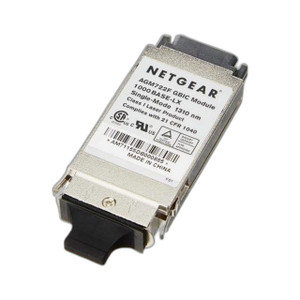
NETGEAR AGM732F 1000BASE-LX SFP GBIC Single-Mode Transceiver
The NETGEAR AGM732F is a 1000BASE-LX single-mode fiber SFP transceiver designed for long-distance gigabit Ethernet interconnects across campus networks, multi-building sites, and data center backbone links. Unlike copper cabling, which attenuates signal over distance, the 1000BASE-LX standard extends reliable gigabit connectivity up to 10 km without intermediate amplifiers or regeneration — a critical capability when copper runs are impractical or prohibited by electromagnetic interference. This hot-swappable module plugs directly into any SFP slot on NETGEAR enterprise-class managed and smart-managed switches, making it the standard choice for fiber-based network expansion where distance and isolation matter.
Key Features
- 1000BASE-LX Standard: Single-mode fiber support up to 10 km span. Eliminates signal regeneration and intermediate hops over long backbone runs.
- Hot-Swappable SFP Form Factor: Plugs into any standard SFP slot on compatible NETGEAR switches. Live insertion without downtime on supported platforms.
- Single-Mode Fiber Optimized: Engineered for SM fiber only — delivers full 10 km reach. Multimode fiber reduces range to ~500 m and increases insertion loss.
- Industrial Temperature Rating: Operates across extended temperature range. Tolerates uncontrolled equipment closets, outdoor-mounted cabinets, and rooftop enclosures without derating.
- LC Connector Interface: Standard LC/UPC or APC connector ports for universal fiber patch-cord compatibility. Mechanical durability rated for 500+ mating cycles.
- 5-Year Warranty: Covers defects in materials and workmanship. Standard NETGEAR depot repair terms apply.
Deployment Context & Integration
The AGM732F bridges the gap between switch locations where copper cannot span or where EMI isolation is mandatory. Campus deployments routinely use these for building-to-building backbone links — a 500 m copper run becomes a 10 km fiber run with zero regeneration overhead. Data center environments benefit from isolation between floor-level switches and core aggregation points; the single-mode fiber eliminates crosstalk and grounds loops that plague multi-strand copper bundles. Verify your NETGEAR switch model includes at least one hot-swappable SFP slot — not all fixed-port or non-modular switches support removable transceivers. Check the switch datasheet for SFP compatibility before purchase.
Single-mode fiber installation demands discipline: SM cable only, LC/UPC or APC connectors, and careful port handling to avoid optical damage. Patch cords with mismatched connector types (UPC on one end, APC on the other) will introduce reflection loss and intermittent frame errors. Industrial temperature rating ensures performance stability in thermally dynamic spaces — equipment closets in uninsulated buildings, rooftop cabinets with seasonal swings, and outdoor-mounted network shelters. The module itself dissipates minimal heat; power consumption is passive (no external DC required).
Integration with NETGEAR management platforms (NETGEAR Insight for smart-managed switches, or native SNMP/CLI for fully managed lines) provides port-level visibility and transceiver diagnostics. Many NETGEAR switches report SFP operational status, link state, and (on advanced models) real-time loss-of-signal alerts. This telemetry is invaluable for proactive identification of bent fiber, dirty connectors, or end-of-life module degradation before application-level outages occur.
Total Cost of Ownership & Lifecycle
Fiber backbone infrastructure incurs upfront cost (transceiver, single-mode cable, connectors, installation labor) but delivers exceptional long-term ROI: single-mode fiber is immune to EMI, requires no active cooling, has no refresh cycle (silicon transceivers age; passive fiber does not), and scales to 100 Gbps without replacing the physical plant. The 5-year warranty aligns with typical data center refresh cycles. If you anticipate future 10G or 25G upgrades on the same fiber plant, factor in SFP+ or SFP28 transceiver costs — they plug into the same slots on newer switches but require different module types. For greenfield projects, consider future speed requirements during initial fiber installation to avoid redundant conduit and splicing work.
Marty AllisonPerspective based on aggregated IP Security Depot and affiliated engineering team experience.
We've deployed the AGM732F across campus backbone links, data center interconnects, and remote site aggregation points — it's a mature, reliable transceiver that solves the 10 km distance problem elegantly. The real operational win is elimination of amplifier cascades and active regeneration: fiber runs self-heal, transceiver swaps take minutes, and you avoid the support overhead of chained repeaters. Compared to active copper or short-range SFP modules, the 1000BASE-LX trades slightly higher module cost for zero intermediate equipment, lower power envelope, and indefinite lifespan (fiber doesn't age). The gotchas are real: mismatched connector types, dirty LC ferrules, and incorrect fiber mode (SM vs. MM) introduce insertion loss and phantom intermittent errors that waste troubleshooting hours. We've seen integrators order multimode SFP modules by mistake, then wonder why they get 500 m instead of 10 km — verify fiber type before installation. Industrial temperature rating is genuine — these work reliably in uninsulated rooftop cabinets and outdoor enclosures where copper transceivers would thermally shut down.
Technical Highlights:
- 1000BASE-LX Reach (10 km): Single-mode fiber extends gigabit links across multiple campus buildings or data center floors without regeneration. Eliminates active repeaters and the power/cooling overhead they require. On a distributed surveillance or access-control network, this translates to fewer network bottlenecks and simpler troubleshooting topology.
- Single-Mode Fiber Requirement: SM fiber is narrower and more sensitive than multimode — your cable plant must be SM-grade from day one. Swapping to SM cable mid-deployment is disruptive; specify it correctly in the RFQ phase. The payoff is 20x longer reach and immunity to modal dispersion that plagues multimode links over long runs.
- Hot-Swappable Form Factor: SFP transceivers live-insert into compatible switches. Field replacements take seconds and require no downtime if the switch supports in-service module swaps (most modern NETGEAR managed switches do). This modularity pays dividends when a transceiver fails or when you upgrade from 1G to 10G on the same fiber backbone in the future.
- Industrial Temperature Envelope: Rated for extended operating temperature — from freezing rooftop cabinets to hot equipment closets without thermal throttling. Standard commercial transceivers often derate or fail in uncontrolled environments; this one is built for edge deployments.
- Passive Power Profile: No external DC supply required. The SFP draws power from the switch backplane alone. This simplifies outdoor or remote installations where AC infrastructure is limited.
Deployment Considerations:
- Fiber cleanliness is non-negotiable. Dirt, dust, or connector pitting on LC ferrules introduces insertion loss and reflection noise that manifests as packet loss or intermittent link drops. Use lint-free wipes and factory-sealed connectors. Have a spare fiber-cleaning kit on-site for troubleshooting.
- Connector mismatch (UPC to APC on same cable run) introduces 0.5+ dB loss and reflection spikes. Standardize on UPC across your entire fiber plant unless your fiber vendor specifies APC for a particular link. Mixing types is a silent source of marginal links that fail under load.
- Multimode fiber will not achieve 10 km range. If you inherit an existing multimode fiber plant, the AGM732F will work but with severely degraded reach (typically 500 m) and higher insertion loss. Plan for fiber replacement or accept distance limitations upfront.
- SFP slot availability varies by NETGEAR switch model. Verify your target switch includes at least one hot-swappable SFP port before speccing this transceiver. Fixed-fiber switches and older compact models may not support removable modules.
- Transceiver diagnostics vary by switch platform. Advanced managed switches report real-time loss-of-signal and optical power levels; basic models may only show link state. Review your switch's SNMP MIBs and CLI output capabilities if you require proactive transceiver monitoring.
The AGM732F is the right choice for integrators deploying NETGEAR managed or smart-managed switches where distance or EMI isolation demands fiber backbone links. It's a no-surprises component — mature, widely installed, and backed by a 5-year warranty. For projects spanning campus buildings, data centers, or sites with long copper runs, this transceiver eliminates regeneration complexity and future-proofs your fiber infrastructure. Pair it with discipline around fiber handling, connector standards, and cable plant specification — and your backbone will outlive three switch generations. See the NETGEAR catalog for compatible switch models and other fiber-transport options.