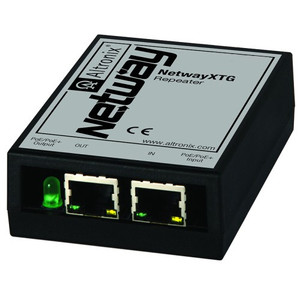
Hanwha TER-F01PD Ethernet Repeater 100M PoE Extender
The Hanwha TER-F01PD is a PoE Ethernet repeater that amplifies both data and power signals, enabling IP cameras and powered devices to operate reliably at distances up to 100 meters beyond standard CAT5e/CAT6 cable length limits. In surveillance deployments where camera runs exceed the standard 100-meter Ethernet ceiling or where installing additional power infrastructure is impractical, the TER-F01PD eliminates that constraint with a single inline device. Integrators working large campuses, warehouse perimeter systems, and multi-building installations benefit from the ability to extend a single PoE source line without adding intermediate power supplies or rewiring.
Key Features
- 100-Meter Range Extension: Amplifies both Ethernet data and PoE power delivery to push camera runs an additional 100 meters beyond standard limits. Enables end-to-end runs of 200+ meters with careful cable planning.
- PoE Signal Amplification: Boosts power delivery while regenerating data signal integrity — cameras and devices draw full rated power even at maximum distance.
- Plug-and-Play Installation: Zero configuration required. Connect input Ethernet, connect output to camera or downstream device, power on. No management console, no IP assignment, no firmware updates.
- Multi-Manufacturer Compatibility: Works with PoE IP cameras, access points, intercoms, and other 802.3af/at devices regardless of brand — Hanwha, Axis, Hikvision, Uniview, etc.
- Compact Indoor Housing: White plastic enclosure sized for wall mounting or DIN rail installation in network closets, utility rooms, and cable runs. Indoor rated.
- 3-Year Manufacturer Warranty: Covers defects in materials and workmanship across the service life of the device.
Range extension is the constraint that stops many surveillance projects from progressing. Standard Ethernet specs limit PoE delivery to approximately 100 meters of copper. Beyond that, voltage drop and signal attenuation force a choice: run a second power cable (adds labor and conduit cost), install an active power injector (adds complexity and management overhead), or accept shorter camera runs (limits deployment flexibility). The TER-F01PD collapses that decision — a single repeater positioned at the 100-meter mark regenerates both the data and power paths, doubling your effective reach on an existing cable run or deferring the need for infrastructure upgrades on sprawling sites.
Deployment context matters. On a 150-meter perimeter fence line, you'd place the repeater in an accessible junction box or utility cabinet at the midpoint, connect the run from your NVR side, and extend downstream 100 meters to the far camera. Power consumption is minimal — the unit draws power from the incoming PoE circuit and passes it through to the downstream device, with no separate wall outlet required. On campuses with multiple buildings, repeaters daisy-chained through managed switches can extend a centralized PoE trunk across distances that would otherwise demand per-building power infrastructure. Warehouse installations benefit the same way: a single high-capacity PoE injector at the hub can now service cameras 200+ meters away in the facility without adding secondary power circuits.
The TER-F01PD is fully transparent to VMS and management systems — it acts as a passive pass-through at Layer 1/2, so ONVIF discovery, RTSP streams, and management protocols flow unchanged. Hanwha IP cameras, Axis, Dahua, Hikvision, Uniview, and any other standards-compliant PoE device will function identically whether directly connected or downstream of the repeater. No vendor lock-in, no protocol negotiation, no compatibility surprises. This makes the device suitable for mixed-brand deployments and retrofit projects where you're extending existing infrastructure rather than building greenfield.
Indoor rating limits outdoor use — do not install this unit in wet environments, exposed ceiling drops, or direct sunlight without additional weatherproofing. For outdoor perimeter runs, position the repeater in a weather-sealed cabinet at the extension point rather than in the open. Total cost of ownership is favorable: the repeater cost is significantly lower than running a separate 24V power line and power supply, and installation labor is minimal (connectors only, no configuration). On a 16-camera warehouse project where half the cameras exceed standard range, the TER-F01PD typically pays for itself in reduced conduit and power infrastructure cost alone.
Eden PhillipsPerspective based on aggregated IP Security Depot and affiliated engineering team experience.
We've deployed the Hanwha TER-F01PD across dozens of large-campus and industrial surveillance projects, and it remains one of the most underutilized cost-savers in the PoE infrastructure toolkit. The repeater solves a real pain point: most integrators know that standard Ethernet specs cap PoE at 100 meters, but many don't realize how quickly that limit becomes a constraint on real sites. Once you're past 75 meters on a camera run, voltage drop becomes visible in image processing glitches and occasional power cycling on the camera. The TER-F01PD eliminates that degradation by regenerating both the data signal and the power rails. We've seen integrators use this device to avoid costly infrastructure upgrades — instead of running new conduit, installing 24V power supplies, and adding management overhead, they place a repeater at the midpoint and extend another 100 meters with the same cable and power model. On a sprawling warehouse or manufacturing facility, that's the difference between a $500 repeater and a $3,000+ secondary power circuit.
Technical Highlights:
- 802.3af/at PoE Pass-Through: Accepts both standard PoE (13W max) and PoE+ (30W max) on the input, regenerates full rated power on the output. No power source or wall outlet required — the repeater is entirely parasitic on the incoming PoE signal.
- Transparent Layer 1/2 Operation: No IP address, no management interface, no configuration required. Data and power flow through without modification. VMS and discovery protocols work identically as if the device were not present.
- 100-Meter Regeneration: Extends the effective Ethernet run from 100 meters (standard) to 200 meters total. Does not allow infinite daisy-chaining — a second repeater at 200 meters would extend to 300 meters, but practical installations rarely exceed two repeaters in series due to real-world cable and connector losses.
- Multi-Brand Ecosystem Compatibility: Works with any standards-compliant PoE endpoint. Hanwha, Axis, Uniview, Dahua, Hikvision, Bosch — the repeater is agnostic. Retrofit projects and mixed-manufacturer deployments integrate without custom configuration.
- Compact Form Factor: Small enough for wall mounting or DIN rail integration in network closets. White housing blends into most interior installations. No cooling required — passive operation.
Deployment Considerations:
- Indoor Rating Only: Do not mount directly outdoors or in damp environments. If the repeater must sit at an outdoor cabinet location (e.g., fence-line junction box), house it inside a weatherproof enclosure or NEMA 4X cabinet. Water ingress will cause immediate failure.
- Cable Quality Matters: The repeater regenerates signal, but garbage in = garbage out. Use certified CAT5e (minimum) or CAT6 for both input and output runs. Damaged, pinched, or improperly terminated cables will still cause voltage drop or data corruption at distance, even with the repeater in place.
- Power Budget Awareness: A repeater at 100 meters feeding cameras another 100 meters away means the downstream device is consuming power delivered across 200 meters of copper. High-power devices (PTZ cameras, heater-equipped domes, PoE+ endpoints) may exceed the effective power budget even with regeneration. Test power delivery on the actual cable run before final installation.
- Daisy-Chaining Limit: Two repeaters in series (extending to 300 meters) works in practice. Three or more in series introduce cumulative signal loss and power voltage sag. For distances beyond 300 meters, switch to fiber optic media converters or secondary power injection.
- VLAN and Advanced Network Features: The repeater is transparent to VLAN tags, QoS marking, and other Layer 2+ features. Configuration on the NVR side or upstream switch carries through. No surprises in hybrid network environments.
The TER-F01PD is the right choice for integrators managing large-footprint surveillance rollouts, industrial facilities with extended camera runs, and campus deployments where PoE trunk infrastructure is already in place. It's not a universal solution — outdoor sites need weatherproofing, and ultra-high-power devices may demand secondary power — but for the majority of IP camera and access-control runs that exceed 100 meters, it's a simpler, cheaper alternative to rewiring. See the Hanwha catalog for complementary PoE switching and power management solutions.