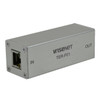
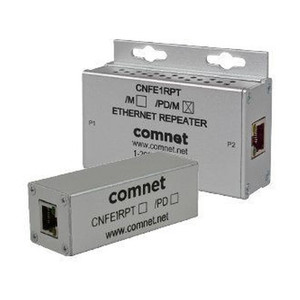
Hanwha TER-F01 Ethernet Repeater 100M PoE Pass-Through
The TER-F01 is a compact Ethernet repeater engineered to solve one hard problem: extending network reach beyond the standard 100-meter Ethernet cable limit while preserving power delivery to downstream devices. Built for IP surveillance deployments and large-scale network installations, this repeater eliminates cable-run restrictions without requiring additional power infrastructure or complex configuration.
Key Features
- 100-Meter Signal Extension: Amplifies Ethernet signals to expand coverage beyond the standard single-run limitation. Critical for camera placement in large campuses, warehouses, or perimeter positions where the distance from the central switch or NVR would otherwise require intermediate power injection.
- Pass-Through PoE Delivery: Both data and power pass through to the downstream device via a single cable. This means you avoid splitting cables or installing a separate power supply at the repeater location—a real savings on installation labor and materials.
- Plug-and-Play Operation: No configuration required. Connect, power it from the incoming PoE, and it immediately begins repeating. No VLAN tagging, no IP assignment, no management interface—just plug in and it works.
- Compact Form Factor: Small enough to mount in cable trays, junction boxes, or equipment racks without consuming significant real estate.
- Broad Device Compatibility: Works with Hanwha IP cameras, NVRs, and any standard PoE-enabled networked device. No proprietary protocol—it operates at the Ethernet physical layer, making it vendor-neutral.
- Wired Indoor Deployment: Designed for protected environments (buildings, cable runs in conduit). Not rated for direct outdoor exposure; install in weatherproof enclosures if placed on exterior walls or masts.
Why This Matters for Your Network
Standard Ethernet runs max out at 100 meters due to signal degradation over twisted-pair cable. The TER-F01 (often searched as TER F01) solves this by regenerating the signal and passing PoE power forward without loss. In a warehouse surveillance retrofit, for example, if your NVR is 180 meters from a camera at the far end of the facility, you'd normally install an intermediate PoE injector or add a second switch. The TER-F01 eliminates that step—one cable run from switch to repeater, one from repeater to camera, PoE power flows end-to-end.
Integration & Compatibility
The TER-F01 integrates seamlessly into Hanwha surveillance ecosystems and works equally well with third-party IP cameras and PoE devices that follow standard 802.3af/at power limits. It does not require management, does not consume DHCP addresses, and does not interrupt traffic—it regenerates and repeats transparently. If you're planning a multi-building campus deployment or need to extend a run beyond a single 100-meter segment, pair this with PoE-capable network switches and PoE power planning to confirm your power budget across the full extended run.
Typical Deployments
- Large commercial or industrial campuses where camera placement is far from central equipment rooms
- Perimeter security systems with coverage at remote fence lines or property boundaries
- Warehouse and logistics facilities requiring distributed camera coverage without intermediate power infrastructure
- Retrofit and expansion projects where drilling new conduit or adding power supplies is impractical
- Enterprise networks integrating distributed IP surveillance across multiple buildings or floors
Deployment Considerations
The repeater itself draws power from the incoming PoE feed and must operate within the power budget of a standard 802.3af source (roughly 15W available after accounting for cable losses). If your downstream camera requires more than 13W, ensure your upstream PoE source can deliver enough power to feed both the repeater and the camera. Cable quality matters—use certified Cat5e or Cat6 cable to maintain signal integrity over the full 200-meter span (100m + 100m). If you exceed this distance, install a second repeater.
When to Choose a Different Approach
If you need to extend beyond 200 meters total, chain multiple TER-F01 units or consider a managed PoE switch at an intermediate location. If power requirements exceed 802.3af budget, a PoE+ (802.3at) injector or switch becomes necessary. For outdoor cable runs subject to weather exposure, plan for weatherproof enclosures or conduit—the TER-F01 itself is rated for indoor use only.
Ted PerryPerspective based on aggregated and affiliated engineering team experience.
The TER-F01 solves a real constraint: 100 meters is the hard limit for Ethernet signal integrity. This repeater buys you another 100 meters without requiring a power supply at the midpoint or complex reconfiguration. In multi-building deployments, that simplicity translates to faster installation and fewer failure points.
Technical Highlights:
- Pass-Through PoE Architecture: The repeater accepts incoming PoE, regenerates the Ethernet signal, and forwards PoE power to the downstream device. No power loss, no intermediate injector needed. Matters when you're running 180+ meters total and want to avoid a second power supply installation.
- Plug-and-Play Operation: Zero configuration. Eliminates the need for management overhead on what should be a transparent infrastructure element. Reduces deployment time and support burden.
- Broad Compatibility: Works with any standard PoE device. Not locked to Hanwha. If you're mixing manufacturers or upgrading cameras later, the repeater stays in place and adapts.
Deployment Considerations:
- Power budget is your constraint. A standard 802.3af source delivers roughly 15W usable after cable loss. Verify that the repeater (drawing ~2–3W) plus your downstream camera (drawing up to 13W for 802.3af devices) fits within that envelope. If your camera needs 90W (PoE++), this repeater won't work—you'll need a managed switch or PoE+ injector at the midpoint.
- Indoor-only rating. If your cable run crosses outdoor sections or exposed eaves, wrap it in conduit and mount the repeater in a weatherproof box. Moisture ingress will kill it.
- Single 100-meter extension per unit. If your total distance exceeds 200 meters, chain two repeaters or switch to a managed switch strategy.
Use the TER-F01 for campus surveillance retrofits where the camera is genuinely 150–200 meters from the switch and you want to avoid a second power supply or conduit run. For mega-spans, perimeter fence lines, or power-hungry cameras, plan infrastructure first and consider whether a managed switch investment makes more sense than chaining repeaters.
Frequently Asked Questions
Q: Can I chain multiple TER-F01 units to extend beyond 200 meters?
A: Yes. Each repeater adds another 100-meter extension. Connect switch → repeater #1 → cable run → repeater #2 → camera. Power flows through-line. However, power loss accumulates across longer runs, so confirm your PoE source is rated for the aggregate wattage (repeaters + camera).
Q: Does the TER-F01 require any configuration or management?
A: No. It is a plug-and-play device with no IP address, no web interface, and no configuration. Connect PoE in, connect camera out, it works immediately.
Q: What is the maximum PoE power the TER-F01 can pass through?
A: The repeater is designed for standard 802.3af PoE (up to 15.4W at the source, roughly 13W usable after cable loss). It will handle PoE+ (802.3at) sources, but power delivery to the downstream device is limited by the incoming source. Verify your upstream switch or injector matches your camera's power requirement.
Q: Is the TER-F01 suitable for outdoor cable runs?
A: The repeater itself is rated for indoor use only. If your cable run crosses outdoor sections, use conduit and mount the repeater in a weatherproof enclosure. The Ethernet cable can be outdoor-rated, but the device must be protected from direct weather exposure.
Q: Does the TER-F01 work with non-Hanwha IP cameras?
A: Yes. It is vendor-neutral and operates at the Ethernet physical layer. Any standard PoE-enabled IP camera (Axis, Hikvision, Uniview, etc.) will work with it as long as the total power draw fits within your PoE source budget.
Q: What cable type should I use with the TER-F01?
A: Use certified Cat5e or Cat6 Ethernet cable (UTP or STP). Cable quality directly affects signal regeneration performance. Avoid cheap, uncertified cable—signal loss over 100 meters compounds at the repeater input.