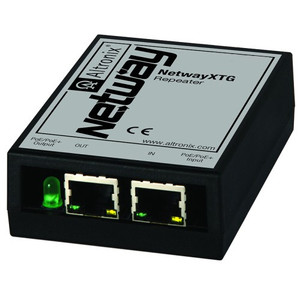
Comnet CNFE1RPT 100 Meter Ethernet Repeater with Pass-Through PoE
Overview
The Comnet CNFE1RPT is a 10/100 Mbps Ethernet repeater that extends network signals and power beyond the standard 328-foot (100 meter) Ethernet limit. The CNFE1RPT operates on pass-through PoE power from a switch or midspan injector—no local power supply required—making it ideal for remote surveillance deployments where power infrastructure is limited. Multiple units can be chained in series, with each repeater adding another 328 feet of extension, allowing you to reach distances up to 656 feet with a single repeater or 2,625 feet with seven units in proper power configurations. This is a purpose-built solution for extending both signal and power to IP cameras, access control devices, and other PoE-powered equipment in demanding environments.
Key Features
- Pass-Through PoE Support (60W): Accepts IEEE 802.3af/at PoE input and passes full power downstream to the next device, eliminating the need for separate power injection at the repeater location. This matters for remote sites where adding local power infrastructure is expensive or impractical—one PSE device at the source can power a chain of cameras or readers.
- 328-Foot (100 Meter) Extension per Unit: Each CNFE1RPT regenerates the Ethernet signal, allowing you to double distance to 656 feet with one repeater or extend further by stacking multiple units. In a 200-meter warehouse or campus environment with moderate PoE loads (15–20W per device), two repeaters deliver clean signal and stable power delivery.
- Low Power Consumption (<1W): The repeater itself draws minimal power, ensuring nearly all available PoE budget flows to your end devices. On a 15W PoE switch, this means maximum watts reach cameras or access readers instead of being consumed by the infrastructure.
- Compact Form Factors (Tube & Mini): The standard tube design (3.3 × 1.25 × 1.25 in) fits directly inside conduit or small enclosures for seamless integration with existing cable runs. A mini variant (3.3 × 2.5 × 1.1 in) supports surface or DIN-rail mounting with the optional DINBKT4 bracket, giving you flexibility in equipment rooms or outdoor cabinets.
- Extended Operating Temperature (-40°C to +75°C): Rated for harsh climates—desert heat, high-altitude cold, or unheated equipment sheds—without thermal de-rating. This is critical for campus networks, airport grounds, and industrial sites where ambient temperature swings are severe.
- Plug-and-Play Installation: No configuration required. Insert the repeater in line between your PoE source and end device, and it regenerates both signal and power immediately. LED status lights confirm link and activity, helping you troubleshoot cable runs or device failures in the field.
- Full 10/100 Mbps Bandwidth: The repeater operates in full-duplex mode without bandwidth restriction, preserving the native speed of your Ethernet link. For surveillance systems delivering 5–10 Mbps per camera, this leaves plenty of headroom for multiple simultaneous streams.
- High Reliability (>100,000 Hour MTBF): Mean time between failures exceeds 100,000 hours, translating to roughly 11+ years at continuous operation. This is typical industrial-grade durability for devices that rarely receive maintenance after installation.
Integration & Compatibility
The CNFE1RPT works with any standard PoE switch or injector meeting IEEE 802.3af or 802.3at output specifications. It regenerates and passes through the 48V or 50V PoE signal without modification, so it integrates seamlessly into existing surveillance and access control networks. The repeater is available in two modes: standard pass-through (extends power downstream) or /PD variant (acts as final PoE endpoint, does not pass power further). Choose /PD when the CNFE1RPT itself is the last device in the chain and you want to guarantee full power isolation for a camera or reader at that location. The device complies with IEEE 802.3 Ethernet standards, RFC protocols (UDP, HTTP, TCP, IP, TFTP), and meets NEMA TS-1/TS-2 environmental compliance for traffic and industrial control equipment—a mark of rugged design pedigree.
Power and Transmission Performance
Maximum transmission distance depends on the PoE source and device power consumption downstream. A 15W PoE switch can reach 100 meters without repeaters, 200 meters with one CNFE1RPT, or up to 450 meters with four repeaters (assuming low-power devices like 5W cameras). A 30W PoE+ switch extends to 300 meters with one repeater and 600 meters with five units. A 60W PoE++ source supports seven repeaters for 800-meter-plus runs with moderate power draw per endpoint. These distances assume 48V or 50V PSE voltage at the source; actual range scales with device wattage, cable gauge (Cat5e vs Cat6), and ambient temperature. Repeaters operate independently—each passes full PoE current with high-impedance protection and start-up voltage detection to prevent device damage from voltage transients.
Environmental Durability
Operating temperature spans -40°C to +75°C with storage tolerance to -80°C, covering unheated outdoor cabinets, rooftop enclosures, and industrial spaces. Humidity tolerance of 0–95% (non-condensing) means fog, salt spray, and high ambient moisture won't degrade performance. The repeater is designed and manufactured in the USA and carries a lifetime manufacturer warranty, reducing replacement uncertainty in long-term deployments.
What's in the Box
The CNFE1RPT ships as a single unit in either tube or mini configuration. No mounting hardware, cables, or adapters are included; these are specified separately based on your installation environment. For DIN-rail mounting of the mini variant, order the DINBKT4 bracket separately.
Frequently Asked Questions
Q: Can I use the CNFE1RPT to extend PoE to multiple cameras in a daisy-chain?
A: Yes, the standard CNFE1RPT passes PoE through to the next device in the chain. You can daisy-chain multiple repeaters, with each adding 328 feet of extension. A /PD variant (sold separately) terminates the chain and does not pass power further, useful if the repeater itself is your final device location.
Q: What happens if I run out of PoE power before reaching the next repeater?
A: The repeater's built-in start-up voltage detection and current limiting protect against under-voltage faults. If downstream devices draw more than available PoE budget, the PSE will shut down or cycle. Refer to the transmission distance chart in the datasheet—it shows maximum reach for different PoE wattages and device power consumption. Plan for headroom; do not assume full budget is available.
Q: Does the CNFE1RPT work with PoE++ (802.3bt)?
A: The CNFE1RPT supports IEEE 802.3af and 802.3at (PoE and PoE+ up to 30W). It does not officially support 802.3bt PoE++. However, it will pass through higher voltages if your PSE delivers them; verify with the manufacturer or your systems engineer before deploying in a PoE++ environment.
Q: Can I install the tube version directly in outdoor conduit without additional weatherproofing?
A: The tube design allows installation inside conduit, but the connectors remain exposed at the ends. Ensure RJ-45 connections are protected from standing water and direct spray. Outdoor cable glands or weatherproof connector covers are recommended for permanent outdoor installations.
Q: What's the warranty on the CNFE1RPT?
A: The CNFE1RPT carries a lifetime manufacturer warranty from Comnet. Coverage typically includes defects in material and workmanship; confirm specific terms with Comnet technical support at 1.888.678.9427.
Q: Is the CNFE1RPT NDAA Section 889 compliant?
A: No NDAA compliance certification is listed in the product documentation. If you require NDAA compliance, contact Comnet technical support to confirm availability of approved variants.
The Comnet CNFE1RPT solves a real problem: extending Ethernet and power beyond 328 feet without running new infrastructure to every remote location. In a multi-building campus or warehouse with cameras scattered across docks and yards, the pass-through PoE design means you activate the repeater with the same switch port that powers the camera—no equipment room redesign, no additional UPS circuits. The <1W power draw ensures your PoE budget stays intact; I've seen deployments where engineers burned 5–10W on inferior repeaters and ran out of switch capacity before reaching half the camera count they needed.
Technical Highlights:
- 60W Pass-Through PoE (802.3af/at): Supports full IEEE standard power delivery without step-down or regeneration loss. On a 30W PoE+ switch, you get 2–3 cameras per port at distance with a single CNFE1RPT; scale to five repeaters and you reach 600 meters with the same power budget intact.
- 328-Foot Repeater Spacing: Each unit extends signal one standard Ethernet run. In gridded warehouse layouts or campus quadrangles, this modular approach beats alternatives that force you to install everything in one topology. Mix and match repeater counts to fit your layout.
- Extended Temperature (-40°C to +75°C): Unheated outdoor cabinets, rooftop equipment sheds, and parking structures won't thermally shut down the CNFE1RPT. This is a hard spec advantage over consumer-grade repeaters that derate above 60°C.
Deployment Considerations:
- Transmission distance depends directly on downstream device wattage. A 5W camera lets you reach farther than a 20W PTZ on the same PoE source. Use the included distance chart to size your repeater count; undersizing repeaters kills voltage margin and causes flaky connections.
- The /PD variant terminates PoE at that location. If you order the standard CNFE1RPT and chain repeaters, ensure your final device is either a standard CNFE1RPT powering a camera or a /PD unit if the repeater itself is the last node.
The CNFE1RPT is the right pick for fixed surveillance infrastructure in geographically spread sites—airports, campuses, industrial parks, casinos. If you're running fiber backhaul and just need to extend the last copper run 200–400 meters to a camera, this beats buying a new PoE switch or running a separate power line to the field.