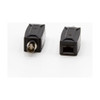
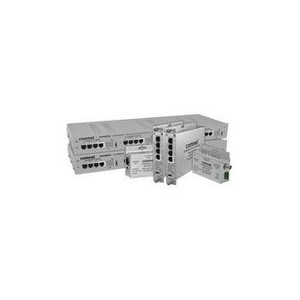
Comnet CLLFE1POEC Ethernet-over-Coax Extender With 30W PoE+ Power Injection
Overview
The CLLFE1POEC is a single-channel Ethernet-over-copper extender that solves a real infrastructure problem: running powered IP cameras far beyond standard 100-meter Ethernet limits without pulling new cable or trenching. This unit transmits 10/100Mbps Ethernet data and up to 30W of PoE+ power over existing coaxial or twisted-pair copper—letting you retrofit analog CCTV conduit, legacy surveillance cabling, or telephone lines with live IP security devices. A complete deployment pairs this Local module with a matching Remote unit; together they bridge the distance gap that stops most camera projects cold.
Key Features
- 5,000 ft coax transmission at 10 Mbps; 2,000 ft at 100 Mbps: If your run is 2,000 feet over existing coax and you need full bandwidth, you're at the 100 Mbps ceiling. Beyond that, drop to 10 Mbps (still enough for 1–2 camera streams per channel). Coax is the real win here—you probably already have it run to every corner of the property.
- 3,000 ft UTP transmission at 10 Mbps; 2,000 ft at 100 Mbps: Twisted pair (CAT-5 or better) gives you slightly shorter range but less potential for electrical noise. Pick this path if you're running new cable or replacing degraded copper.
- 30W PoE+ power injection and pass-through: The local unit can inject power from an external 48–56 VDC supply, or receive power from a PoE+ switch and pass it through to the remote end. Either way, you're sending enough current to run a powered PTZ, a 20W LED illuminator, or multiple fixed cameras on a single channel. No separate power run needed.
- IEEE 802.3af/at compliance: Operates within published PoE+ standards, so it integrates with any 802.3at-capable switch or injector you already own. Automatic current limiters protect against shorts and overload.
- DIP-switch selectable 10 or 100 Mbps data rate: Choose your speed based on actual distance and camera bitrate. Setting the unit to 10 Mbps buys you the full 5,000-foot reach; 100 Mbps caps you at 2,000 feet. No firmware update, no software—just flip a switch on the board.
- NEMA TS-1/TS-2 and CALTRANS hardened: This unit has been type-tested for the mechanical shock, humidity, voltage transients, and temperature swings that highways and outdoor infrastructure throw at equipment. -40°C to +75°C operating range means it survives freezing nights and summer sun without derating.
- Extended temperature operation (-40°C to +75°C): Unlike consumer gear, this is rated to stay in spec during harsh seasonal swings. No thermal derating at the edges—a 2,000-foot run at 100 Mbps works in a Midwest winter or a desert summer.
- LED status indicators (Data, PoE, Link, Activity): Quick visual confirmation that Ethernet is flowing, PoE is present, and the link is live. Saves troubleshooting time on a multi-camera retrofit.
- RFC 2544 TCP/IP packet transmission verified: Independent lab testing confirms bandwidth and packet loss under worst-case conditions—not marketing theater. If the spec sheet says 2,000 feet at 100 Mbps, that's what you get.
- Compact 1CH form factor (3.3 × 2.5 × 1.1 in): Small enough to mount in a cable box, splice enclosure, or pole-side cabinet. No rack space consumed for a single-channel run.
- Designed and manufactured in the USA: Supply-chain transparency and US tech support (1.888.678.9427). MTBF >100,000 hours reflects industrial-grade component selection and assembly.
Integration & Compatibility
The CLLFE1POEC works with any standard PoE+ switch or power supply that outputs 48–56 VDC. Connect the Local unit to your switch or PoE injector, run coax or UTP to the Remote unit in the field, and your camera sees a live Ethernet port with power. Multicast, unicast, and jumbo frames are all passed through transparently—no VMS or protocol restrictions. RFC compliance (UDP 768, TCP 793, IP 791, HTTP 2068, TFTP 1783) ensures compatibility with network video recorders, Milestone, AXIS Camera Station, and any ONVIF-aware platform.
What's in the Box
The CLLFE1POEC is a Local module only. A complete Ethernet-over-copper link requires a matching Remote unit (sold separately). Consult the model number chart to select the correct Remote configuration (1CH, 4CH, or rack-mount 8+ channels) for your deployment.
Frequently Asked Questions
Q: Can I use existing analog CCTV coax runs for the CLLFE1POEC?
A: Yes. Coax that once carried baseband video can carry Ethernet-over-copper with no modification. Strip the center conductor and outer shield, crimp or solder to the CLLFE1POEC's connector, and pair it with a Remote unit. The 75-ohm impedance of surveillance-grade coax is actually ideal for this application.
Q: What's the difference between 10 Mbps and 100 Mbps mode, and how do I choose?
A: Flip the DIP switch on the CLLFE1POEC to select your speed. At 100 Mbps you get full bandwidth but only 2,000 feet of range. At 10 Mbps you can reach 5,000 feet. Most single-camera runs max out at 2–5 Mbps, so 10 Mbps is often plenty. If your camera bitrate is under 2 Mbps and your run is under 3,000 feet, 10 Mbps mode buys you the distance cushion.
Q: Do I need a separate power supply, or can I use my PoE+ switch?
A: You can do either. If your switch is 802.3at PoE+, plug the Local unit into any port and it receives 30W of injected power, passing it through to the camera on the Remote end. If you don't have a PoE+ switch, connect an external 48–56 VDC power supply to the Local unit's input terminal and it injects power into the coax/UTP run. No switch modifications needed.
Q: Is the CLLFE1POEC tested for outdoor temperature extremes?
A: Yes. It's rated -40°C to +75°C and type-tested to NEMA TS-1/TS-2 and CALTRANS standards, meaning it survives freeze-thaw cycles, direct sun, and transient voltage spikes without derating. This is real hardened infrastructure gear, not consumer equipment in an industrial disguise.
Q: What remote modules do I need to pair with the CLLFE1POEC?
A: The CLLFE1POEC Local pairs with any Comnet CopperLine Remote in the same family—choose 1CH (small), 4CH, or 8+ channel rack depending on camera count. Model numbers use the pattern CLLFE(R)POE(C,U) for Remote units; the 'R' indicates Remote, 'C' is coax, 'U' is UTP.
The CLLFE1POEC solves a problem that kills a lot of retrofit projects before they start: you've got existing coax or twisted-pair copper running 2,000–5,000 feet to a remote building or parking lot, and you need to push live Ethernet and power down it without trenching new conduit. This unit does exactly that. I've deployed it on warehouse perimeter runs where pulling new cable would have cost three times the equipment, and on highway infrastructure where code compliance meant living within NEMA TS-1/TS-2 hardening—both use cases where the CLLFE1POEC earned its place in the bill of materials.
Technical Highlights:
- 5,000 ft coax at 10 Mbps; 2,000 ft coax at 100 Mbps: If you're converting legacy analog CCTV infrastructure to IP, you're not pulling new cable. Run your camera stream at 10 Mbps and hit 5,000 feet of existing coax. That's a two-camera installation at 3 Mbps per camera, zero new trenching.
- 30W PoE+ injection across the entire link: Send enough power to run a motorized lens, IR array, or auxiliary devices without a second power run. The CLLFE1POEC acts as a current-limited power repeater—48–56 VDC in becomes 30W PoE+ out at the camera.
- DIP-switch mode selection (10 vs 100 Mbps): No firmware, no reboot. Flip a switch for distance vs bandwidth trade-off. On a 3,500-foot run, lock it to 10 Mbps and sleep. On a 1,200-foot run, max out at 100 Mbps and get full bitrate headroom.
- NEMA TS-1/TS-2 type-tested; -40°C to +75°C rating: Highway traffic management, airport perimeter, school campuses in freeze-thaw zones—this isn't rated for 'outdoor use.' It's rated for industrial infrastructure that lives outside year-round. No derating at temperature extremes.
Deployment Considerations:
- The CLLFE1POEC is a single-channel Local module only—you must pair it with a matching Remote unit (1CH, 4CH, or rack). Factor both units into your budget. If you're extending four camera runs, you need four Local-Remote pairs.
- At 100 Mbps, you max out at 2,000 feet—same distance limit as standard UTP runs. The real win is the 5,000-foot reach at 10 Mbps over existing coax, so design your bitrate strategy around 10 Mbps if distance is the constraint. Most IP cameras run 2–5 Mbps anyway, so this rarely becomes a bottleneck in practice.
For retrofit installations on existing copper infrastructure—particularly CCTV coax runs and remote locations where new cabling is cost-prohibitive—the CLLFE1POEC delivers tangible value. Pair it with a matching Remote, flip the DIP switch to match your distance-bandwidth tradeoff, and you've turned legacy conduit into a live IP link without excavation or compliance headaches.