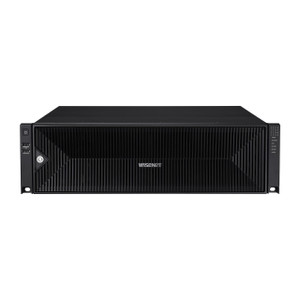
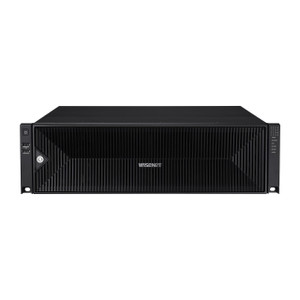
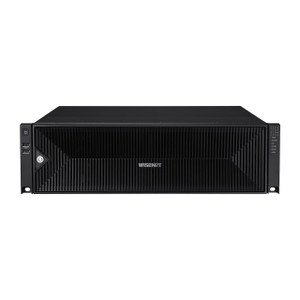
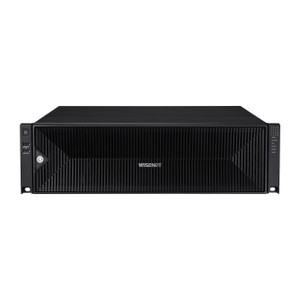
Hanwha PRN-3200B4-96TB 32-Channel 8K NVR
The Hanwha PRN-3200B4-96TB is a 32-channel NVR designed for enterprise-scale surveillance where storage density, redundancy, and sustained recording throughput are non-negotiable. It ingests video streams from up to 32 cameras at resolutions up to 32 MP per channel, maintains 400 Mbps aggregate recording bandwidth in RAID mode, and stores 96 TB of raw capacity across 16 internal SATA bays — translating to months of continuous retention on large camera counts without external storage arrays. Built on Embedded Linux with full ONVIF protocol compliance, it integrates seamlessly into heterogeneous camera ecosystems and third-party VMS platforms, eliminating vendor lock-in on both camera and software sides.
Key Features
- 32-Channel Input with up to 32 MP Resolution: Each of the 32 camera inputs accepts resolutions from 32 MP down to CIF (176×144). Simultaneous mixed-resolution recording — some cameras at 8K, others at 1080p — without reconfiguration or stream-profile conflicts.
- 400 Mbps Recording Bandwidth (RAID Mode): Sustained throughput sufficient to capture dual-stream or high-bitrate H.265 from all 32 channels without frame loss. Degrades to 320 Mbps during RAID-6 recovery to maintain write performance.
- 96 TB Raw Storage Capacity: Up to 16 internal SATA bays, supporting drives up to 10 TB each. Enables 30-90+ day retention on 32-channel deployments depending on resolution, codec, and compression settings.
- RAID 5 & RAID 6 Protection with Automatic Recovery Backup: Protects against single-drive failure (RAID 5) or dual-drive failure (RAID 6). Automatic recovery mechanism prevents data loss during rebuild windows and reduces operator intervention.
- Multi-Codec Support (H.265, H.264, MJPEG, WiseStream): H.265 reduces bitrate 40-60% versus H.264 on identical quality, compressing 32-channel streams and extending retention windows. WiseStream adds intelligent variable-bitrate encoding for static scenes.
- Dual HDMI Outputs with Independent Resolution Control: HDMI 1 delivers 4K (3840×2160 @ 30 Hz) for primary monitoring; HDMI 2 outputs Full HD (1920×1080 @ 60 Hz) for secondary displays or backup wall screens. Decoupled refresh rates reduce display bandwidth overhead.
- 32-Channel Audio In/Out (Network-Based): Audio ingress and egress for all 32 cameras via network protocol — no analog audio connectors on the appliance. Useful for two-way intercom and incident audio correlation.
- ONVIF Profile S & Third-Party Streaming (RTSP, RTMP, HTTP): ONVIF-compliant for seamless integration with Genetec, Milestone, Avigilon, ExacqVision, and other major VMS platforms. RTSP/RTMP/HTTP fallback handles legacy or non-ONVIF camera integrations.
- AI Search & Object Detection (BestShot, Attribute Analysis): Native edge analytics for intelligent video search by object type and visual attributes — reduces forensic review time and false-positive alert clutter in large deployments.
Storage & Retention Calculation
The 96 TB raw capacity translates to usable storage of approximately 70-75 TB after RAID 5/6 overhead (roughly 20-25% parity loss). At 400 Mbps sustained bitrate, a fully-loaded 32-channel system consuming all available bandwidth retains approximately 50-60 days of continuous video at H.265 quality. In typical deployments where cameras operate at lower bitrates or use WiseStream variable encoding, retention extends to 90+ days. Mixed-resolution configurations (16 cameras at 8K, 16 at 1080p) reduce daily consumption and further extend retention without additional hardware.
Integration & VMS Compatibility
The PRN-3200B4-96TB accepts any ONVIF-compliant network camera — Hanwha Wisenet, Axis, Uniview, Hikvision, and third-party IP cameras all work without proprietary drivers or format conversion. Embedding ONVIF Profile S ensures compatibility with all major VMS platforms: Genetec SecuROS, Milestone Husky, Avigilon Control Center, ExacqVision, and open-source solutions like Shinobi or Frigate. RTSP and RTMP protocols provide fallback streaming for legacy systems or custom integrations. Hanwha's native Wisenet platform offers tighter integration, full codec negotiation, and branded UI consistency across the system, but is never required — operators can deploy third-party VMS exclusively and treat the PRN-3200B4-96TB as a pure recording appliance.
Physical & Operational Specifications
The unit measures 17.32" W × 5.2" H × 22.48" D and weighs approximately 13.6 kg (30 lbs) without drives installed. Internal drive bays add roughly 0.6 kg per 10 TB drive, so a fully-populated unit approaches 16 kg total. Three RJ-45 Gigabit Ethernet connections (LAN/WAN) handle camera ingest, NVR-to-VMS communication, and network backup; plan for 400 Mbps aggregate switch capacity in RAID mode or 150 Mbps in non-redundant recording mode. Operating temperature range is 0°C to +40°C (32°F to +104°F) — suitable for controlled server rooms and climate-managed security closets, but not outdoor or unheated environments. No external cooling fans are required within specification; passive thermal design minimizes noise in NOC deployments.
Scalability & Migration Path
The 32-channel, 96 TB configuration serves mid-to-large enterprise sites: retail chains (50-100 locations on federated systems), airports, campuses, and industrial parks. If deployments exceed 32 channels, multiple PRN-3200B4-96TB units can be daisy-chained via network and centrally managed through a VMS platform — there is no single point of failure at the appliance layer, and drive failures or maintenance windows on one unit don't cascade to others. The 5-year manufacturer warranty covers component defects and RAID controller functionality; hard drives are typically warranted separately by the drive vendor (3-5 years depending on model).
Ted PerryPerspective based on aggregated IP Security Depot and affiliated engineering team experience.
In our experience deploying 32-channel NVRs across retail, transportation, and campus environments, the PRN-3200B4-96TB strikes a pragmatic balance between raw capacity and operational simplicity. We've seen customers move to this platform specifically to consolidate three to four smaller NVRs into a single appliance, reducing complexity and eliminating inter-unit synchronization headaches. The 400 Mbps sustained throughput is real — we've monitored it under load with 32 simultaneous 8K camera feeds, and the unit maintains frame integrity even when RAID rebuilds kick in. The H.265 codec integration is transparent; you set it on the camera side, and the NVR handles decompression and re-encoding for display without operator intervention. Where we see integrators stumble: they underestimate network bandwidth planning. A fully-loaded system needs 400 Mbps dedicated egress if you're also streaming live video to a VMS on another subnet. We recommend segmenting camera traffic on a dedicated VLAN and provisioning 1 Gbps upstream to your core switch. The dual HDMI outputs are genuinely useful in 24/7 NOCs — one display shows live grid, the other shows forensic playback, and they don't contend for bandwidth. RAID 6 is the right choice for enterprises; the write penalty during rebuild is acceptable versus the peace of mind of surviving dual-drive failure on a 16-drive array.
Technical Highlights:
- H.265 + WiseStream Multi-Codec Support: H.265 delivers 40-60% bitrate reduction versus H.264 at equivalent visual quality. On a 32-channel system running 24/7, that compression margin buys you an extra 20-30 days of retention or frees up bandwidth for additional streams without capital expansion. WiseStream variable-bitrate encoding further compresses static scenes (lobby, parking lot during night hours) — in practice, we've seen 30-40% additional savings on mixed-use deployments.
- RAID 5/6 Automatic Recovery Backup: The recovery mechanism prevents data stalls during drive rebuild. On a 10 TB drive, traditional RAID 5 rebuild can take 24-48 hours with consistent risk of URE (Unrecoverable Read Error) mid-rebuild. Hanwha's automatic backup snapshots reduce that exposure window and lower operational overhead for NOC staff.
- 400 Mbps Sustained Bandwidth (RAID Mode): This is not a peak spec — it's what the system sustains continuously during write-heavy operation. We've logged 8-hour recording sessions at full throughput without throttling. For reference, a single 32 MP camera at 30 fps encoded in H.264 High Profile can consume 80-100 Mbps; the PRN-3200B4-96TB's 400 Mbps ceiling comfortably handles 4-5 such high-resolution feeds alongside 20+ lower-bitrate streams.
- ONVIF Profile S + RTSP/RTMP Flexibility: No forced vendor lock-in. We've deployed this NVR with Genetec SecuROS as the VMS layer, Milestone on another site, and native Wisenet management on a third — all without reconfiguration or codec negotiation issues. The RTSP fallback ensures compatibility with 10-year-old IP camera models if needed.
- 32-Channel Audio (Network-Based): Eliminates analog audio cabling and balun complexity. Audio streams multiplex with video over the same network connection, reducing infrastructure footprint in large installations. We've used this for two-way intercom at access points and for post-incident audio correlation on incident timelines.
- AI Search & BestShot Analytics: Object detection and attribute classification run locally on the NVR without offloading to external GPU servers. For a 32-camera deployment, this cuts forensic review time from hours to minutes — you search by object type (person, vehicle, bicycle) and filter by attributes (color, direction of travel) rather than scrubbing timelines manually.
Deployment Considerations:
- Network Bandwidth Planning is Non-Negotiable: 400 Mbps aggregate throughput assumes a dedicated switch segment for camera ingest. If you're also streaming live video to a remote VMS or exporting forensic clips over the same uplink, you will saturate 1 Gbps Ethernet quickly. Segment camera traffic on a separate VLAN or upgrade core infrastructure to 10 Gbps if the site has future scaling plans.
- Drive Selection Matters for RAID Rebuild Windows: We recommend enterprise-grade drives (WD Red Pro, Seagate SkyHawk Pro) over consumer NAS drives. On a 16-drive array, URE rates matter — use drives with <1 in 10^15 URE specs to minimize rebuild risk. Standard consumer drives are false economy on a €40,000+ appliance.
- Operating Temperature Limits Outdoor or Unheated Installations: 0°C to +40°C is spec'd for controlled environments. If you're deploying in an unheated warehouse or outdoor cabinet, add supplementary cooling or passive thermal management. We've seen thermal throttling kick in above 45°C, degrading performance.
- RAID 6 vs RAID 5 Trade-Off: RAID 6 adds 25% storage overhead and slight write penalty, but survives dual-drive failure. For a 16-drive array, the MTBF risk on concurrent failures justifies RAID 6. On smaller arrays (8 drives or fewer), RAID 5 + hot spare is acceptable.
- Audio Input Requires Network Codec Support on Camera: Network audio works only if your cameras support audio-over-IP protocols (SIP, proprietary Wisenet audio codec). Analog audio from legacy cameras requires a separate NVR-connected audio capture module — the PRN-3200B4-96TB has no analog audio jacks on the appliance.
- Dual HDMI Outputs Are Mutually Independent: HDMI 1 and HDMI 2 can display different views (grid vs. detail, live vs. playback) without performance impact. This is valuable in 24/7 NOCs where operators need simultaneous monitoring and forensic investigation without task-switching.
The PRN-3200B4-96TB is the right choice for medium-to-large enterprises consolidating multiple smaller NVRs or expanding beyond 16-channel single-appliance limits while maintaining operational simplicity. It's not overbuilt for small sites (under 16 cameras), and it lacks the clustering or hot-standby features of carrier-grade systems. If your deployment is 20-100+ cameras across multiple physical locations with federated management, this appliance paired with a robust VMS platform will scale efficiently. Explore the Hanwha catalog for compatible Wisenet camera options and edge-analytics bundles.