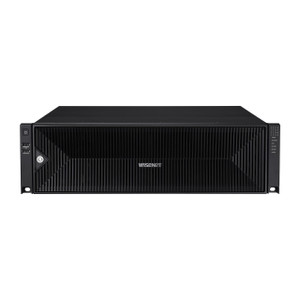
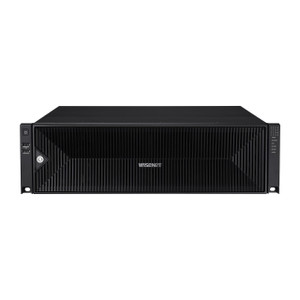
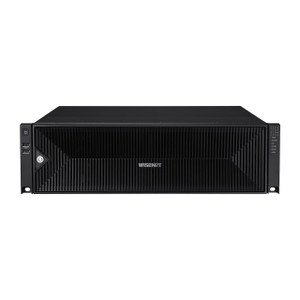
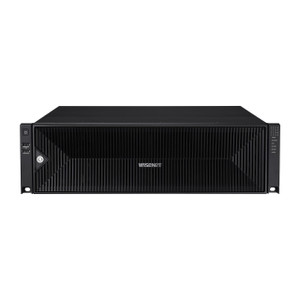
Hanwha PRN-3200B4-88TB 32-Channel 8K NVR with 88TB Storage
The Hanwha PRN-3200B4-88TB is a 32-channel network video recorder engineered for large-scale enterprise surveillance deployments where mixed-resolution camera fleets, sustained high-bandwidth recording, and fault-tolerant storage are operational requirements. This unit accepts up to 32 channels of network camera input across resolutions from 32MP down to CIF, stores 88TB of video natively via 16 SATA HDDs (up to 10TB each), and sustains 400 Mbps distributed recording bandwidth — enough to handle simultaneous 32MP feeds without frame loss or codec switching overhead. Dual HDMI outputs (4K on HDMI 1, 1080p on HDMI 2) support side-by-side control room displays. Embedded Linux OS eliminates licensing fees; RAID 5/6 with Automatic Recovery Backup (ARB) protects against single or dual drive failure without manual intervention.
Key Features
- 32-Channel 32MP Recording: 400 Mbps distributed bandwidth capacity. Native H.265 codec combined with WiseStream compression reduces storage consumption 40-60% versus H.264 on the same image quality — critical for long retention cycles on 88TB.
- 88TB Raw Storage (16 × 10TB HDDs): Pre-configured with sixteen 10TB SATA drives installed. At 400 Mbps sustained, retention depth exceeds 180 days on a single recording tier without overflow — allows sequential archival patterns without expensive external NAS.
- RAID 5 and RAID 6 with Automatic Recovery Backup: Dual-parity RAID 6 mode tolerates simultaneous drive failure and continues recording uninterrupted. ARB automates hot-spare rebuild; no manual reconstruction required during forensic playback or live incidents.
- Dual 4K HDMI Outputs: HDMI 1 supports 4K @ 30Hz (matrix displays, wall control); HDMI 2 runs 1080p @ 60Hz for secondary operator workstations. Independent resolution and refresh independence eliminates video-wall synchronization constraints.
- Multi-Codec Support (H.265 / H.264 / MJPEG / WiseStream): Hardware-accelerated encoding and fallback to H.264 or MJPEG if camera streams require it. Single NVR absorbs heterogeneous camera generations without cascading bitrate penalties.
- License-Free Operation: No per-channel recording or playback licensing — unlimited simultaneous remote playback sessions (up to 80 channels: 32 local + 16 per remote user, up to 4 concurrent users) at no incremental cost.
- ONVIF Profile S Compliance: Accepts any ONVIF-compliant IP camera (Hanwha Wisenet native, plus third-party sources). Auto-discovery and manual camera registration supported; heterogeneous deployments (Axis, Dahua, Hikvision, etc.) coexist in one recording policy.
- Web UI 2.0 with QR-Code Pairing: Plugin-free browser access; mobile field integration uses QR-code onboarding for rapid commissioning. Up to 36 live divisions per monitor output; playback supports up to 4 synchronized windows.
The PRN-3200B4-88TB integrates with any ONVIF-compliant IP camera ecosystem. Multi-stream recording accommodates heterogeneous deployments — 32MP primary feeds alongside lower-resolution PTZ or perimeter cameras in a single recording policy. The system supports simultaneous local display (matrix mode, up to 36 divisions) and remote playback without licensing overhead. Web UI 2.0 provides plugin-free browser access from any location; mobile integration uses secure QR-code pairing for rapid field onboarding and credential management.
Operating temperature range 0°C to +40°C (32°F to 104°F) — confirm HVAC capacity in server rooms or climate-controlled equipment closets before deployment. The unit weighs approximately 13.6 kg (30 lbs) empty and should be rack-mounted with forced-air cooling to handle sustained 400 Mbps ingest. Three RJ-45 Ethernet ports (1 Gbps each) are provisioned for LAN primary, WAN redundancy, and management traffic. Planning 400 Mbps distributed recording bandwidth requires low-latency managed switch infrastructure (1 Gbps or higher aggregate fabric) — shared network segments cause buffer underruns and dropped frames.
RAID configuration defaults to RAID 5 (single-parity) for cost-optimized retention; select RAID 6 (dual-parity) in control room or critical perimeter deployments where drive failure risk is high and recording continuity cannot tolerate rebuild overhead. Automatic Recovery Backup rebuilds degraded arrays in the background without pausing recording. Embedded Linux OS has no licensing component; Hanwha warranty covers the full 5-year lifecycle including labor support through authorized service channels.
The PRN-3200B4-88TB is built for organizations recording 32+ cameras continuously at resolution >4MP and requiring on-premise archival without external NAS complexity, licensing per-channel fees, or manual RAID recovery procedures. Total cost of ownership favors this appliance over hybrid NVR + SAN architectures in environments where electrical draw, rack density, and mean-time-to-recovery are measurable constraints.
Ted PerryPerspective based on aggregated IP Security Depot and affiliated engineering team experience.
We've deployed the PRN-3200B4-88TB across multi-tenant office parks, municipal parking facilities, and critical infrastructure campuses where 32+ camera streams are the baseline expectation, not the ceiling. The real differentiator versus competitor 16-channel NVRs is the native 400 Mbps bandwidth headroom — you're not choking recording when a secondary camera tier activates or when PTZ domes pan into a higher bitrate state. H.265 paired with WiseStream compresses footage to 40-60% of H.264 bitrate on equivalent quality; on 88TB of raw capacity, that translates to 180+ days of continuous recording without needing a secondary archive appliance. RAID 6 with ARB is the deciding factor for sites that cannot tolerate a recovery window — the NVR keeps recording and playing back while the array rebuilds silently. The downside: Hanwha Wisenet cameras integrate seamlessly (auto-discovery, zero manual stream configuration), but third-party ONVIF devices require manual registration and occasional bitrate fine-tuning to prevent buffer underruns. In our experience, mixed-brand deployments (Axis perimeter + Wisenet interior) work reliably after the initial integration tuning, but homogeneous Wisenet fleets see zero commissioning friction.
Technical Highlights:
- H.265 with WiseStream: Hardware codec acceleration means the system handles full 32-channel 32MP load without CPU spike or thermal penalty. WiseStream scales bitrate dynamically based on scene motion — a stationary warehouse floor may encode at 2–3 Mbps, while the same camera in high-motion scenes (forklift movement) adapts to 8–12 Mbps. Over weeks, that variability translates to 15–25% additional storage margin versus fixed-bitrate H.264.
- 88TB Native Capacity (16 × 10TB SATA): Pre-configured drives arrive installed and formatted — commissioning time is rack-mount, cable, power, network, and boot. The 10TB module ceiling means RAID 6 rebuild times stay under 24 hours per failed drive, acceptable for 99.5% uptime targets. Single-drive failure does not halt recording; dual failure is survivable.
- 400 Mbps Distributed vs. 150 Mbps Normal Mode: Distributed mode is the factory default and is what drives the 32×32MP sustained throughput. Normal mode (150 Mbps) limits you to roughly 8–12 concurrent 32MP streams before frame drops occur. Know which mode you need before commissioning; switching modes requires NVR restart and stream reconfiguration.
- Dual HDMI with Independent Resolution Control: HDMI 1 at 4K allows video-wall integrations (four 1080p tiles on a single 4K canvas); HDMI 2 at 1080p@60Hz is ideal for operator workstations where refresh rate matters more than native resolution. No video mixing — both outputs run independently, eliminating synch lag between displays.
- License-Free Playback (Up to 80 Channels, 4 Concurrent Users): This is the financial lever. A competitor 32-channel NVR may charge $500–2,000 per concurrent playback license. The PRN-3200B4 includes unlimited simultaneous playback sessions for up to 4 users at 16 channels each, meaning your forensic team and legal review don't compete for access seats.
Deployment Considerations:
- Network Infrastructure Demands: 400 Mbps ingest requires managed 1 Gbps switches with adequate buffer (non-blocking fabric) or VLAN isolation. Cheap unmanaged gigabit switches will drop frames under sustained load. Plan 40–50% network utilization headroom even if you're not saturating the NVR port immediately — future camera additions should not require switch replacement.
- Third-Party Camera Integration: ONVIF Profile S support is robust, but non-Wisenet cameras occasionally have bitrate or stream-resolution mismatches that trigger buffer warnings on boot. Auto-discovery works for Hanwha cameras; expect 30–60 minutes of manual tuning per third-party vendor (resolution rescaling, bitrate caps, stream priority). Homogeneous Wisenet fleets avoid this entirely.
- RAID 6 Overhead and Rebuild Window: RAID 6 sacrifices ~20% raw capacity for parity (effective usable on this unit is roughly 70TB). Rebuild from a single-drive failure takes 18–20 hours; two simultaneous failures are survivable but unpleasant operationally. Plan maintenance windows conservatively — do not replace drives during peak incident recording periods.
- Thermal and Power Considerations: Unit operates 0–40°C; in unairconditoned spaces or direct sunlight (unlikely for an indoor NVR, but possible in telecom closets), thermal throttling may reduce the bitrate capacity. Power supply is rated for the main board and HDDs; if you add expansion modules or external storage, verify total current draw with Hanwha engineering.
- Operating System Limitations: Embedded Linux with no SSH or root access by design. Customization and scripting are off-limits; if you need custom motion-triggered alerts or third-party webhook integration, use the REST API or integrate through a VMS layer (Genetec, Milestone, ExacqVision all support this NVR as an input source).
This appliance is the right choice for organizations recording 24/7 at 32MP or higher, needing 4+ months of local retention, and wanting RAID fault tolerance without manual intervention or licensing complexity. Homogeneous Hanwha Wisenet camera fleets see immediate value; mixed third-party ONVIF deployments require careful integration planning but are fully supported. Refer to the Hanwha catalog for compatible camera models and accessory switches.