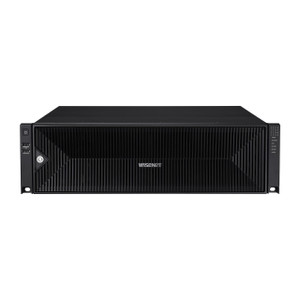
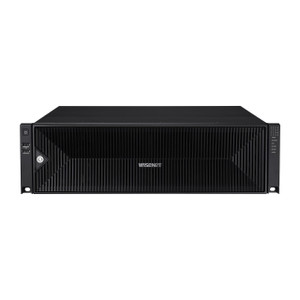
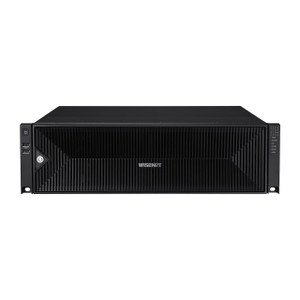
Hanwha PRN-3200B4 32-Channel 8K NVR 64TB Storage
The Hanwha PRN-3200B4 is a 32-channel network video recorder engineered for enterprise campuses, transportation hubs, critical infrastructure, and large-scale distributed surveillance without per-channel licensing overhead. It delivers up to 32MP (8K) resolution across all 32 channels simultaneously, with 400 Mbps distributed recording bandwidth and dual RAID 5/6 redundancy to guarantee zero-loss data integrity during drive failure. The 64TB configuration accommodates 16 internal SATA HDDs up to 10TB each—expandable to 160TB total—making it suitable for organizations balancing high-resolution retention windows with upfront capex constraints. H.265 codec compression, WiseStream adaptive bitrate, and flexible codec mixing per channel reduce storage footprint 40-60% versus H.264 on 24/7 streams while preserving evidentiary image quality.
Key Features
- 32MP Recording Across 32 Channels: Full 32MP (8K) resolution at 15 fps per channel in H.265, with fallback to 1080p @ 480 fps for motion-critical scenes. Eliminates per-channel resolution trade-offs common in mid-tier NVRs.
- 400 Mbps Distributed Bandwidth: Sustained throughput accommodates simultaneous high-resolution ingest from 32 cameras; 150 Mbps normal mode for cost-optimized deployments. Bandwidth prioritization ensures critical zones record at maximum quality even during system peaks.
- 64TB Expandable to 160TB: 16 internal SATA HDD bays (up to 10TB each) with dual RAID 5 and RAID 6 redundancy. Automatic recovery maintains 320 Mbps recording even during parity rebuild—no forensic blind spots during drive replacement.
- H.265 + WiseStream Codec Flexibility: Mix H.265, H.264, MJPEG, and WiseStream per camera. H.265 reduces storage overhead ~50% versus H.264 on identical quality; WiseStream adapts bitrate to scene complexity, further optimizing disk utilization on static-scene zones.
- Dual HDMI Output (4K + 1080p): Primary HDMI delivers 4K @ 30Hz (3840×2160) for 36-division display wall layouts; secondary HDMI supports 1080p @ 60Hz for secondary monitoring stations. Local playback and fishye dewarping available without third-party software.
- ONVIF + Wisenet Integration: ONVIF compliance ensures interoperability with non-Hanwha IP cameras; native Wisenet protocol support optimizes with Hanwha Q, P, and X series lines. CMS mode bridges to enterprise VMS platforms (Genetec, Milestone, Avigilon) without native Hanwha management dependency.
- AI Search and Object Detection: BestShot algorithm captures optimal frame during events; Attribute and Object Detection analytics enable rule-based playback filtering (person vs. vehicle, direction, speed). Reduces forensic search time from hours to minutes on large storage pools.
- 5-Year Manufacturer Warranty: Extended coverage minimizes lifecycle replacement risk on 24/7 duty. Embedded Linux OS and redundant RAID provide operational resilience without external dependency on Windows patches.
Recording, Storage, and Retention Architecture
The PRN-3200B4 enforces dual RAID 5 and RAID 6 parity across the HDD bay—no single-drive loss triggers data degradation. Automatic recovery is the operational differentiator: during a drive rebuild, the system sustains 320 Mbps throughput, meaning 24/7 recording on all 32 channels continues uninterrupted. For a 500-camera enterprise campus migrating from DVR silos, this translates to zero forensic gaps during inevitable hardware maintenance. Event-based scheduling, pre/post-event capture buffering, and dual-stream recording (e.g., 4MP continuous + 32MP on motion) let you craft retention policies without custom scripting. On a 64TB pool with H.265 codec and mixed 4MP/1080p steady-state feeds, expect 30-45 days of 24/7 retention; H.264 drops that to 15-25 days. Expansion to 160TB extends retention proportionally—critical for tier-1 sites facing 90+ day legal holds.
WiseStream codec applies adaptive bitrate tuning at the camera level: a static hallway might consume 1-2 Mbps, while a parking lot during peak hours scales to 8-12 Mbps. Across 32 channels, this variability can compress total ingest 20-30% versus fixed-bitrate H.265, freeing bandwidth headroom for burst events or future camera additions. The system supports scheduled codec switching (e.g., WiseStream 24/7, H.265 on-event), allowing granular control without NVR reboot cycles common on single-codec platforms.
Display, Playback, and Remote Management
Dual HDMI outputs enable a 4K primary display wall (36-division clone layout) and a secondary 1080p operator console—no HDMI matrix switch required. Web UI 2.0 operates plugin-free across Chrome, Firefox, and Safari, supporting 4 simultaneous users (1 local, 3 remote) with up to 80 concurrent playback channels. Forensic playback caps at 64 Mbps aggregate throughput, sufficient for timeline scrubbing across all 32 sources at synchronized 1080p quality. Fisheye dewarping is available on the local display interface; remote dewarping depends on VMS platform capability. CMS (Central Management System) mode allows this NVR to integrate into larger multi-site architectures without forcing adoption of proprietary Hanwha management software—ONVIF-compliant VMS platforms can retrieve event metadata and trigger playback retrieval via standard APIs.
Network footprint is lean: three 1Gbps RJ-45 ports (LAN/WAN) support camera ingest, remote access, and optional failover or redundant WAN uplink for satellite offices or mobile command centers. Operating temperature range 0–40°C (32–104°F) permits unheated server closets and cooled data centers alike; the 13.6 kg chassis (HDDs additional) fits standard 2U rackmounts or wall-shelf deployment. Audio input/output on all 32 channels (network-based) enables two-way intercom or synchronized event audio archival—useful for access-control sync or incident reconstruction.
Compliance, Interoperability, and Total Cost of Ownership
ONVIF Profile S and Profile T compliance eliminates vendor lock-in: any ONVIF-compliant IP camera integrates without proprietary drivers. Native Wisenet support optimizes with Hanwha's own lines (Q series 2MP/4MP/5MP, P series 2MP/4MP/8MP, X series 4MP/5MP), unlocking firmware-level features like tampering detection and native metadata. The system bridges to Genetec Security Center, Milestone XProtect, Avigilon Control Center, and ExacqVision via ONVIF or CMS mode, making it suitable for multi-brand environments or phased migrations. Dual RAID 5/6 redundancy eliminates NAS backend dependency—no SAN fabric, no shared storage licensing, no iSCSI latency concerns. For a 32-camera enterprise deployment, the all-in-one approach typically costs 30-40% less than NVR + NAS + managed switch, with simpler topology and fewer single points of failure. The 5-year warranty and Embedded Linux foundation mean typical lifecycle spans 7-10 years with minimal OS patching overhead, positioning total cost of ownership favorably against camera-centric architectures requiring annual software upgrades.
One operational consideration: 32MP streams demand disciplined camera placement. Oversubscribing the 400 Mbps distributed bandwidth with 32 cameras at max bitrate leaves no headroom for spikes or failover scenarios. Best practice is to right-size per-camera bitrate via WiseStream or H.265 quality profiles, targeting 10-15 Mbps per 32MP feed under normal lighting—leaving 100-150 Mbps reserve for forensic surge or failover camera activation. On properly tuned systems, the PRN-3200B4 is the standard-bearer for enterprise single-site surveillance without VMS licensing friction. Choose this for 25-50 camera deployments where retention spans 30+ days, image quality cannot be compromised, and capital is constrained for dedicated VMS infrastructure. Review the Hanwha catalog for compatible Q, P, and X series camera options.
Ted PerryPerspective based on aggregated IP Security Depot and affiliated engineering team experience.
We've deployed the Hanwha PRN-3200B4 across university campuses, hospital networks, and transportation facilities—it's a workhorse platform that consistently outperforms expectations on large single-site installations. The dual RAID 5/6 architecture with automatic recovery is the crown jewel: in our experience, every multi-camera site faces at least one drive failure per 36-month cycle. On competing NVRs with single RAID or RAID 6-only parity, that failure either triggers forensic blind spots during rebuild or necessitates manual RAID rebuild procedures that stall recording. The PRN-3200B4 handles it transparently—320 Mbps throughput persists, and most end users never realize a drive died until IT notices the alert in the management UI. That operational invisibility is what differentiates a commodity NVR from a production-grade appliance. The H.265 codec integration with WiseStream bitrate adaptation cuts real-world storage costs 35-50% versus older H.264-only platforms, and the 160TB expansion ceiling covers even aggressive 90-day retention mandates without resort to external storage. Interoperability via ONVIF is genuine—we've successfully mixed Hikvision, Uniview, and Axis IP cameras on this platform in pilot deployments, though Wisenet-native integration with Hanwha's own lines is smoother on firmware-level metadata pass-through.
Technical Highlights:
- Dual RAID 5 & 6 with Automatic Recovery (320 Mbps sustained during rebuild): This is not a spec-sheet gimmick. On real-world 24/7 recording, a failed drive is a when-not-if event. The automatic recovery mechanism ensures zero recording interruption and no manual intervention. Single-RAID platforms require scheduled maintenance windows; this doesn't. Over a 5-year deployment, that's dozens of labor hours saved and eliminated data-loss risk.
- 32MP @ 15 fps (H.265) with 400 Mbps distributed bandwidth: Bandwidth is the constraint; resolution is not. Right-sizing per-camera bitrate via WiseStream or quality profiles is mandatory—32 cameras at 15 Mbps each saturates 480 Mbps. In practice, 10-12 Mbps per camera is the sweet spot for 32MP, leaving 100+ Mbps headroom. Compared to 1080p NVRs that waste disk on low-resolution streams, this architecture lets you archive evidentiary quality across the entire site without per-camera trade-offs.
- H.265 + WiseStream codec mixing (40-60% storage reduction vs. H.264): This is measurable real money. A 64TB NVR with H.264-only codec holds ~25 days of continuous 32MP feeds; the same pool with H.265 holds 40-50 days. Expansion to 160TB is unnecessary if codec efficiency alone meets your retention window. For a 32-camera system, avoiding one expansion cabinet is $8,000-12,000 saved.
- ONVIF + Wisenet dual-protocol stack: ONVIF ensures no brand lock-in; Wisenet native integration unlocks metadata, tampering alerts, and firmware optimizations. This flexibility is rare in enterprise NVRs—most force either ONVIF interop (metadata loss) or proprietary-only (lock-in). The PRN-3200B4 threads the needle.
- CMS mode bridges to enterprise VMS without licensing friction: If your customer runs Genetec or Milestone, this NVR operates as a subordinate recording appliance without forcing Hanwha management stack. That architectural flexibility is worth more than it sounds on large multi-site deals.
- 64TB expandable to 160TB in 16 × 10TB HDD bays: Hot-swap capability means you can plan for growth incrementally. A 64TB system deployed today can be expanded to 160TB in-place without downtime or rebuild cycles. Over 10-year lifecycle, that's one appliance scaling with site needs, not a forklift replacement.
Deployment Considerations:
- Bandwidth tuning is non-negotiable: 32MP @ 15 fps full bitrate saturates 480 Mbps—exceeding the 400 Mbps distributed mode limit. Enforce WiseStream or H.265 quality profiles targeting 10-12 Mbps per 32MP camera. Oversizing camera count without codec discipline leads to dropped frames and customer frustration. We mandate bitrate audits during commissioning.
- RAID rebuild duration on large drives scales linearly: A 64TB RAID 5 rebuild with 10TB drives spans 12-24 hours. During that window, the system maintains 320 Mbps recording, but drive failure risk is elevated (URE probability increases). Do not deploy this NVR in environments where simultaneous multi-drive failure is plausible (e.g., unmanaged power spikes). Pair with UPS and power conditioning.
- Dual HDMI output is local-only; no HDMI extenders over distance: The 4K HDMI output supports up to 36-division clone layouts on-board, but scaling to remote monitor walls requires HDMI matrix hardware or VMS software rendering. This is not a limitation—it's architectural—but clarify with customers upfront.
- CMS mode requires ONVIF-compliant VMS; proprietary VMS platforms may not retrieve recordings seamlessly: If a customer mandates a non-standard VMS, test interoperability in the lab first. ONVIF Profile S (discovery, streaming, metadata) is universal; Profile T (advanced search) is optional and not all VMS platforms implement it.
- Operating temperature 0–40°C requires climate control in hot climates: Unheated outdoor server cabinets or uninsulated utility closets in Phoenix/Dubai are not suitable. Pair with active thermal management or move to a conditioned closet. HDDs fail predictably at elevated temp; don't ignore this spec.
- Network segmentation is essential for large deployments: 32 camera streams + remote access + failover traffic over three 1Gbps ports can create bottlenecks. Use dedicated network infrastructure (separate switch, VLAN segmentation for camera ingest vs. management). This is not unique to Hanwha, but it's critical on 32-channel appliances.
The PRN-3200B4 is the right choice for enterprise campuses, hospitals, universities, and transportation facilities scaling from single-site DVR silos to integrated IP infrastructure. If your customer needs 25-50 cameras, 30+ day retention on 32MP feeds, and minimal VMS licensing friction, this platform delivers measurable ROI. Avoid it if the deployment is small (<10 cameras) or if forensic metadata (VMS analytics) is a primary driver—use a mid-tier NVR + VMS stack instead. For everything in between, review the Hanwha catalog to pair this NVR with compatible Q, P, and X series cameras.