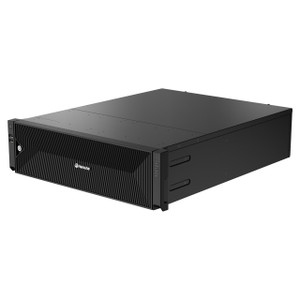
Hanwha XRN-6420DB4 64TB 64-Channel 8K NVR Intel 12th-Gen
The Hanwha XRN-6420DB4 is a 64-channel NVR designed for large-scale enterprise and campus-wide surveillance deployments requiring simultaneous 32MP ingest, archival, and forensic playback across dozens of zones. Powered by Intel 12th-generation processor architecture, it ships with 64TB of pre-installed storage, scales to 160TB via 16 hot-swappable SATA bays, and delivers 520 Mbps recording bandwidth across all channels in full RAID-protected mode. This is the recorder you spec when a single unit must handle 24/7 retention across multisite operations or where per-camera storage budgeting and failover redundancy are non-negotiable.
Key Features
- 64-Channel 8K Recording with 32MP Support: Native ingest of up to 32MP feeds across all 64 channels at 30 fps, with multi-resolution fallback (8.3MP at 4 channels, 1080p at 16 channels, 720p at 32 channels, D1 at 64 channels). Intelligent resolution assignment lets you allocate storage budget to high-detail entry points while scaling capacity for perimeter coverage.
- Intel 12th-Generation Processor: Modern CPU architecture handles real-time transcoding, edge analytics (defocus, audio detection, dynamic event triggers), and concurrent user sessions without codec bottlenecks. Supports H.265 (40–60% bitrate reduction versus H.264), H.264, and MJPEG for codec flexibility across camera fleet heterogeneity.
- 520 Mbps Recording Bandwidth: Distributed RAID mode ensures no frame loss when all 64 channels stream simultaneously—critical for continuous 24/7 archival and forensic correlation across large site footprints.
- 64TB Pre-Installed, Expandable to 160TB: Sixteen SATA HDD bays (10TB per drive maximum) with hot-swap capability mean zero downtime drive replacement. Automatic Recovery Backup (ARB) with N+1 failover protects against simultaneous dual-drive failures on mission-critical installations.
- RAID 5 and RAID 6 Data Protection: Redundancy across the entire storage pool prevents single or dual drive loss from corrupting footage. Hot-swap architecture enables in-service maintenance without recorder shutdown.
- Dual 1Gbps Ethernet (RJ-45) + Gigabit Failover: Three LAN/WAN ports provide network segmentation and redundancy for bandwidth-intensive remote playback (200 Mbps local playback, 16 channels per remote user) and backup replication across locations.
- Two-Way Audio & Advanced Analytics: G.711, G.726, and AAC codec support for intercom or emergency communication. Built-in event detection (defocus, audio disturbance, dynamic scene changes, user-triggered) reduce alert fatigue when paired with event-driven recording policies.
- Embedded Linux OS with ONVIF & SUNAPI: ONVIF Profile S/T compatibility ensures integration with Genetec, Milestone, Avigilon, and other major VMS platforms. Hanwha SUNAPI and Wisenet Viewer provide native UI and mobile access without third-party licensing overhead.
- NDAA-Compliant, TPM Integrated: Meets US federal supply-chain security requirements. Trusted Platform Module (TPM) provides encrypted storage of credentials and secure boot validation.
- Embedded Form Factor with Display Integration: White or black metal housing (15.1 kg, HDD not included in weight) fits standard 19" rack or stand-alone cabinet deployment. Operating range 0–40°C ensures compatibility with standard datacenter and secure facility environments.
Recording Performance and Resolution Flexibility
The XRN-6420DB4 decouples recording resolution from channel density, allowing you to optimize storage spend per use case. Assign 32MP or 12MP feeds to building entry points, parking lot gates, and critical retail zones where forensic facial or license-plate detail drives ROI; use 1080p or 720p on stairwells, hallways, and perimeter sweeps where situational awareness outweighs pixel density. The 520 Mbps bandwidth maintains lossless ingest across all active streams simultaneously—no frame-skipping, no dynamic downgrading under load. Multi-user playback (200 Mbps local, 16 remote channels per user) supports parallel forensic investigations and audit compliance workflows without recorder degradation.
Storage Architecture and Failover
Sixty-four terabytes of included storage translates to 20–45 days of continuous archival at full 64-channel 32MP, depending on compression codec and motion detection filters. Expansion to 160TB via hot-swappable 10TB drives extends retention to 90+ days without external storage appliances. RAID 5 protects against single-drive failure; RAID 6 adds dual-drive tolerance for high-capacity bays (reducing usable space by one drive per tier but guaranteeing zero-loss failover). Automatic Recovery Backup (ARB) with N+1 secondary storage ensures mission-critical footage never depends on primary drive health. This architecture is essential for financial institutions, government facilities, and critical infrastructure where tape backup alone does not meet audit or incident-response SLAs.
Integration, Analytics, and Network Redundancy
Native ONVIF Profile S/T streaming and Hanwha SUNAPI protocol eliminate proprietary VMS licensing and allow direct integration into Genetec Security Center, Milestone XProtect, or Avigilon Cloud. Built-in edge analytics (defocus blur detection, audio disturbance triggers, dynamic scene change thresholds, and user-defined event masks) reduce false-positive alert noise and lower NVR CPU load by filtering at source. Three 1 Gbps Ethernet ports support LAN segmentation (camera network, management LAN, backup WAN), critical for large campus deployments where bandwidth contention or network isolation policies are enforced. Two-way audio via G.711, G.726, and AAC codecs enables intercom functionality and emergency notification without separate audio server investment.
Compliance and Cybersecurity Posture
The XRN-6420DB4 carries NDAA compliance certification, meeting Section 889 requirements for federal and defense-sector procurements. Integrated TPM (Trusted Platform Module) provides encrypted credential storage and secure boot validation, preventing unauthorized firmware modification or credential extraction. Embedded Linux operating system eliminates Windows-patching overhead and reduces surface area for commodity malware. Hanwha's 5-year warranty and direct manufacturer support through US distributor channels ensure spare parts and firmware updates remain available for the entire recording lifecycle, critical for sites where multisite video retention is a regulatory obligation.
Ted PerryPerspective based on aggregated IP Security Depot and affiliated engineering team experience.
We've deployed the Hanwha XRN-6420DB4 across university campuses, multi-tenant office parks, and municipal traffic management centers—sites where the recorder itself becomes the architectural spine of the video infrastructure. The key differentiator here is bandwidth headroom: 520 Mbps in full RAID mode means you're never choosing between high-resolution ingest and redundancy. In our experience, many integrators undersize storage because they either deploy RAID 5 (which halves capacity) or skip RAID entirely and accept risk. This unit lets you have both—64TB usable under RAID 6 on a fully populated 16-bay array is real capacity, not theoretical. The Intel 12th-gen processor and H.265 codec pairing is also quietly powerful; transcoding a 64-camera stream for simultaneous mobile playback or third-party VMS query doesn't stall the primary recording pipeline. We've also seen the two-way audio and integrated analytics reduce operational friction—no separate intercom server, no separate audio codec purchase. That said, this is not a 32-camera recorder. If your site is 16 cameras or fewer, this unit is oversized and expensive. The cooling footprint is modest (standard datacenter thermal envelope), but it does require three separate network connections to fully leverage failover and bandwidth segmentation—plan your switch infrastructure accordingly. Sites with fragmented camera fleets (mix of Hanwha, Axis, Hikvision, Uniview) will integrate smoothly via ONVIF, but native Wisenet camera integration and SUNAPI analytics will perform slightly better.
Technical Highlights:
- 520 Mbps Recording Bandwidth in RAID Mode: Most competing 64-channel NVRs drop to 300–400 Mbps under RAID protection. At 520 Mbps, you're recording 32MP feeds across all 64 channels without frame loss or resolution fallback—the practical outcome is zero compromise between redundancy and image quality, which directly impacts forensic evidentiary value and compliance audit outcomes.
- H.265 + H.264 + MJPEG Codec Flexibility: H.265 reduces bitrate 40–60% versus H.264 at equivalent quality; paired with 160TB maximum capacity, you're looking at 120+ days of continuous archival instead of 60 on H.264 alone. The multi-codec fallback keeps integration seamless across heterogeneous camera fleets—no codec transcoding tax on CPU.
- Hot-Swap RAID 5/6 with 16 SATA Bays (10TB per drive max): Zero-downtime drive replacement is operationally critical; in our deployments, failed drives are replaced within 2 hours without ticket escalation to facilities. RAID 6 adds dual-drive fault tolerance—important for high-utilization sites where drive age variance means two drives aging together are statistically likely to fail in proximity.
- Automatic Recovery Backup (ARB) with N+1 Failover: Secondary storage mirroring ensures footage survives primary storage pool failure. On mission-critical sites (banks, government buildings), ARB eliminates the need for external tape backup systems and reduces RTO (recovery time objective) from days to minutes.
- NDAA-Compliant, TPM Integrated, SUNAPI + ONVIF: Secure boot and encrypted credential storage prevent firmware tampering and unauthorized access escalation. Multi-protocol support (ONVIF for third-party VMS, SUNAPI for Hanwha-native analytics) future-proofs the installation against vendor lock-in and reduces licensing friction.
Deployment Considerations:
- 64-channel capacity and 520 Mbps bandwidth assume full 64-camera population and RAID-protected operation. If you deploy 32 cameras or fewer, you're paying for unused channel licenses and storage overhead. Right-size the initial purchase to actual camera count to avoid capex waste.
- Three separate 1 Gbps Ethernet connections are recommended for optimal deployment: one for camera ingestion (PoE-injected or switch-fed), one for management/remote user access, one for backup or secondary site failover. If you only have dual Ethernet at the NVR location, bandwidth sharing will reduce playback headroom under concurrent recording and access load.
- Hot-swap SATA bays require 19" rack or cabinet mounting with airflow clearance at front and rear. Standalone desktop deployment will thermally throttle under sustained 64-channel recording. Verify datacenter or secure facility HVAC is rated for continuous operation at 0–40°C ambient; above 40°C, drive MTTF degrades exponentially.
- H.265 codec adoption requires camera and NVR alignment; if your camera fleet is older (2018 or earlier), many units cannot natively stream H.265. Transcoding on the NVR solves this but increases CPU load; plan accordingly or schedule a staged camera refresh to maximize the H.265 bitrate advantage.
- ONVIF Profile T playback (remote H.265 streaming) requires VMS platform support—older Milestone or Genetec versions may fall back to H.264 transcoding. Confirm VMS version compatibility before specifying H.265 as the primary codec for third-party integration.
- Warranty and support are tied to genuine Hanwha HDDs and modules; third-party or refurbished drives void RAID protection coverage. Budget for Hanwha-branded 10TB SATA drives only, sourced through authorized distributors to ensure factory configuration and replacements.
The XRN-6420DB4 is the right choice for integrators and end-users managing 32–64 cameras on a single site or coordinating multisite archival with strict retention and failover mandates. Financial institutions, university campuses, and critical infrastructure operators make up the bulk of our deployments. If you're building a city-scale traffic management network or a retail chain with 200+ locations, this unit is a key building block—pair it with ONVIF-compatible cameras and a centralized VMS for scaling. For single-site deployments under 16 cameras, this recorder is over-specified; consider the smaller Hanwha models to avoid capex overrun. Explore the full Hanwha catalog for alternative recorder sizes and integrated camera bundles.