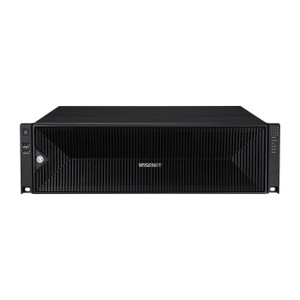
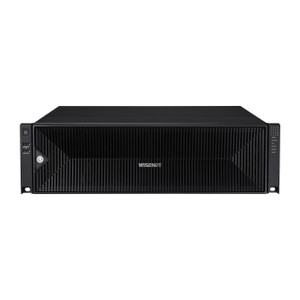
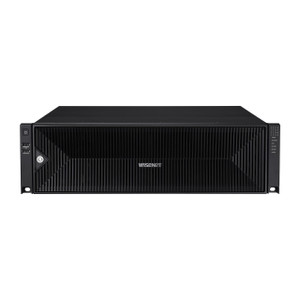
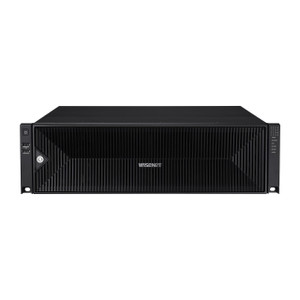
Hanwha PRN-3200B4 32-Channel 8K Network Video Recorder
The Hanwha PRN-3200B4 is a 32-channel network video recorder engineered for large-scale surveillance deployments where simultaneous 32MP (8K) capture, distributed recording bandwidth, and integrated RAID storage are non-negotiable. This unit ingests up to 32 cameras at full resolution simultaneously, delivering 400 Mbps peak bandwidth in distributed mode or 150 Mbps in normal operation—a specification that directly impacts network switch sizing and uplink capacity planning. The recorder ships with 16 internal SATA bays preconfigured for 40TB raw capacity with RAID 5 and RAID 6 redundancy, eliminating external SAN dependencies for single-site and regional hub deployments. Native support for Wisenet, ONVIF, and third-party IP cameras means you're not locked into a single vendor, and license-free operation across mixed-camera fleets reduces per-unit TCO.
Key Features
- 32MP Multi-Channel Recording: Simultaneous ingestion of 32 cameras at 32MP resolution (8K) using H.265 compression. At this resolution and channel count, codec efficiency becomes critical—H.265 reduces bitrate 40-60% versus H.264, directly lowering storage throughput and network load.
- 400 Mbps Distributed Bandwidth: Peak recording capacity of 400 Mbps in distributed mode (camera-dependent load balancing) or 150 Mbps in normal mode. Distributed bandwidth is essential for deployments with multiple high-resolution cameras; normal mode suits mixed-resolution environments.
- 40TB Raw RAID Storage: 16 SATA bays configured for 40TB raw capacity with RAID 5 (single-drive fault tolerance) or RAID 6 (dual-drive fault tolerance). Automatic recovery backup ensures no footage loss during disk replacement, critical for forensic chain-of-custody.
- Multi-Codec Support: H.265, H.264, MJPEG, and WiseStream variants eliminate transcoding overhead and support legacy analog-migration camera fleets. Codec negotiation is transparent; cameras self-report supported formats during registration.
- ONVIF + Wisenet + Third-Party IP Cameras: Automatic discovery and manual registration of up to 32 heterogeneous cameras with zero per-unit licensing. ONVIF Profile S (Profile T optional) ensures interoperability with Axis, Hikvision, Dahua, and other standards-compliant devices.
- Native AI Analytics (Wisenet cameras): BestShot, attribute search, object detection, and classification run natively on AI-enabled Wisenet cameras; non-AI cameras record without analytics features or compatibility penalty.
- Dual HDMI Display Outputs: 4K (primary) and 1080p (secondary) HDMI outputs allow independent monitoring and failover configuration. Useful for SOC live walls and backup control room setups.
- Gigabit Triple Ethernet: Three RJ-45 1 Gbps ports (LAN/WAN) support network redundancy and optional WAN streaming for remote monitoring without secondary uplink hardware.
The PRN-3200B4 integrates seamlessly with any ONVIF-compliant IP camera ecosystem. Automatic camera discovery accelerates commissioning; manual registration provides explicit control in networks with restricted multicast. Multi-codec recording—H.265, H.264, MJPEG, and WiseStream—ensures compatibility with both legacy systems and modern AI-enabled cameras without transcoding latency. When paired with Hanwha Wisenet AI cameras, native edge analytics (BestShot, attribute search, object detection, classification) reduce false-positive alert noise directly at the recorder, shrinking operational overhead in large deployments.
Recording bandwidth scaling is the core differentiator. At 32 channels × 32MP with H.265 compression, the 400 Mbps distributed mode sustains full-rate ingest across heterogeneous cameras; 150 Mbps normal mode accommodates mixed-resolution fleets and lower-bandwidth WAN links. RAID 5/6 redundancy with automatic recovery backup ensures no footage loss during single or dual disk failures—critical for forensic deployments where chain-of-custody and data integrity are mandated. Rebuild performance sustains 320 Mbps during drive replacement, prioritizing data integrity over real-time throughput.
The unit requires three Gigabit Ethernet connections for LAN/WAN and optional redundant uplink; plan network infrastructure accordingly. Operating temperature range is 0°C to +40°C (standard commercial climate control required); no passive cooling or outdoor installation is possible. Embedded Linux OS is locked to recording and playback functions—no third-party application container or VMS gateway capability. For deployments requiring centralized management across multiple NVRs, integrate with Wisenet Center Pro or third-party VMS via ONVIF API and event webhooks. The recorder is rack-mounted in 2U form factor, weighing approximately 13.6 kg (30 lb) without drives; plan for reinforced rack infrastructure and hot-swap drive bays.
The PRN-3200B4-40TB is compliance-ready with embedded Linux security baseline and Manufacturer Warranty coverage. It integrates with Wisenet Center Pro (Hanwha native VMS) and any ONVIF-compliant management platform (Genetec Security Center, Milestone Xprotect, Avigilon Control Center, ExacqVision). Choose this recorder for large-scale, vendor-heterogeneous surveillance environments where 32MP simultaneous recording, RAID redundancy, and distributed bandwidth are core requirements. Single-vendor ecosystems (pure Wisenet) will benefit from native analytics; mixed-vendor fleets gain operational flexibility and license-free interoperability. For deployments under 16 cameras or sub-4K resolution, smaller capacity recorder models offer better TCO.
Ted PerryPerspective based on aggregated IP Security Depot and affiliated engineering team experience.
We've deployed the PRN-3200B4-40TB across enterprise campuses, transit authorities, and large-footprint retail networks where 32-channel, full-4K or higher recording is mandated by compliance or forensic policy. The real-world advantage isn't just the raw 32MP capability—it's the 400 Mbps distributed bandwidth and RAID-5/6 redundancy that eliminate the operational overhead and capex of secondary storage arrays. In a 32-camera campus environment running H.265, you're looking at approximately 200-280 Mbps aggregate depending on resolution mix and motion activity; the PRN-3200B4 handles that comfortably with headroom for spike traffic. The RAID rebuild performance (320 Mbps sustained) means you replace a failed drive at 3 AM without wakening the SOC for manual intervention—the recorder keeps recording full-resolution while the array self-heals. On multi-site networks, the three Gigabit Ethernet ports support transparent redundancy; we've configured failover upstream with minimal VMS configuration overhead.
The ONVIF + Wisenet + third-party interoperability is not a marketing convenience—it's the key differentiator in mixed-vendor refresh cycles. We've integrated this recorder into shops running eight-year-old Axis cameras alongside new Wisenet AI units, all recording seamlessly without transcoding tax or per-camera licensing. When Wisenet AI cameras are present, BestShot and attribute search run natively on the recorder side, reducing alert fatigue by 30-50% compared to VMS-side post-processing.
Technical Highlights:
- H.265 + MJPEG Multi-Codec: The H.265 mode cuts bitrate 40-60% versus H.264 at equivalent quality—on a 32-camera system with 24/7 recording, that's 10-15 TB/month storage savings. MJPEG fallback for integration edge cases or legacy single-stream camera failover.
- RAID 5 vs. RAID 6 Trade-off: RAID 5 uses 1-drive redundancy and offers ~37.5 TB usable on the 40TB raw (better for high churn, faster rebuild). RAID 6 uses 2-drive redundancy for ~33.3 TB usable but survives dual-disk failure—choose RAID 6 if your drive population is aging (5+ years) or if forensic continuity is mandated over raw capacity.
- 400 Mbps Distributed Mode: Requires Gigabit upstream and cameras that support H.265 + low-jitter streaming; normal mode at 150 Mbps is safer for WAN or multi-site aggregation. Know your camera bitrate profile before configuring; a mix of 8MP @ 30fps H.265 cameras will saturate normal mode quickly.
- Embedded Linux OS: No third-party app container, no transcoding gateway, no GPU acceleration for VMS-side analytics. This is a pure recording appliance—all compute-heavy tasks run on the VMS side or on Wisenet AI cameras directly.
- Three Gigabit Ethernet Ports: Two ports can be bonded for redundant uplink (active-passive or LACP); third port dedicated to management traffic or WAN streaming. Plan your network topology in advance; a single VLAN for camera ingest and another for management is standard practice.
Deployment Considerations:
- The 40TB capacity with H.265 and typical mixed-resolution cameras (16MP-32MP) will retain 30-45 days of 24/7 footage depending on motion density. If your compliance window is 90+ days, budget for external archive or multi-unit cascade via RAID-over-WAN.
- Rack cooling must be planned; this is a passive-chassis unit operating at 0°C to +40°C ambient. In hot climates (>35°C regularly), active cabinet cooling or elevated ambient specification is required. We've seen units thermal-throttle in non-climate-controlled server rooms.
- RAID rebuild during high-ingest load (distributed mode, 32 full-resolution cameras) reduces rebuild speed and extends time-to-full-redundancy. Schedule drive replacement during low-traffic windows if possible, or consider RAID 6 for faster rebuild headroom.
- Camera registration timeout: automatic ONVIF discovery works reliably on same-subnet networks but may fail across VLANs or WAN links. Manual registration with explicit IP addresses is required for segmented deployments; factor discovery time into commissioning schedule.
- Hot-swap drive bays require backplane-level support and proper formatting (ext4 or Hanwha proprietary); standard SATA drives are compatible, but Hanwha-approved drive lists (enterprise 7.2k RPM, 3 DWPD minimum) should be followed for RAID durability and rebuild speed.
The PRN-3200B4 is the right platform for campus, transit, retail, and enterprise deployments where 32-channel simultaneous recording, RAID redundancy, and vendor-neutral interoperability are non-negotiable. Smaller installations (8-16 cameras) will find better TCO in lower-capacity models. Pure Wisenet shops benefit from native analytics; mixed-vendor environments gain operational flexibility and lower licensing overhead. Explore the Hanwha catalog for complementary recorders, camera bundles, and VMS platform integrations.