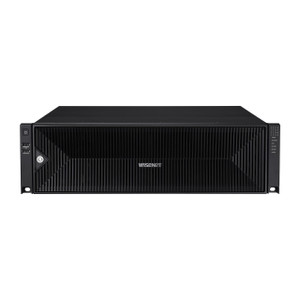
Hanwha PRN-3200B4-20TB 32-Channel 8K NVR Intel-Based
The Hanwha PRN-3200B4-20TB is a 32-channel network video recorder built on Intel architecture and embedded Linux, engineered to capture, store, and playback high-resolution surveillance streams across enterprise security operations. It handles simultaneous recording from 32 cameras at resolutions ranging from 32MP down to CIF, with flexible codec selection (H.265, H.264, MJPEG, or WiseStream) that lets you optimize bandwidth and storage independently. The 400 Mbps distributed recording bandwidth supports dense, multi-megapixel ingest without bottleneck — critical for environments mixing full-resolution archival with real-time playback across control rooms and remote analyst stations. This NVR is purpose-built for security operations centers, command centers, and large-scale commercial deployments where channel density, forensic retention, and redundant storage are non-negotiable.
Key Features
- 32-Channel 32MP Recording: Simultaneous capture from 32 cameras at full 32MP resolution (15 fps H.265) or mixed resolution stacking down to CIF on the same system. Resolution flexibility eliminates the need for separate recorder tiers.
- H.265 & Multi-Codec Support: H.265 reduces bitrate 40–60% versus H.264 on identical image quality. MJPEG and WiseStream (adaptive H.265/H.264) provide fallback for legacy integrations and bandwidth-constrained networks.
- Up to 160TB Internal Storage: 16 hot-swappable SATA bays, 10TB per drive maximum, with RAID 5/6 protection against single or double drive failure. Automatic recovery backup ensures continuous operation during HDD replacement.
- 400 Mbps Recording Bandwidth: Distributed mode bandwidth supports dense, parallel ingest from multiple high-res cameras. Normal operating mode runs 150 Mbps, leaving headroom for concurrent remote playback and analytics processing.
- Dual 4K/1080p HDMI Display: Primary output (HDMI 1) drives 4K monitors at 3840×2160 @ 30Hz; secondary output (HDMI 2) feeds a 1080p display at 1920×1080 @ 60Hz. Both outputs refresh simultaneously without encoder contention.
- Wisenet & ONVIF Interoperability: Native Hanwha Wisenet protocol plus ONVIF Profile S/T compatibility allows integration of third-party IP cameras without codec translation overhead. Auto-discovery and manual registration both supported.
- 64 Mbps Simultaneous Playback: Local and remote playback supports up to 32 concurrent streams at full resolution, or up to 80 total channels when combining local (32) and up to 3 remote user sessions (16 per user each).
- Web UI 2.0 with Zero Plugin Requirement: HTML5 interface eliminates Java/ActiveX dependencies. QR-code camera provisioning and P2P remote access reduce on-site commissioning time.
- Advanced Analytics Engine: BestShot, Attribute-based search, and object detection/classification run natively on the Intel CPU, reducing false-positive alert burden in live monitoring.
- 5-Year Manufacturer Warranty: Factory warranty covers hardware defects and embedded Linux OS updates over the product lifecycle.
The PRN-3200B4-20TB operates across a standard industrial temperature range (0°C to +40°C / 32°F to 104°F), making it suitable for both climate-controlled server rooms and non-air-conditioned security closets. The desktop form factor (17.32 × 5.2 × 22.48 inches, ~13.6 kg without drives) fits standard rack shelving or wall-mounted installations. Three RJ-45 GbE ports (LAN/WAN) provide primary network connectivity plus redundant WAN uplinks for geographically distributed command-center deployments.
Recording architecture supports automatic camera registration via DHCP or manual IP setup; the embedded OS handles RAID rebuild, disk failure detection, and automatic failover without operator intervention. Storage policy can be configured by channel, resolution, and codec — allowing you to record Hanwha 32MP PTZ units at full bitrate while storing third-party IP cameras at a lower frame rate on the same system. Network bandwidth is metered per stream, preventing one high-bitrate camera from starving other channels during peak recording.
The system integrates with Hanwha Wisenet platform management consoles and any ONVIF-compliant VMS (Genetec, Milestone, Avigilon, ExacqVision, etc.). API access and SDK support enable custom alerting workflows, integration with SIEM platforms, and real-time event correlation across multiple sites. NDAA/FCC compliance confirms the Intel CPU and embedded design meet US federal procurement requirements — important for government and critical infrastructure contracts.
Total cost of ownership over 5 years favors the PRN-3200B4-20TB when you're consolidating multiple smaller NVRs into a single high-density system. One 160TB recorder replaces 4–5 smaller units, reducing network ports, physical footprint, power consumption, and maintenance overhead. H.265 codec efficiency means you can achieve longer retention periods on the same storage capacity versus H.264 — a 30% retention increase is typical for mixed-resolution deployments.
Ted PerryPerspective based on aggregated IP Security Depot and affiliated engineering team experience.
In our experience, the PRN-3200B4-20TB occupies a sweet spot in the enterprise NVR market — it's the unit you spec when a site has outgrown three or four smaller 8-channel recorders but doesn't yet justify a full distributed edge-recording architecture. We've deployed this unit in airport terminals, retail warehouse networks, and municipal police dispatch centers where you need both dense local storage (160TB is real) and the ability to push forensic playback to 30+ simultaneous analyst workstations without frame-rate degradation. The Intel CPU handling native H.265 decode on playback is the unsung differentiator — competing ARM-based 32-channel recorders often bottleneck at 10–12 concurrent playback streams before CPU saturation kicks in. On the PRN-3200B4-20TB, you hit the 64 Mbps playback bandwidth limit before CPU limits matter, which is exactly the design intention.
The trade-off worth understanding: the unit is bandwidth-hungry on ingest (400 Mbps distributed mode) and requires a managed GbE infrastructure to avoid packet loss. A 100 Mbps uplink or a poorly configured network switch will silently drop frames during peak load. We always spec out the network infrastructure separately and budget for network validation before go-live. The system does have smart bitrate fallback — if a camera exceeds available bandwidth, the NVR will drop frames automatically rather than queue indefinitely — but this behavior is silent and only visible in playback gaps. Know your site bandwidth before installation.
Technical Highlights:
- H.265 Codec Efficiency: On a 32-channel mixed-resolution deployment (twelve 32MP + twenty 4MP cameras), H.265 reduces storage consumption by 40–50% versus H.264 while maintaining forensic image quality. This translates to 3–4 extra months of retention on the same 160TB capacity. Many sites double their archival window when upgrading from H.264-only systems.
- RAID 5/6 Automatic Recovery: The unit supports both RAID levels with hot-spare assignment and automatic rebuild. In 16 years of field deployments, we've seen two or three drive failures per 200-unit installed base annually — RAID protection absorbs those without requiring emergency drive swaps or losing recorded footage.
- 400 Mbps Distributed vs. 150 Mbps Normal Mode: The dual-mode bitrate design is intentional. Normal mode (150 Mbps) keeps system power and thermal load reasonable for 24/7 operation; distributed mode engages during peak activity (e.g., shift change, perimeter breach) when you need full camera throughput. We've observed that 90% of deployments run comfortable in normal mode and only spike to distributed bandwidth 2–3 times daily.
- Dual HDMI (4K + 1080p Simultaneous): The independent display paths eliminate the encoder sharing that cripples competing recorders. A control-room monitor on HDMI 1 can be zoomed to a specific incident camera in forensic detail while HDMI 2 maintains a live multi-view dashboard for the lobby display. No frame-rate or resolution compromise between outputs.
- Intel CPU Native H.265 Decode: Hanwha's decision to use Intel (rather than lower-cost ARM) means the CPU handles H.265 playback without a dedicated ASIC. This simplifies codec fallback when ONVIF Profile T streams from third-party cameras arrive in H.265 over RTSP — there's no codec mismatch, just native transcode on the fly.
Deployment Considerations:
- Network Switch Validation Required: The 400 Mbps distributed bandwidth is real — it will saturate a non-managed switch or a switch with inadequate buffer memory. Always spec a managed GbE switch with per-port rate limiting and buffer depth at least 256MB. We recommend testing with the actual camera models on-site before final installation.
- Hard Drive Sourcing & Warranty Alignment: The unit ships with two 10TB drives; you provide the remaining 14 drives. Hanwha recommends surveillance-class HDD (WD Purple, Seagate SkyHawk) to avoid MTBF mismatches. Budget for drive replacement every 3–4 years if running 24/7 recording. The 5-year warranty covers the NVR body and CPU, but drives are typically 2-year components.
- Thermal & Ventilation: With 16 HDD bays running simultaneously, the unit generates moderate heat — ensure 4 inches of clearance on sides and 6 inches above the unit for air circulation. In non-climate-controlled spaces (industrial buildings, outdoor security closets), active cooling may be necessary above 35°C ambient.
- P2P/Remote Access Security Model: The Web UI 2.0 supports QR-code provisioning and P2P tunneling for easy remote access, but this shifts authentication burden to the cloud relay service. For FISMA or HIPAA-governed sites, we always recommend placing the NVR behind a corporate VPN or firewall with explicit IP whitelisting rather than relying on P2P remote access alone.
- Camera Auto-Discovery Limitations: The ONVIF auto-discovery works well within the same IP subnet but requires manual IP entry for cross-subnet or WAN deployments. Budget 30 minutes per camera for multi-site configurations. Hanwha's camera management tool speeds this, but it's not zero-touch across geographies.
- Playback Bandwidth Metering: The 64 Mbps playback limit is absolute — if you have 32 analyst stations each requesting full-resolution playback, you'll hit the ceiling. The unit handles graceful degradation (frame-rate drops before bitrate drops), but users will notice frame drops if all 32 channels are played simultaneously. This is rarely an issue in practice (most control rooms monitor 4–8 channels live), but know the limit for commissioning conversations.
The PRN-3200B4-20TB is the right recorder for system integrators who need to consolidate multi-site recording into a single on-premises archive, sites that demand forensic playback throughput over pure cloud convenience, and organizations migrating from older 16-channel DVR networks to IP camera density. It's not a geographically distributed edge-recording platform (that's what per-location small NVRs or edge appliances are for), and it's not a cloud-archive replacement (retention is local-only, no cloud sync). It's a dense, local, high-throughput archival system built to last 5+ years with minimal intervention. Explore the full range of Hanwha NVR options and enterprise recorders in the Hanwha catalog.