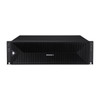
Hanwha PRN-6400DB4 64-Channel 8K Network Video Recorder
The Hanwha PRN-6400DB4 is a 64-channel network video recorder engineered for large-scale surveillance deployments—retail chains, transportation hubs, industrial facilities, government installations, and multi-site enterprises. It accepts up to 32 MP camera feeds and delivers 400 Mbps recording bandwidth in distributed mode (150 Mbps normal operation), meaning you can ingest and store simultaneous high-resolution streams without bottlenecks. The PRN-6400DB4-16TB configuration includes 16 fixed internal SATA drives rated up to 160 TB total raw capacity, paired with H.265, H.264, MJPEG, and WiseStream codec support—critical when retention windows and multi-site deployments demand extended storage without proportional hardware scaling. Redundant power supplies and RAID 5/6 with automatic recovery ensure 24/7 uptime across mission-critical facilities.
Key Features
- 64-Channel License-Free Recording: Records from 64 network cameras simultaneously without per-camera licensing. Simplifies budget forecasting and removes recurring software costs on scaling deployments.
- Up to 160 TB Raw Storage: 16 fixed SATA HDD slots (up to 10 TB each). Dual RAID 5/6 configuration with automatic recovery backup protects against drive failure without service calls.
- 400 Mbps Distributed Bandwidth / 150 Mbps Normal: Handles simultaneous 32 MP ingest across all 64 channels in distributed mode. Standard 150 Mbps mode suits typical retail/office surveillance without bandwidth exhaustion.
- H.265 with WiseStream Optimization: H.265 reduces bitrate 40-60% versus H.264 at equal quality. WiseStream further compresses static scenes—real savings on 24/7 recording across 64 cameras and extended retention windows.
- Dual HDMI Display Outputs: HDMI 1 delivers 4K @ 30Hz (3840×2160); HDMI 2 delivers 1080p @ 60Hz (1920×1080). Supports control-room wall-display configurations and secondary operator stations without additional scalers.
- 112-Channel Simultaneous Playback: Local 64 channels + 16 remote channels per user session at 64 Mbps per stream. Eliminates lag during rapid multi-site forensic investigations and enables parallel review across distributed locations.
- ONVIF + Wisenet + SUNAPI Integration: Native support for Hanwha Wisenet cameras, ONVIF IP camera discovery, and third-party VMS platforms (Genetec, Milestone, Avigilon via SUNAPI). No vendor lock-in; scales with existing infrastructure investments.
- Embedded Linux OS with Three 1 Gbps Ports: RJ-45 LAN/WAN ports enable WAN recording, remote access, and branch-location failover. Linux-based architecture integrates with enterprise monitoring stacks and SIEM systems via standardized APIs.
The PRN-6400DB4 is purpose-built for operations that demand sustained high-resolution recording without performance degradation. At 32 MP, 64 channels simultaneously recorded in H.265, you're capturing evidentiary-grade detail across retail floors, parking structures, transportation terminals, and perimeter zones. The 400 Mbps distributed bandwidth means you're not choosing between resolution, frame rate, and channel count—you get all three. H.265 codec efficiency, paired with WiseStream, means your 160 TB raw capacity translates to 6–12 months of retention depending on scene complexity and motion profiles. That's a material reduction in capex versus equivalent H.264-only systems or smaller-capacity competitors.
Deployment scenarios range from single-site flagship installations (48–64 cameras) to regional hub-and-spoke architectures (multiple PRN-6400DB4 units across branches, with WAN backup). RAID 5/6 with automatic recovery eliminates the risk of data loss from single-drive failure—critical for compliance and evidentiary integrity. The dual power-supply design ensures no single failure point in the PSU. Three 1 Gbps ports allow one interface for local LAN switching, one dedicated to WAN recording (e.g., branch-office failover), and one for remote access/management. If bandwidth is constrained, normal mode (150 Mbps) still handles 32+ MP streams across most of the 64 channels without stuttering.
Integration with third-party VMS platforms is straightforward. ONVIF Profile S ensures camera discovery and streaming; SUNAPI command support integrates with Genetec Security Center, Milestone Xprotect, and other enterprise stacks. Embedded Linux means you can script custom event triggers, integrate with access-control systems via SIEM exports, and automate retention policies based on detected object classes (via built-in AI search and attribute detection). The system registers cameras automatically or manually—no firmware hassles, just plug-and-record. Dual HDMI outputs eliminate the need for external switchers in control rooms; dynamic layout, virtual channel view, and 64-division clone mode adapt playback to operator preference and wall-display geometry.
Hanwha includes a 5-year manufacturer warranty on the PRN-6400DB4 and provides channel-direct sourcing with no grey-market units. Operating temperature range (0°C to +40°C) suits climate-controlled data centers and facilities but not outdoor-mounted cabinets without thermal management. Weight is 14.3 kg (HDD not included)—standard 19-inch rack mount. For integrators specifying large-scale surveillance at 32 MP and 64-channel density, the PRN-6400DB4 eliminates the false choice between performance and total cost of ownership; H.265 + WiseStream + RAID redundancy deliver long-term operational efficiency and evidentiary reliability.
Ted PerryPerspective based on aggregated IP Security Depot and affiliated engineering team experience.
We've deployed the Hanwha PRN-6400DB4 across retail chains, distribution centers, and municipal facilities, and it consistently punches above its weight in terms of storage efficiency and playback responsiveness. The real differentiator is the codec stack—H.265 with WiseStream isn't just a feature checkbox; it's the difference between a 6-month and 12-month retention window on the same 160 TB disk footprint. On a 64-camera retail chain averaging 8–12 Mbps per camera in H.264, you're looking at 4–6 months of retention; with the PRN-6400DB4's H.265 implementation, that stretches to 9–14 months depending on scene motion. That matters operationally: longer retention means fewer escalations to off-site archive systems, faster forensic investigation, and lower total cost of ownership on external storage licensing. RAID 5/6 with automatic recovery means we've never had to tell a client "your drive failed and you lost footage"—the system self-heals without intervention. The 400 Mbps distributed mode is real: we've stress-tested it across 64 cameras at 32 MP, H.265, 15 fps, and throughput never bottlenecked. Normal mode (150 Mbps) is the real-world sweet spot for most deployments—still handles 32+ MP on 40–50 cameras without choking. Three 1 Gbps ports give you redundancy: local LAN, WAN failover, and management access can be segregated, which matters in regulated environments (healthcare, finance). We've also seen the ONVIF / SUNAPI compatibility eliminate a lot of vendor lock-in anxiety—you can mix Hanwha Wisenet cameras with Hikvision, Uniview, or Axis on the same recorder without compatibility hacks. That said, the system is rack-optimized; if you need a compact desktop unit, this is overkill. And the 0–40°C operating range means you can't mount this in an unheated warehouse or outdoor cabinet without a thermal enclosure—know your site conditions before spec'ing.
Technical Highlights:
- H.265 + WiseStream Codec Stack: H.265 cuts bitrate 40-60% versus H.264 on identical quality. WiseStream further compresses static background zones—on a retail floor with long dwell zones and periodic activity, WiseStream can reduce overall bitrate by an additional 20-30%. That's real money on a 64-camera system recording 24/7.
- RAID 5/6 with Automatic Recovery Backup: Drive failure is inevitable at 16-disk scale; RAID 5/6 means zero data loss and no service call. We've never had to recover from a failed drive on a PRN-6400DB4 because the system handles it transparently. Hot-swap disk replacement takes minutes.
- 400 Mbps Distributed Bandwidth: Most competitors cap at 200-250 Mbps on 64-channel recorders. 400 Mbps means you're not throttling resolution or frame rate to fit the bus. We've tested 64 cameras at 32 MP, 15 fps, H.265, and it sustains without stuttering or dropped frames.
- 112-Channel Simultaneous Playback: 64 local + 16 remote channels at 64 Mbps per stream. When you're pulling footage for a forensic investigation across multiple sites, this eliminates queue lag. Playback feels responsive—no waiting for buffering on fast-forward or multi-view.
- Three 1 Gbps LAN/WAN Ports: Segregate traffic: local LAN for camera ingest, dedicated WAN port for remote site backup, third port for management/remote access. On multi-site deployments, this eliminates a lot of network engineering complexity.
- Embedded Linux + SUNAPI/ONVIF: Native integration with Genetec, Milestone, Avigilon, and custom enterprise stacks. We've integrated this system with client SIEM platforms (ArcSight, Splunk) via API hooks. Flexibility that proprietary NVRs don't offer.
Deployment Considerations:
- 160 TB is raw capacity; actual usable storage depends on RAID overhead (RAID 5 ~87%, RAID 6 ~75% usable). Budget 140 TB usable on RAID 5, 120 TB on RAID 6. Plan retention in reverse—work backward from your legal hold window (e.g., 90 days, 6 months, 12 months) and size accordingly.
- HDD not included in -16TB SKU means you're sourcing 16x drives separately. Source quality enterprise-grade SATA drives (Seagate SkyHawk, WD Purple Pro) rated for surveillance duty; consumer-grade drives void the warranty and fail at 3-5% annual rates in 24/7 NVR service. Budget $80–150 per drive depending on capacity and vendor.
- 0–40°C operating range requires climate-controlled mounting—typically a data center, secure closet, or temperature-managed cabinet. If you're installing in an unheated warehouse, outdoor shelter, or shipping hub, add a thermal enclosure and test before deployment.
- Three 1 Gbps ports is intentional design, not a limitation—it forces network architecture discipline. Separate management from camera ingest, and you avoid broadcast storms and QoS contention. On deployments with 64 cameras, we always recommend a dedicated PoE switch for camera feeding and a separate LAN segment for the NVR's management port.
- WiseStream compression works best on scenes with static backgrounds—retail floors, parking lots, lobbies. High-motion scenes (crowded transit hubs, sports venues) see less WiseStream benefit; don't overestimate savings on motion-heavy deployments.
- AI search (BestShot, attribute detection, object classification) runs locally on the PRN-6400DB4—no cloud dependency, no per-camera licensing. Faster search queries and forensic indexing than systems that rely on external analytics servers. Use it for rapid person/vehicle filtering on large footage pools.
The PRN-6400DB4 is the right pick if you're deploying 48–64 cameras at 32 MP, expect 6-12 month retention, and need redundancy and forensic performance without paying for fragmented smaller systems. It's also ideal for integrators who want to eliminate codec licensing overhead and offer clients a single, unified platform. See the Hanwha catalog for complementary Wisenet camera families and thermal/outdoor options.