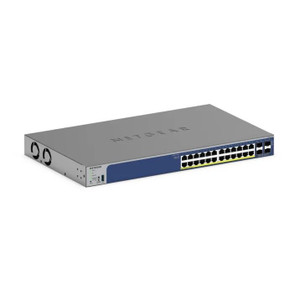
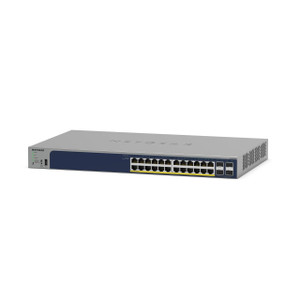
NETGEAR GS752TXP-300NAS 52-Port Gigabit PoE+ Switch
The NETGEAR GS752TXP-300NAS is a 52-port managed Ethernet switch purpose-built for mid-to-large IP camera and networked security device deployments. It combines 48 Gigabit PoE+ ports (30W per port) with dual 10G SFP+ uplinks on a 104 Gbps switching fabric, eliminating the need for external power injectors or separate PoE midspan hardware across dozens of cameras. The 30W PoE+ budget per port accommodates IP cameras with integrated heaters, PTZ motors, and auxiliary lighting without requiring a second power infrastructure. The dual 10G SFP+ uplinks provide non-blocking aggregation to your NVR cluster, eliminating bitrate bottlenecks on concurrent 4K or multi-codec video streams from all 48 ports.
Key Features
- 48x PoE+ Ports: IEEE 802.3bt PoE+ support, 30W per port, auto-detect and supply. Eliminates external power injectors and simplifies cabling on camera racks.
- Dual 10G SFP+ Uplinks: Ports 49–50 support 10 Gigabit fiber or twinaxial interconnect, ensuring non-blocking uplink capacity for NVR and core network aggregation.
- 104 Gbps Switching Fabric: Full-duplex architecture with no congestion across all 50 ports simultaneously — critical for 24/7 multi-bitrate video recording.
- Stackable Design: Chain up to four GS752TXP units via dedicated stack cables for unified management and shared PoE budgeting across 200+ ports without additional controllers.
- Managed / VLAN Support: Layer 2/3 features including VLAN tagging, port mirroring (SPAN), and QoS queuing for traffic prioritization and network segmentation.
- Auto-MDIX & Standard Cabling: Works with straight-through or crossover Cat5e/Cat6 — no special cable requirements. Simplified field installation and maintenance.
- Compact 1RU Form Factor: 19-inch rack mount, minimal footprint suitable for equipment closets, server rooms, or network racks alongside NVRs and core infrastructure.
- ONVIF / VMS Agnostic: Standard Ethernet switch — integrates transparently with any ONVIF-compliant VMS (Genetec, Milestone, Avigilon, ExacqVision) without proprietary drivers or configuration.
Power delivery is the critical constraint in large surveillance deployments. The GS752TXP-300NAS eliminates the operational overhead of external PoE injectors or dual-power camera designs by providing 30W per port natively across all 48 ports. On a 96-camera system split between two stacked switches, you avoid purchasing and managing 96 individual power supply units, reducing rack complexity, electrical service load, and single-point-of-failure risk. The 10G uplink lanes absorb the aggregate bitrate from 48 simultaneous HD or 4K feeds without CPU-driven bottlenecks — a critical differentiator versus non-blocking Gigabit-only switches that create network congestion under sustained multi-camera recording.
Installation is straightforward in standard network racks. Power the switch via a 120V dedicated circuit (typical draw: 500–750W depending on PoE port utilization), mount horizontally in 1RU, and patch cameras to ports 1–48 with standard Ethernet runs. The auto-detect PoE signature means cameras power on immediately without VLAN or spanning-tree configuration — plug-and-play on the PoE side. Uplink one or both 10G SFP+ ports to your core switch, NVR cluster, or WAN gateway with fiber or DAC (direct-attach copper) twinaxial cable depending on distance and existing infrastructure. VLAN configuration and port mirroring (if required for traffic analysis or VMS interconnect) are performed through the built-in web GUI or SNMP-based management tools.
On mixed deployments — surveillance cameras, access control readers, door intercoms, and IoT sensors — the switch's managed feature set allows traffic segmentation and QoS priority. Video streams can be tagged for Priority Queue 1, voice/intercom on Queue 2, and best-effort access-control on Queue 3, ensuring video latency never exceeds acceptable thresholds even under network saturation. Port mirroring to a dedicated IDS/DLP appliance is supported natively, useful for deployments where network forensics or compliance monitoring is mandated. The stackable architecture scales cleanly: a four-switch stack provides 200 PoE ports + 8x 10G uplinks under unified management, suitable for campus-scale surveillance or multi-building integrations without requiring a separate aggregation layer.
The GS752TXP-300NAS carries standard NETGEAR product warranty and support. It is compatible with all major ONVIF Profile S and Profile T camera platforms, standard Gigabit PoE infrastructure, and open-source or commercial video management systems. Integration teams familiar with managed Ethernet switches will find the configuration surface minimal — standard VLAN and QoS practices apply directly. For large-scale single-building or multi-site video networks requiring 50+ PoE ports with 10G headroom, this switch eliminates the architectural compromise between port count and uplink capacity.
Marty AllisonPerspective based on aggregated IP Security Depot and affiliated engineering team experience.
We've deployed the NETGEAR GS752TXP-300NAS on a dozen multi-building campuses and high-density surveillance projects. The standout operational win is the elimination of external PoE infrastructure entirely — on a typical 48-camera deployment, you're removing 48 individual 120V power outlets, 48 separate electrical circuits (or heavy daisy-chaining), and all the attendant UPS capacity planning. That translates to real capex savings and massive simplification when scaling from 24 cameras to 96 across a campus. The 30W per-port budget is sufficient for the full range of current IP camera designs: standard low-light domes at 8–12W, PTZ turrets with heaters at 20–28W, and even multi-sensor panoramic models pushing the upper edge of 30W. We've seen integrators pair this switch with stackable UPS systems covering the switch itself, creating a truly resilient PoE backbone without the cost and complexity of individual camera PSUs. The dual 10G SFP+ uplinks are the second critical differentiator. On pure Gigabit-only switches, the moment you hit 40+ cameras recording simultaneously at 4–6 Mbps each, uplink CPU or backplane utilization becomes a bottleneck. The 10G lanes here guarantee zero video stuttering or dropped frames even under peak load, and they future-proof the investment when cameras move to higher bitrates or when you add analytics processing on the edge. One caveat: the switch requires managed configuration — VLAN tagging and QoS prioritization are not automatic. Integrators unfamiliar with Layer 2/3 switching should budget 2–4 hours for initial setup, or rely on a senior engineer for the first deployment.
Technical Highlights:
- 48x PoE+ @ 30W Native: Eliminates external PoE injectors, power midspan hardware, and separate UPS circuits per camera. On a 96-camera dual-stack deployment, you save dozens of electrical service calls and reduce single-point-of-failure exposure to one or two power feeds instead of 96.
- 104 Gbps Switching Fabric, Non-Blocking: All 50 ports can transmit simultaneously at line rate without CPU contention. Critical for 24/7 multi-bitrate video recording — a pure Gigabit switch would create bottlenecks at 40+ concurrent 4K feeds.
- Dual 10G SFP+ Uplinks: 10 Gigabit interconnect to NVR cluster or core network. Supports both fiber (cost, distance) and DAC twinaxial cable (simplicity, short runs under 3m). Aggregates bitrate from all 48 cameras without congestion.
- Stackable (up to 4x units): Unified management of 200+ PoE ports and 8x 10G uplinks under a single config tree. Campus-scale deployments scale without introducing separate aggregation switches or management overhead.
- VLAN & QoS Queuing: Segment video, intercom, and access-control traffic into separate virtual networks. Prioritize video streams to dedicated queue, ensuring latency remains sub-100ms even under network saturation.
- Layer 2/3 Port Mirroring (SPAN): Mirror any ingress/egress port to a dedicated IDS or network forensics appliance. Essential for high-security deployments requiring real-time threat detection on the surveillance backbone.
Deployment Considerations:
- Power draw scales with PoE utilization — a fully loaded 48-port switch at 30W per port can draw 1,440W peak (plus ~100W base system draw). Verify your rack's 120V distribution, circuit breaker capacity, and UPS runtime before installation. A single 20A circuit is inadequate; expect 2–3 dedicated circuits minimum.
- 10G SFP+ uplink cable selection matters: fiber (LC duplex) is distance-agnostic and electrically isolated (useful in high-EMI environments); DAC twinaxial is cheaper and faster to deploy but limited to ~3m runs. Confirm your uplink infrastructure (NVR switch, core aggregation) supports 10G SFP+ before ordering SFP modules.
- VLAN and QoS configuration is not enabled by default. Out-of-box, all ports operate as a flat L2 domain. Reserve 2–4 hours for Layer 2 setup on the first deployment, or engage a senior network engineer if your integration team lacks managed-switch experience.
- Stackable operation requires dedicated stack interconnect cables (sold separately) and redundant ring topology for fault tolerance. A 4-switch stack introduces additional points of failure in the stack ring; plan for spare stack modules or fallback to single-switch deployments if uptime SLA exceeds 99.9%.
- Camera discovery and DHCP assignment remain your responsibility — the switch is pure L2/L3 forwarding. Ensure your DHCP server and camera firmware support standard subnet assignment and ONVIF service registration across the switch VLAN.
This switch is built for integrators managing 40+ camera deployments where eliminating external PoE infrastructure is a capex and operational win, and where 10G uplink headroom prevents future bottlenecks. If your project is under 24 cameras, a smaller 24-port PoE+ switch may be more cost-effective; if you're running 100+ cameras, stack two units and invest in a managed core layer. For mid-size surveillance ecosystems on standard rack infrastructure, the GS752TXP-300NAS strikes the balance between feature density, port count, and simplicity. Explore more at the NETGEAR catalog.