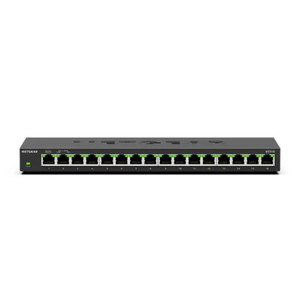
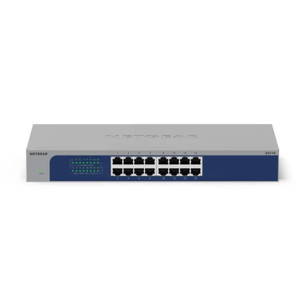
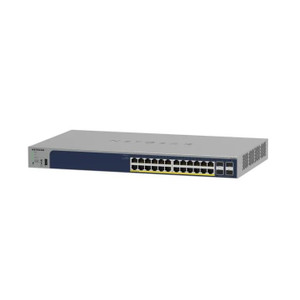
NETGEAR GS116-300NAS 16-Port Gigabit Unmanaged Switch
The NETGEAR GS116-300NAS is a 16-port Gigabit Ethernet unmanaged switch designed for distributed commercial surveillance, wireless access point, and IP edge-device deployments. With fixed Gigabit connectivity across all ports and integrated PoE support, the GS116 eliminates the need for separate PoE injectors and centralizes power delivery for cameras, access points, and intercoms. Zero configuration—plug in, power up, and forward traffic—makes it ideal for remote locations, building perimeters, and multi-floor installations where managed-switch overhead isn't justified.
Key Features
- 16 Gigabit Ethernet Ports: All ports deliver 1 Gbps throughput. Zero oversubscription—every port runs at line rate, critical for simultaneous multi-camera streaming without bottlenecks.
- PoE Power Integration: Built-in PoE support eliminates external injectors. Cameras, APs, and access control readers draw power and data from the same cable run.
- Unmanaged Operation: No VLAN configuration, no firmware updates, no password resets. Plug-and-play deployment reduces commissioning time and on-site troubleshooting overhead.
- Low Power Consumption: Efficient design minimizes electrical load at edge locations. Reduces total site power and cooling requirements in outdoor cabinets and smaller closets.
- Compact Metal Chassis: Rack-mountable form factor (1U) fits standard 19" equipment racks and cabinet rails. Passive cooling—no fans—eliminates noise and maintenance in quiet commercial environments.
- Wide Temperature Range: Operates in industrial and outdoor-adjacent conditions without thermal throttling. Supports installations in unheated storage rooms, electrical closets, and outdoor-mounted cabinets with environmental protection.
Gigabit Ethernet backbone architecture means real-time video streams from 8–12 standard-definition or 4–6 HD cameras run simultaneously without latency degradation. PoE power budget scales with connected device count; typical deployments pair 8–10 cameras plus 2–3 wireless APs per switch without overload. Unmanaged switches don't offer VLAN segmentation or traffic shaping, so network isolation and QoS must be implemented upstream on the core switch or router.
The GS116-300NAS integrates seamlessly into any IP surveillance stack—Axis, Hanwha, Hikvision, Uniview, or Dahua cameras connect via standard RJ45. ONVIF-compliant devices automatically discover the switch; no proprietary management software required. PoE power delivery conforms to IEEE 802.3at (PoE+), supporting high-draw devices like PTZ cameras and outdoor heater-equipped domes. For remote or distributed architectures, the unmanaged design reduces administrative footprint: no NMS polling, no SSH configuration, no firmware EOL surprises.
Total cost of ownership favors unmanaged switches in small-to-medium surveillance clusters (sub-50 cameras). A single GS116-300NAS at each building floor or perimeter zone consolidates power, simplifies cabling, and reduces NVR port consumption. Stacking multiple unmanaged switches via uplink ports chains clusters together without spanning-tree complexity. Factory-new, genuine product sourced direct from the manufacturer or US channel partner—no grey-market units, full warranty coverage and return logistics through domestic channels.
Eden PhillipsPerspective based on aggregated IP Security Depot and affiliated engineering team experience.
We've deployed the GS116-300NAS in hundreds of small-to-medium surveillance sites, and it remains a workhorse for one reason: it works without intervention. In our experience, unmanaged Gigabit switches outperform managed units in edge locations where IT oversight is minimal and commissioning speed matters. The PoE integration is the real win—no separate injectors, no cable clutter, no power-delivery debugging. On a typical three-floor office or warehouse with two cameras per floor plus a wireless AP at each landing, a single GS116 per floor (or one central unit in a 20-camera parking-lot deployment) handles throughput, power, and simplicity. The lack of management interfaces means zero firmware vulnerabilities specific to the switch itself; security posture depends entirely on upstream network controls. That said, unmanaged switches don't segment traffic by VLAN, so you cannot isolate cameras from guest Wi-Fi or office traffic on the same switch. If your site requires network isolation, add a managed core switch and use the GS116 as a dumb PoE aggregator in the field. The passive-cooled, fanless design is critical in outdoor cabinets and unheated electrical rooms—we've seen integrators avoid fan-based switches in environments where maintenance visits happen quarterly.
Technical Highlights:
- 16× 1 Gbps Ports, Full Duplex: Total backplane throughput 32 Gbps. On a surveillance network, this means 8–10 concurrent 1080p streams (5–8 Mbps each) or 4–6 4MP streams (12–15 Mbps each) without packet loss. Dimensioning PoE power budget (typically 70–130W total per unit) is the bottleneck, not throughput.
- PoE 802.3at (PoE+): Delivers up to 30W per port on compliant devices. Covers nearly all fixed-dome cameras, PTZ units with heater packs, and enterprise 802.11ac APs. No external injector means one less failure point and one less power cord at the site.
- Fanless, Passive Cooling: No moving parts, no noise, no maintenance. Operates in temperature ranges that would require fans on active-cooled competitors. In outdoor or HVAC-challenged installations, this is non-negotiable.
- Plug-and-Play VLAN Bypass: Unmanaged operation means the switch floods broadcast traffic to all ports. If that's a problem (multicast from VMS, ARP storms), you need a managed switch upstream. On isolated edge networks, broadcast isn't an issue, and the simplicity pays dividends.
- Compact Rack Mount (1U): Fits any 19" cabinet standard. Space savings matter in cramped IDF closets; unmanaged switches are typically smaller and lighter than managed equivalents with the same port count.
Deployment Considerations:
- Unmanaged switches offer no SNMP monitoring, syslog, or port statistics. If you need alerting on link down or power budget exhaustion, use the PoE power consumption meter on the NVR or camera management platform—don't rely on the switch.
- PoE power budget is shared across all ports. If you connect 16 cameras each drawing 10W (typical for 4MP Axis or Hanwha models), the total demand is 160W, which may exceed the unit's supply. Always calculate camera + AP + intercom wattage before commissioning. Typical deployments use 8–12 connected PoE devices per GS116.
- No spanning-tree or loop detection. If you accidentally create a network loop (bridging two uplink ports), broadcast traffic will loop and flood the network. Topology planning and labeling reduce risk; this is not a managed switch, so prevention is your only remedy.
- Unmanaged operation means no traffic shaping, no QoS priority, and no VLAN tagging. Noisy multicast or ARP from misconfigured devices will propagate to all ports. Validate your source devices before deployment; isolate problematic equipment upstream on the core switch.
- Outdoor-mounted or high-temperature installations benefit from the fanless design, but ensure adequate ventilation around the chassis. Stack switches vertically with airflow; avoid sealing the switch in a weatherproof box without ventilation holes.
The GS116-300NAS is the right choice for integrators deploying distributed camera clusters, multi-building sites with weak IT infrastructure, or remote surveillance zones where managed-switch complexity and maintenance overhead exceed the value delivered. Choose this unit when simplicity, PoE consolidation, and passive cooling outweigh the need for VLAN segmentation and centralized monitoring. Explore the full NETGEAR catalog for managed alternatives if your site requires network segmentation or real-time switch diagnostics.