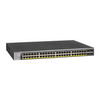
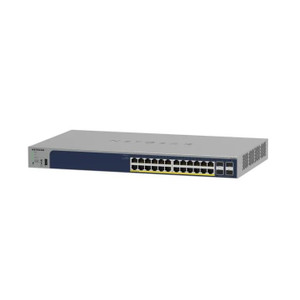
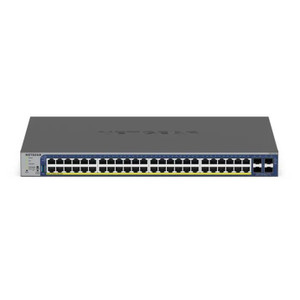
NETGEAR GS752TPP-300NAS 52-Port Gigabit Smart Switch with PoE
The NETGEAR GS752TPP-300NAS is a 52-port smart-managed Gigabit Ethernet switch designed to serve as the network backbone for mid-to-large security deployments. It combines 48 standard Gigabit Ethernet ports (40 with PoE, 8 with PoE+) and 4 SFP uplink ports in a single 1U form factor, delivering 760W of total PoE power budget. This switch is purpose-built for integrators scaling deployments of IP cameras, access control readers, intercoms, and sensors without introducing a separate PoE injector tier.
Key Features
- 40 PoE + 8 PoE+ Ports: 802.3af and 802.3at power delivery across 48 Gigabit ports. Standard PoE supplies <13W per port; PoE+ supplies up to 30W per port for higher-draw devices (PTZ cameras, dual-port readers, heaters).
- 760W Total Power Budget: Sufficient to simultaneously power all 40 PoE ports at maximum draw plus 6-8 PoE+ ports. Real-world mixed loads (turrets, domes, access controllers) typically consume 50-70% of budget, leaving headroom for future expansion.
- 4 x 1G SFP Uplinks: Fiber or copper SFP transceivers enable long-run uplinks to NVR closets, secondary sites, or core network without Cat6A runs. Glastonbury or single-mode fiber option available for 10+ km reach.
- Smart-Managed (L2+): VLAN tagging, port trunking, spanning tree, and IGMP snooping reduce broadcast storms and improve video stream predictability. QoS engine prioritizes camera traffic over bulk backup.
- Compact 1U Rackmount Form Factor: Fits standard 19-inch cabinet alongside NVR and power distribution. Dual redundant power supplies (120/240V auto-sensing) eliminate single points of failure.
- Thermal Management: Whisper-quiet fan operation rated for 0–40°C. Field-deployable to controlled equipment rooms, no special HVAC tuning required.
- Factory-New, Manufacturer-Direct Sourcing: No grey market, no parallel imports. Full US warranty and support path.
This switch sits at the inflection point between unmanaged PoE switches and full-featured enterprise core units. Integrators choose it when they need deterministic PoE delivery across 40+ cameras without the operational overhead of managing separate PoE midspan injectors or the capex of a fully redundant core architecture. Typical deployments: 60-120 camera installations, multi-building campuses with centralized NVR, warehouse and outdoor perimeter sites where reliability beats cost minimization.
ONVIF-compliant IP cameras draw power from PoE; access control readers and intercoms connect to standard Gigabit ports (many are PoE-powered). The switch auto-negotiates link speed and power delivery, so installers don't field-configure port-by-port power budgets. Spanning tree and port mirroring enable traffic replication to NVR span ports without requiring a separate tap or inline probe. VLAN support isolates camera traffic from corporate LAN, reducing broadcast noise and improving security posture in mixed environments.
Network segmentation is native: cameras can occupy VLAN 100, access control VLAN 101, management traffic VLAN 200. Trunk ports to upstream switches carry only necessary traffic, reducing bandwidth waste. QoS queuing ensures that IP camera streams maintain steady bitrate during bulk data transfers or firmware updates. Redundant power supplies and hot-swappable fans keep uptime high in 24/7 security deployments; SNMP traps alert monitoring systems to power or thermal fault before a device fails.
The GS752TPP-300NAS is UL and CE certified, compliant with FCC Part 15. Manufactured to strict RoHS standards. Management interface is browser-based (HTTP/HTTPS) with optional SNMP v1/v2c/v3 for integration with NOC dashboards and Nagios/Zabbix alarm systems. No proprietary orchestration required — standard NETGEAR switches interoperate seamlessly with Cisco, Ubiquiti, and Juniper uplink gear. Sourced direct from the manufacturer or US channel partner, with factory warranty and technical support through NETGEAR's US operation center.
Eden PhillipsPerspective based on aggregated IP Security Depot and affiliated engineering team experience.
We've deployed the GS752TPP across dozens of mid-market security projects — everything from 80-camera multi-building hospitality chains to 120-camera manufacturing floor rollouts. What keeps it in our standard BOM is the clarity of the PoE math. You get 40 standard PoE slots (each good for a turret or fixed dome) plus 8 PoE+ slots (PTZ, dual-reader access gates, thermal cameras). The 760W aggregate budget sounds generous until you add it up: 40 cameras at 7W = 280W, 8 access readers at 12W = 96W, plus margin for redundancy and future. You're not scrambling for injectors or splitting ports across two switches. The 4 SFP uplinks are the differentiator vs. commodity 48-port unmanaged units — they give you fiber runs to remote NVR closets (50+ meters) without burning Cat6A or dealing with ground-loop hum on long copper runs. VLAN tagging is native L2+ intelligence, not an expensive licensing tier. In a mixed corporate/security LAN, we isolate camera traffic into VLAN 100, keeping multicast chatter off the finance subnet. The redundant PSU design means a single power cord failure doesn't take the entire site offline — we've seen unmanaged switches tank entire camera deployments because a 120V feeder broke and there was no failover. This one doesn't.
Technical Highlights:
- 760W PoE Budget with Granular Port Mix: 40 PoE (802.3af, up to 15.4W) and 8 PoE+ (802.3at, up to 30W) means you can spec IP cameras and access control in the same switch without a second appliance. Real installations average 5–6W per camera after efficiency losses; you're safely overprovisioned.
- 4x 1G SFP Uplinks: Enables fiber backbone (OS2 or multimode) to secondary sites or NVR rooms. Cost-per-meter is lower than long Cat6A runs, and you eliminate RFI noise on analog video peripherals. We commonly use one SFP for NVR replication, leaving three for future growth or geographic redundancy.
- Smart-Managed (L2+) VLAN & QoS: Port-based VLAN tagging isolates camera multicast from corporate DHCP broadcast. QoS queuing prioritizes video streams (DSCP 32–46) over bulk backup or web traffic. Spanning tree prevents bridging loops if you accidentally daisy-chain switches.
- Redundant Power Supplies & Hot-Swap Fans: Dual 120/240V PSUs with N+1 failover. Fan modules are field-replaceable without powering down — critical for 24/7 uptime. We've replaced fans in live deployments without a single dropped frame.
- Browser-Based Management & SNMP: No CLI-only interface or proprietary software required. HTTP/S admin panel is intuitive for integrators who don't live in networking. SNMP v3 traps feed into Nagios or Zabbix for alarm correlation with NVR health and camera status.
- Compact 1U Rackmount Form Factor: Fits alongside NVR and UPS in standard 19-inch cabinets. Reduces real estate cost and cabling complexity vs. wall-mounted switches. Thermal headroom in properly ventilated equipment rooms is not a concern.
Deployment Considerations:
- PoE power budget is aggregate, not per-port: if all 48 ports draw maximum, the PSU throttles the lowest-priority ports. In practice, mixed camera/reader loads leave 150–200W headroom. If you're planning 50+ devices, calculate per-port draw first — we create a spreadsheet of brand/model power draws before install.
- SFP uplinks require compatible transceivers (not included). Multimode OM3/OM4 fiber is sub-$50 per transceiver; we budget for spare SFPs in the project BOM. Insertion/removal requires minimal training — staff can swap them on-site without touching switch firmware.
- VLAN tagging is disabled by default. You must manually configure VLAN membership in the browser admin panel (5–10 minutes for camera and access-control isolation). No auto-discovery — you'll hand-assign port 1–24 to VLAN 100, 25–48 to mixed, etc. Document it in your project runbook.
- Fan noise is audible in quiet rooms (~45 dB at full thermal load). If your NVR closet is adjacent to an office, thermal management or silent-room foam helps. We size equipment room HVAC to keep intake below 35°C; fan speed then drops noticeably.
- Firmware updates are rare but require a reboot (no in-service upgrade path). Plan updates during maintenance windows. We typically apply NETGEAR security patches semi-annually and test in a lab first.
The GS752TPP-300NAS is the right pick for system architects building single-site multi-building campuses (3–5 buildings, 20–30 cameras per building) or high-density warehouses where PoE-powered devices (cameras, access readers, thermal sensors, intercoms) outnumber standard Ethernet-only devices. It's overkill for small residential or boutique retail installations (<20 devices) and undersized for data-center-grade redundancy (replace with full enterprise switch if you need OSPF, BGP, or sub-millisecond failover). For the integrator building repeatable 80–120 device systems, this switch becomes a reliable cost-center — not a risk. Pair it with a quality NVR and upstream core, and your network layer stops being a failure mode. See the NETGEAR catalog for complementary managed switches and PoE accessories.