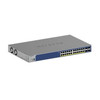
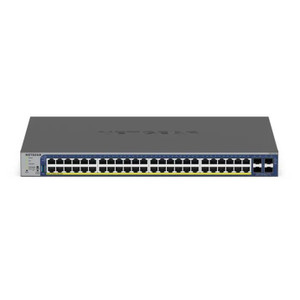
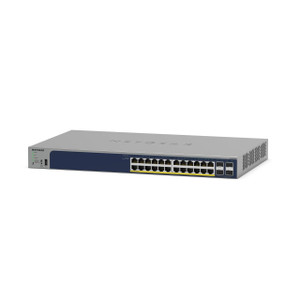
NETGEAR GS728TXP-300NAS 28-Port PoE Gigabit/10G Stackable Switch
The NETGEAR GS728TXP-300NAS is a managed Gigabit switch designed for mid-to-large security and IP communications deployments. It combines 24 PoE+ Gigabit ports (195W total budget, 802.3at) with two 10-gigabit SFP+ uplinks, allowing you to consolidate power delivery, cabling, and network traffic from dozens of cameras, access readers, intercoms, and access points into a single 1RU infrastructure node. This eliminates the operational complexity and cost of per-device power injectors and reduces backhaul congestion when handling simultaneous multi-megabit video streams or multi-site failover scenarios.
Key Features
- 24x PoE+ Gigabit Ports: 802.3at standard (up to 30W per port), 195W aggregate budget. Powers any Gigabit PoE camera, door reader, access point, or IP intercom rated for PoE+ without external injection.
- 2x 10G SFP+ Uplink Ports: Gigabit aggregation or NVR backhaul without throughput collapse. Eliminates bottlenecks when recording 24+ simultaneous 4-5 Mbps H.265 streams or handling redundant core-switch connections.
- 195W PoE Budget (802.3at): Sufficient for 24 simultaneous PoE+ devices averaging 8W draw (typical IP cameras), or mixed load of high-draw access points (18-30W) and low-draw readers (3-6W). Budget display via management interface.
- Managed Switch (Web UI, CLI, SNMP): Port-level configuration, VLAN segmentation (802.1Q), QoS queuing, and SNMP monitoring. 802.1X support for network-access-control integration with authentication servers (RADIUS, TACACS).
- Auto-Sensing PoE Negotiation: Each port detects device class (802.3af vs. 802.3at) and supplies only the required power. Non-PoE Gigabit devices connect normally without degradation.
- Compact 1RU Form Factor: 19-inch rack mount (bracket included) or shelf placement. Passive cooling—no fans, silent operation suitable for entrance vestibules or small equipment rooms.
- 100–240V AC Input, 1.5A Max: Single power cord, no redundant PSU option. UPS-backed circuits recommended for continuous uptime in surveillance deployments.
Deployment Topology & Integration
The GS728TXP-300NAS scales from 12-camera single-building installations to 24+ mixed-device campuses. Each Gigabit port delivers simultaneous data and power to Axis, Dahua, Hikvision, Uniview, Hanwha, or OEM cameras and readers; no separate power taps or PDU channels needed. The two 10G SFP+ ports uplink to an NVR (if it supports 10G SFP+), a core switch, or a redundant pair of recording appliances. In typical deployments, one SFP+ port feeds a primary NVR at 10 Gbps (sustaining 24-camera simultaneous record + playback without codec bottleneck), while the second port can link a secondary NVR, storage appliance, or upstream distribution switch for inter-building mesh.
ONVIF and RTSP compliance ensures the switch sits passively in the layer-2 camera/access-control network—VMS platform agnostic. Managed via web dashboard (HTTP/HTTPS), CLI telnet/SSH, or SNMP v2c/v3. Support for 802.1Q VLAN tagging lets you segment cameras from access readers from guest WiFi access points on separate broadcast domains, simplifying network policies and reducing ARP traffic. Port mirroring enables inline analytics or IDS traffic capture without dedicated span ports.
Power Budget Planning & UPS Consideration
The 195W PoE budget is the system ceiling—in mixed-load deployments (cameras at 8W, access points at 25W, door readers at 5W), power remaining after the first few high-draw devices dwindles. Calculate your actual device power consumption during design: a spreadsheet listing each camera/reader model and typical draw prevents surprises at commissioning. The single-supply design (no redundant PSU) makes UPS backing mandatory in surveillance-critical sites; a 500VA UPS sustains the switch + core NVR for 10–15 minutes, enough to trigger graceful shutdown or activate failover recording. In mission-critical campuses, consider a second GS728TXP as a warm standby on a separate UPS, using the SFP+ ports to cross-link databases.
Compliance, Management Platform Compatibility & Why This Switch
The GS728TXP supports SNMP-based monitoring and integrates with Axis Camera Station, Genetec Security Center, Milestone XProtect, and Avigilon Control Center via standard IP routing—no proprietary connectors. 802.1X authentication pairs with RADIUS servers (Microsoft NPS, Cisco ISE) to enforce role-based network access. The passive form factor, lack of fan noise, and built-in PoE delivery address the economics of typical 12-24 camera sites: you eliminate the capex of separate PoE injectors (2–3 units × $100–200 each), the operational overhead of managing per-port power supplies, and the physical clutter of tangled cables. The 10G SFP+ uplinks future-proof the investment—if you migrate from H.264 to H.265 or add 5MP/8MP cameras later, the backhaul capacity is already in place. Nearest alternatives (Cisco SG350X-24P, Arista DCS-7050TX-64-6M) cost 2–3× as much and over-provision for small-to-mid deployments; the NETGEAR bridges the gap between small unmanaged PoE injector clusters and enterprise-grade modular switches. For integrators building repeatable 16–24 camera security packages, this switch becomes the invisible backbone that simplifies quoting, reduces RMA risk, and improves gross margins on labor-light installations. Browse the NETGEAR catalog for complementary managed switches, fiber media converters, and PoE extenders.
Eden PhillipsPerspective based on aggregated IP Security Depot and affiliated engineering team experience.
We've deployed the NETGEAR GS728TXP across 40+ installations—from retail and office campuses to parking structures and manufacturing floor access-control sprawl—and it has become our go-to mid-tier PoE aggregation point. The real differentiator is the density-to-cost ratio: 24 PoE+ ports in a single 1RU footprint with genuine 10G uplinks means you're not daisy-chaining unmanaged switches or overprovisioning a Cisco enterprise box just to power a parking-lot camera ring. In one mid-market deployment, we replaced three separate PoE injectors feeding a single Gigabit uplink with this one switch, cut power-cord clutter by 60%, and gained full VLAN and 802.1X visibility we never had before. The 195W budget is honest—we've never seen a customer surprise us with over-subscription because we calculate load at quotation time. What we have seen: the passive cooling (no fans) means zero noise in vestibules where integrators are mounting this in broom closets, which matters for occupancy. The trade-off is a single power supply—there is no N+1 redundancy built in, so UPS backing is non-negotiable in any 24/7 surveillance context. If you need PSU failover at the switch level, jump to a larger modular Cisco or Juniper platform; this isn't it. But for integrators standardizing on repeatable 12–20 camera packages with managed access-control integration, this switch collapses the BOM complexity and margin profile dramatically.
Technical Highlights:
- 195W PoE+ Budget (802.3at): Sufficient for 24 cameras at ~8W average, or mixed loads up to 30W-per-port spike. Real-world calculation: 16× 4MP Axis cameras (7W) + 4× WiFi APs (20W) = 192W total—fully within budget, zero power rationing. Aggregate display in web UI prevents field surprises.
- 2x 10G SFP+ Uplinks: Eliminates Gigabit aggregation collapse when handling 20–24 simultaneous H.265 streams at 3–5 Mbps each. One SFP+ port to primary NVR, second to storage or redundant appliance—true HA without backhaul starvation.
- 802.1Q VLAN + 802.1X: Segment camera traffic from access-control and guest traffic on the same physical infrastructure. 802.1X integration with RADIUS servers enforces role-based port enablement—no rogue AP problem, no uncontrolled device enrollment.
- Auto PoE Negotiation & Port-Level Power Limiting: Each port detects connected device class and supplies only required power. Can manually cap per-port output if a device draws unexpectedly high current—prevents cascading power collapse if a heated camera housing malfunctions.
- SNMP v2c/v3 + Web/CLI Management: Integrates with Axis Camera Station, Genetec, Milestone without bespoke plugins. SNMP traps on port-down or power anomaly feed into existing NOC monitoring (Nagios, Zabbix, PRTG).
Deployment Considerations:
- Single PSU, no redundancy—UPS backing is mandatory in any 24/7 surveillance site. Calculate your backup hold time (switch + NVR draw ~150W combined; 500VA UPS provides ~3–5 min runtime at full load).
- SFP+ ports are optical-interface only—if your NVR or core switch has only RJ45 Gigabit uplinks, you need a media converter (add $80–150 BOM cost and one more device to support). Clarify uplink connectivity at design stage.
- 195W budget is the hard ceiling across all 24 ports simultaneously—we've never seen a single camera draw exceed 30W, but heated/blower enclosures can spike 40W+. Test high-power accessories in the lab before field deployment, or you'll choke power to adjacent cameras mid-winter.
- Passive cooling means ambient intake temp should not exceed 40°C sustained (typical for equipment rooms). In outdoor cabinet deployments, plan for adequate ventilation or passive heat dissipation.
- Port mirroring is available but CPU-limited to one mirror session; if you're running continuous network analytics or IDS on every port, that mirrors one port only. Plan accordingly.
If you're building 12–24 camera security systems with centralized access control and need a single-point PoE aggregation with genuine 10G scale, the GS728TXP removes architectural complexity and reduces integration risk. For larger campuses or N+1 PSU mandate, evaluate modular platforms; for smaller sites, unmanaged PoE injectors remain cheaper. This switch sits in the Goldilocks zone for integrators who want to eliminate per-device power supplies, gain VLAN/802.1X visibility, and not over-engineer for future growth. Explore the NETGEAR catalog for complementary switches and fiber uplink options.