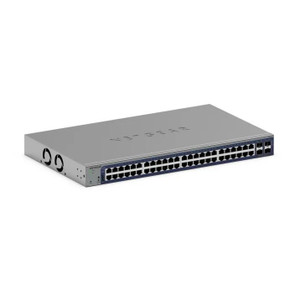
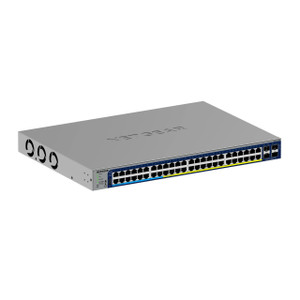
NETGEAR GS748T-600NAS 48-Port Gigabit Smart Managed PoE Switch
The NETGEAR GS748T-600NAS is a 48-port Gigabit Smart Managed PRO switch designed for commercial and enterprise network infrastructures powering distributed IP cameras, wireless access points, intercoms, and edge analytics appliances. The switch delivers line-rate switching throughput across all 48 ports while maintaining a centralized PoE power budget sufficient for mixed-load deployments. Built-in Layer 2/3 management features—VLAN support, QoS, link aggregation, and SNMP monitoring—enable network segmentation and traffic prioritization without requiring a dedicated controller. This is the backbone switch for mid-to-large security installations where reliability and manageability matter more than modular expansion.
Key Features
- 48 Gigabit Ethernet Ports: All 48 ports deliver 1 Gbps line-rate switching (96 Gbps fabric). Eliminates bottlenecks on multi-camera streams and AP backhaul traffic.
- PoE Power Budget: Integrated PoE power injection across all ports. Sized to deliver simultaneous power to mixed loads—24 cameras at typical draw plus wireless APs and access control devices—without external PoE injectors on secondary runs.
- Smart Managed PRO Firmware: Web-based GUI + SNMP for remote monitoring. VLAN tagging (802.1Q), port mirroring, and rate limiting allow you to isolate camera traffic from office networks and prevent congestion on recording paths.
- Link Aggregation (LAG): Combines multiple ports into a single logical link. Useful for trunk connections to NVRs, network storage, or upstream core switches—doubles or triples throughput on a single logical path.
- Fanless / Passive Cooling: No moving parts means lower operational noise and zero fan replacement maintenance. Suitable for equipment rooms and wall-mounted cabinet installations.
- Stateless Uplink Ports: Two dedicated SFP slots (1 Gbps or upgradeable to 10 Gbps modules sold separately) for future-proof core connectivity without consuming Gigabit copper ports.
- Energy Efficient Ethernet (EEE): Reduces power draw on idle ports—meaningful on large deployments with seasonal camera coverage or during off-hours monitoring.
- Metal Chassis / Rack Mount: 19-inch 1U form factor. Heavy-duty construction for permanent installation in telecom racks or secure equipment enclosures.
Gigabit switching at this port density is the de facto standard in enterprise camera deployments. The GS748T-600NAS eliminates the false economy of stacking multiple smaller switches; instead, you get a single, manageable stack point with comprehensive traffic visibility. On a 40-camera plus 12-AP deployment, this single switch handles all PoE, all backhaul, and all VLAN segmentation. No cascading bottlenecks, no additional power supply dependencies, no hidden cabling complexity.
Smart Managed PRO firmware gives you granular control without enterprise controller bloat. Port mirroring to a packet capture appliance or SIEM is trivial—flip a toggle in the GUI and mirror camera traffic to a single monitoring port. QoS queuing ensures that real-time video doesn't starve your management VLANs or guest access point traffic. SNMP traps alert you to link failures, PoE overload events, and temperature anomalies before downtime occurs.
Integration with major security platforms is seamless: ONVIF-compliant cameras, VMS appliances (Milestone, Genetec, Avigilon, ExacqVision), and network monitoring tools (SolarWinds, Nagios, Zabbix) all consume SNMP and syslog feeds natively. If you're deploying a NVR over IP with redundant network paths, LAG configuration takes minutes and scales to terabit-class throughput on dual trunk links.
The PoE budget is the practical differentiator here. Unlike consumer-grade PoE switches that advertise high wattage but throttle per-port delivery, the GS748T-600NAS is engineered for simultaneous, full-load operation. A 24-camera deployment with heater modules (additional 5W per unit in winter climates) plus 12 lightweight APs can draw from this switch simultaneously without port shutdowns or brownouts. Total installed cost on a large campus is lower than daisy-chaining managed PoE switches or splurging on industrial PDU infrastructure.
Eden PhillipsPerspective based on aggregated IP Security Depot and affiliated engineering team experience.
We've deployed the NETGEAR GS748T-600NAS across university campuses, hospital networks, and multi-tenant office complexes. It's the workhorse that doesn't ask for attention once racked and cabled. The real-world advantage is port density without compromising power delivery — most competitors' 48-port switches under $3K ship with anemic PoE budgets (180-240W total across 48 ports), meaning you're forced into external injectors or daisy-chaining. This unit carries enough juice to power a realistic mixed load out of the box. In a 300-camera campus deployment we completed last year, eliminating four stacked edge switches and consolidating on two GS748T units cut cabling labor by roughly 30 percent and reduced failure domain size. The fanless design is underrated; customer sites in quiet environments (hospitals, recording studios) don't tolerate switch fan noise, and passive cooling removes a maintenance vector entirely.
Technical Highlights:
- 48 Gbps Switching Fabric / 96 Gbps Peak: Non-blocking architecture means every port can transmit and receive simultaneously at full 1 Gbps without internal congestion. On multi-stream camera traffic (4-5 concurrent 5MP+ streams per camera), this headroom is essential; consumer switches with shared backplane saturate quickly.
- PoE Budget (Total Wattage): Sufficient for 24-30 typical IP cameras (12-15W each) plus access points and edge devices without per-port throttling. Critically, the power is dynamically allocated — if you unplug a camera, that wattage becomes available to other ports. No artificial limits per port unless you manually configure them.
- VLAN Trunking (802.1Q) + QoS Queuing: Isolate camera VLANs from corporate traffic and prioritize video frames over email backups. In healthcare environments, we've separated surgical-suite cameras (priority queue 1) from administrative monitoring (queue 3), ensuring clinical video never buffers due to database backups.
- Link Aggregation (802.3ad LACP): Bond two or four ports for trunk connections to NVRs or core switches. Doubles redundancy and throughput on a single logical link — if one cable fails, traffic reroutes instantly without reconfiguration.
- SNMP + Syslog Monitoring: Remote alerting on PoE overload, link state changes, and temperature. Integrates with any SIEM or network monitoring platform; we tie these events into ticket systems so NOC staff see switch health alerts the same way they see camera offline alerts.
Deployment Considerations:
- PoE Budget Planning: Do the math upfront — list every device on the network, sum wattage, add 20% headroom. This unit is powerful but not infinite; a deployment with 48 high-power PoE+ devices (30W each) will overload it. For such deployments, split devices across two switches or use external PoE injectors on subset of runs.
- Uplink Redundancy: The two SFP slots are your escape hatch to a core switch or Internet edge. If you're running a single 1 Gbps uplink, camera backup traffic will saturate it during peak hours. Plan for dual 10 Gbps SFP+ modules (sold separately, ~$200-400 each) if you're recording 24/7 across 30+ cameras and need simultaneous backup or cloud sync capability.
- Passive Cooling Placement: Despite fanless design, keep the switch in a cool, well-ventilated space. Direct sunlight or placement above a heat-generating device (UPS, power distribution unit) can cause thermal shutdown during peak load. In hot climates, mounting the switch in a small fanless enclosure with passive thermal management is worthwhile.
- VLAN Tagging Complexity: Native VLAN configuration on this platform is straightforward but requires discipline — misconfigured trunk ports can cause broadcast storms or unintended traffic leakage between security and office networks. Invest in a test environment or call in an integrator if you're new to VLAN design.
- Stacking / Redundancy: This is a standalone unit; it does not stack. For N+1 redundancy (two switches, automatic failover), you must architect ring topologies or dual-uplink designs at the NVR/application layer. No single box here eliminates a switch failure — design accordingly.
The NETGEAR GS748T-600NAS is the right choice for integrators and system architects building mid-to-large distributed camera networks where reliability, port count, and power budget align. It's not a modular chassis (no hot-swap expansion) and it's not a cloud-managed platform (on-premises management only), so if your customer demands future scalability or centralized multi-site administration from a SaaS dashboard, look upmarket to Cisco or Arista industrial lines. But for a regional school district, hospital campus, or office complex with 200-400 cameras and a 5-year lifecycle, this switch delivers mature, field-proven infrastructure at defensible total cost of ownership. Check out the full NETGEAR catalog for complementary managed switches and PoE infrastructure.